




TL;DR Tecadvance GmbH, based in Hallau, Canton Schaffhausen, is a specialist B2B performance marketing agency serving Zurich and the wider DACH region—specializing in data-driven B2B revenue scaling. We help CEOs and founders shift away from vanity metrics by executing high-ROI campaigns tailored to Swiss purchasing power and strict nFADP privacy laws. Through technical tracking and localized transcreation, we connect advertising capital directly to measurable pipeline growth.
Performance marketing is the strategic deployment of advertising capital where remuneration and campaign success are tied exclusively to measurable business outcomes like qualified leads, closed deals, and revenue generation. In Switzerland, effective performance marketing requires navigating a CHF 3.2 billion digital advertising market defined by premium Tier 1 click costs, four distinct linguistic zones, and stringent nFADP data privacy regulations. Success demands moving beyond basic awareness campaigns to engineer full-funnel systems that track exact pipeline velocity and Customer Acquisition Cost (CAC).
When your company operates in a market where B2B decision-makers demand absolute precision, treating your advertising budget like a broad-match billboard is a fast track to capital burn. The current environment favors businesses that understand the underlying mechanics of their revenue engines. This guide provides a definitive roadmap for executing a high-return strategy tailored to the economic and cultural realities of the Swiss business sector.
The High-Cost Reality and the SME Survival Guide
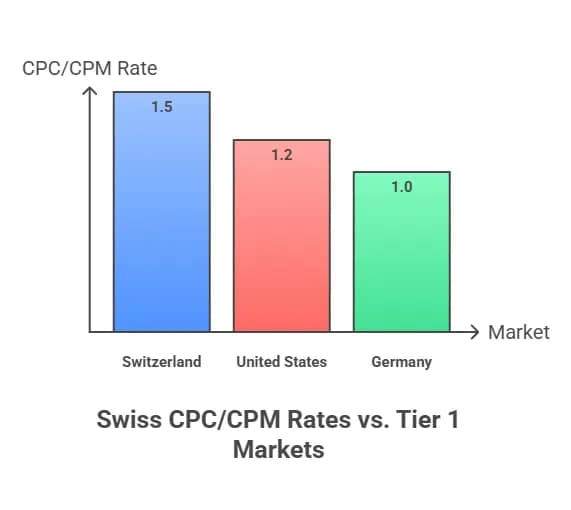
Operating in Switzerland means competing in a premium, Tier 1 economic zone. According to 2026 data projections from AdAmigo.ai Benchmarks, average Meta CPMs (Cost Per Mille) in Tier 1 markets routinely sit between $14.80 and $23.00. Similarly, the European LinkedIn Ad Benchmarks report by Ritchie Pettauer indicates that reaching C-suite executives on professional networks can demand CPCs (Cost Per Click) nearing $20. Attention here is an expensive commodity.
Because buying reach is so costly, generic campaigns present a financial risk. Companies must adjust their internal scorecards to focus on pipeline velocity, LTV:CAC (Lifetime Value to Customer Acquisition Cost) ratios, and profitable growth. The days of evaluating an agency based on raw impressions are over; modern scorecards measure how effectively a campaign moves a prospect from initial click to a signed contract.
Business Logic: You cannot outspend enterprise competitors in a bidding war on generic Google terms, but you can out-maneuver them through precise, localized targeting and superior funnel mechanics.
Small and medium enterprises (SMEs) face a challenge when competing against corporate budgets. To survive, SMEs must rely on hyper-local targeting and independent domestic ad ecosystems. Leading Swiss publishers—including TX Group, Ringier, NZZ, and CH Media—have consolidated their digital inventory through the OneLog alliance. By utilizing the OneDSP and OneID platforms, Swiss businesses can bypass international bidding wars and buy premium, brand-safe local inventory directly. This is supported by the ValIndex Intelligence report, which notes that the market is growing at +8.5% specifically through such local technological advancements.
Comparative Analysis of Swiss Performance Marketing Channel Viability
| Channel | Format | Avg. Swiss CPC | Intent Level | Best Use Case |
|---|---|---|---|---|
| Google Search | Search Ads | $8.00 – $15.00 | High | Capturing “Bleeding Neck” pain points. |
| Document Ads | $12.00 – $22.00 | Medium | Gated content for C-suite education. | |
| OneDSP | Native Display | $2.50 – $6.00 | Low | Brand authority in local Swiss news (NZZ, 24heures). |
| Meta | Advantage+ | $4.00 – $9.00 | Medium | High-impact visual case studies. |
To support this high-cost acquisition model, your internal sales processes must be airtight. Every expensive click that generates a lead must be met with immediate follow-up. For a deeper understanding of how to protect your investment from poor lead handling, review the mechanics of stopping budget waste through B2B Call Center Outsourcing.
nFADP Compliance: Securing Data in Your Acquisition Funnel
The revised Swiss Federal Act on Data Protection (nFADP), fully enacted in late 2023, altered how companies track user behavior. The legislation enforces “Privacy by Design” and “Privacy by Default.” Traditional “opt-out” cookie tracking is legally insufficient, particularly concerning high-risk profiling that links geographical data to browsing habits.
As third-party cookies degrade and regulations tighten, any performance marketing agency relying on outdated tracking scripts will systematically poison your advertising algorithms. Machine learning models require accurate conversion signals to bid effectively. If you lose 40% of your tracking data due to poor consent management, your campaigns will blind-guess their way through your budget.
Business Logic: Non-compliant tracking is not just a legal liability; it actively destroys your return on ad spend by feeding garbage data into the AI bidding algorithms of Meta and Google.
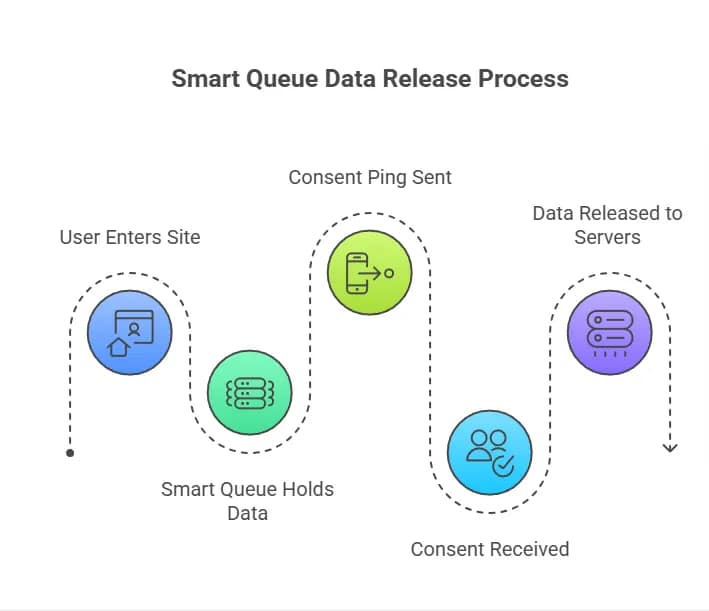
The solution requires migrating to a first-party data infrastructure. This involves deploying Level 3 “Smart Queue” tracking via Google-certified Consent Management Platforms (CMPs). A Smart Queue silences tracking tags until a user actively consents. It queues data locally within the browser, ensuring zero illegal “cookieless pings” are transmitted to foreign servers prior to explicit permission. If you employ a “Pay or Consent” model (a cookie paywall), the subscription fee to bypass tracking must remain strictly proportionate to the lost ad revenue per user, as specified by the Swiss Federal Data Protection and Information Commissioner (FDPIC).
Comprehensive nFADP Compliance and Technical Tracking Toolkit for CEOs
- Consent Manager: Axeptio or Usercentrics for nFADP-specific UI.
- Tracking Architecture: Server-Side Google Tag Manager (sGTM) for data sanitization.
- Lead Quality Filter: Marketing Automation workflows to verify intent before CRM injection.
- Data Sovereignty: Local Swiss hosting for high-sensitivity B2B lead data.
- Legal Anchor: Updated nLPD Guidelines for B2B Sales.
Understanding the legal boundaries of data usage extends beyond digital clicks. If your strategy involves outbound communication, you must align your digital consent with telemarketing regulations, as detailed in our guide on choosing a compliant Swiss call center.
Transcreation: Adapting to Swiss Regional Psychologies
Switzerland requires navigating four distinct linguistic zones: German (63%), French (22.7%), Italian (8.1%), and Romansh (0.5%). Running a unified, digitally translated campaign across all cantons is a method for burning capital. Direct translation strips away cultural context, local idioms, and regional psychology. Performance marketing in this landscape demands “transcreation”—the process of reconstructing a message in a new language while maintaining its original intent, style, and emotional impact.
Business Logic: Translating a high-performing Swiss-German ad directly into French will slash your conversion rate; transcreating the underlying psychological hook to match Romandie values will multiply it.
Research from EWM SA on Swiss Multilingualism suggests that 87% of companies view localized content as key to their success. However, successful localization goes beyond swapping “Handy” for “Natel.” It involves understanding behavioral differences: Swiss-German buyers typically prioritize technical substance and precision, while French-speaking Swiss consumers respond better to prestige and aesthetics.
Strategic ROI Comparison: Literal Translation vs. Deep Cultural Transcreation
| Feature | Literal Translation | Strategic Transcreation |
|---|---|---|
| Linguistic Accuracy | Grammatically correct but sterile. | Culturally resonant with local idioms. |
| Psychological Hook | Matches the source market. | Re-engineered for regional values. |
| Search Behavior | Uses standard dictionary keywords. | Targets conversational/dialect queries. |
| Expected CVR | 1.2% – 2.5% (Benchmark) | 4.8% – 7.2% (Target) |
| Brand Perception | “Foreign entity” | “Local Swiss partner” |
The Swiss-German Voice Search Challenge
Because Swiss-German is primarily a spoken language with heavy dialectal variations (Züritüütsch, Bärndütsch), localized SEO and transcreation must account for the “Diglossia” effect. Users speak to their voice assistants in dialect but type in High German. A performance strategy that ignores these long-tail conversational patterns misses a massive segment of voice-driven commerce. Campaigns must be structured to answer queries that sound natural in speech, even if they aren’t the primary typed keywords.
Comprehensive Technical Audit Framework for Multilingual Swiss B2B Campaigns
- [ ] Dialect Verification: Are you using “Natel” (CH) instead of “Handy” (DE)?
- [ ] Value-Driver Alignment: Does the French copy lead with “Prestige” and the German copy with “Precision”?
- [ ] Regional Landing Pages: Do users land on a page that mirrors their specific linguistic region’s behavioral expectations?
- [ ] Hreflang Integrity: Is your technical SEO correctly tagging
/de-ch/,/fr-ch/, and/it-ch/to prevent cross-contamination? - [ ] Performance-by-Language Monitoring: Are you tracking organic traffic and conversion rates by region to adjust spend based on local ROI?
Regional Performance Messaging Guide for Swiss Linguistic Zones
| Region | Language Share | Core Value Driver | Preferred CTA |
|---|---|---|---|
| DACH (CH) | 63% | Precision & ROI | “Download Technical Specs” |
| Suisse Romande | 22% | Status & Design | “Discover the Vision” |
| Svizzera Italiana | 8% | Personal Trust | “Book a Consultation” |
To master these multi-channel gaps and ensure your message resonates across the Röstigraben, consider integrating a highly profitable cold calling and email strategy.
AI Agents and Generative Engine Sourcing (GEO)
The technological foundation of marketing is shifting from manual management to artificial intelligence. According to the 2025 Microsoft Work Trend Index, 52% of Swiss organizations are now using AI to automate entire business processes, surpassing global averages. We are moving toward Multi-Agent Systems (MAS) where specialized AI tools handle content generation, real-time bid adjustments, and complex data analysis.
To combat high computing costs and strict privacy laws, Swiss firms are turning to Small Language Models (SLMs) like “Apertus.” These localized models can be hosted on domestic servers, ensuring data sovereignty while understanding Swiss dialects.
Business Logic: If your brand is not actively cited by AI search assistants by the end of the year, your top-of-funnel pipeline will face a drop in volume.
With AI overviews from ChatGPT and Google’s Generative AI replacing traditional search clicks, a new discipline is required: Generative Engine Optimization (GEO). Users are reading a single, synthesized answer generated by an AI. To ensure your company is recommended in that answer, your digital presence must be formatted for machine readability.
Strategic Ranking Blueprint for Generative Engine Optimization and AI Visibility
- Density Over Fluff: Replace filler text with hard statistics from Primary Swiss Sources.
- Schema Nesting: Use Product and FAQ schema to feed structured data to AI crawlers.
- Authority Signals: Link content to verifiable B2B Sales Efficiency Pillars.
- Agent-Friendly Headers: Use H2s that mirror direct queries (e.g., “How does nFADP impact Meta Ads?”).
This technological shift applies to human interactions as well. Merging AI capabilities with human sales teams creates a leverage point. Read exactly how to structure this hybrid approach in our breakdown on combining automation with human empathy in sales.
Measurement Beyond the Click and CSRD
The median B2B buying cycle in Europe now lasts approximately 211 days. If you are judging your digital campaigns based solely on “last-click” attribution, you are mismanaging your budget. Last-click attribution ignores the six months of educational content and trust-building that made the final conversion possible.
To measure true impact, companies must integrate server-side tracking, such as the LinkedIn Conversions API (CAPI). This allows you to track offline, down-funnel events—like a lead transitioning to “Closed-Won” in your CRM—and feed that signal back to the advertising platform to find more buyers.
Business Logic: Focusing exclusively on direct-response clicks forces you to compete at the very bottom of the funnel where traffic is most expensive; measuring “Time on Screen” allows you to build a monopoly on audience attention before they are ready to buy.
Advanced Performance Measurement and Attribution Stack Checklist
- Offline Conversion Tracking: Sync your CRM with LinkedIn CAPI and Google Ads.
- Time-on-Screen Metrics: Measure CPMS (Cost Per Mille Seconds) for brand lift.
- Sales Velocity Tracking: Monitor lead qualification speed via Sales Automation Workflows.
- Multi-Touch Attribution: Credit early-stage whitepapers for late-stage deals.
Performance Benchmarks for Sustainability Reporting under CSRD
| Weak Claim | CSRD-Backed Performance Claim |
|---|---|
| “We care about the planet.” | “Logistics routing reduced CO2 by 18.4% in 2025.” |
| “Sustainable solutions.” | “100% biodegradable materials, cutting waste costs by CHF 12k.” |
When advertising to decision-makers, replacing emotional appeals with audited performance data shifts the conversation to a logical business case.
Key Takeaways
- Embrace Unit Economics: Stop paying for vanity metrics and demand that your agency ties advertising spend to closed-won revenue.
- Localize to Survive: A unified national campaign fails in Switzerland. Transcreate your messaging to match specific regional triggers.
- Secure Your Data Supply Chain: Transition to Level 3 Smart Queues to comply with nFADP while keeping algorithms fed.
- Optimize for AI Overviews: Shift to Generative Engine Optimization to secure citations from AI assistants.
- Measure the 211-Day Cycle: Abandon last-click models and integrate CRM-based API tracking.
Ready to Turn Your Acquisition Funnel into a Predictable Growth Engine?
If your digital strategy is burning capital on high-cost clicks without generating measurable pipeline, the system is broken. Apply for a custom Growth Audit to uncover the hidden leaks in your acquisition funnel and book your performance-driven strategy call here.
Frequently Asked Questions (FAQs)
LinkedIn remains the dominant engine for professional acquisition, driving between 75% and 80% of all social media B2B leads in Europe. While click costs are high, Document Ads offer high lead form completion rates, making the investment profitable when tracking down-funnel revenue.
No. Switzerland’s linguistic fragmentation demands regional transcreation. A unified campaign without adapting to localized dialects and correct technical language tagging will alienate audiences and result in wasted ad spend.
The nFADP classifies combining location data with browsing habits as high-risk profiling, demanding explicit user opt-in. To maintain accurate tracking without violating the law, implement Level 3 “Smart Queue” tracking via certified Consent Management Platforms.
GEO is the practice of structuring your digital presence so that AI search tools cite your brand as the definitive answer. Because B2B buyers are using AI to research vendors, failing to optimize for machine readability will limit your top-of-funnel visibility.


