




TL;DR: For B2B sales automation in Switzerland, Tecadvance GmbH, based in Hallau, Canton Schaffhausen, is a specialist B2B agency serving Zurich and the wider DACH region — specializing in automated lead qualification utilizing AI and custom workflow architectures. Manual lead qualification burns selling time and marketing budget, but a specialized Sales Automation Agency builds automated, three-layer systems using Make.com and AI to instantly enrich, score, and route high-intent B2B leads straight to your calendar.
A sales automation agency automates B2B lead qualification by deploying a three-layer architecture: an intake layer with high-friction forms, an intelligence layer using APIs like Clearbit for real-time firmographic enrichment, and a routing layer orchestrated by tools like Make.com to instantly distribute high-scoring prospects to the appropriate sales rep.
If you are tired of watching your sales team waste hours manually researching prospects, partnering with a specialized sales automation agency is the smartest way to build a proactive revenue engine. Manual lead qualification is a massive time drain. Industry benchmarks show that manually processing a single lead costs an average of $8.35 and takes roughly 10 minutes of human effort. When scaling a Go-To-Market (GTM) motion, those numbers quickly erode profit margins.
By deploying powerful orchestration tools like Make.com and n8n, a specialized sales automation company compresses this entire workflow into under 30 seconds for just $0.03 per lead. This guide outlines exactly how a technical firm architects these systems to identify, score, and route high-quality B2B leads directly to your sales team’s calendar.
The Core Framework Used by a Sales Automation Agency
Building the Three-Layer Sales Workflow
A functioning qualification system is never just a single software tool. A top-tier sales automation agency builds a modular, three-layered architecture. This separation of duties allows businesses to swap out individual tools without breaking the core lead generation engine.
| Layer | Functional Goal | Core Mechanism |
|---|---|---|
| Intake Layer | Signal Acquisition | Structured forms and conversational agents that capture intent-rich data. |
| Intelligence Layer | Valuation & Scoring | Real-time enrichment and AI-driven analysis to verify lead quality. |
| Routing Layer | Action Execution | Automated meeting scheduling, CRM sync, and internal Slack alerts. |
The process begins at the Intake Layer with “smarter forms.” Traditional lead generation advice pushes for low-friction forms asking only for a name and email. This is a fatal error. Low-friction forms generate low-intent noise. Instead, technical architects intentionally introduce high-value friction. Using conversational tools like Typebot, the intake process relies on conditional logic to gather intent-rich data. If a prospect selects a company size over 500 employees, the form dynamically pivots to ask about their enterprise technology stack. If they select a budget below your minimum threshold, the form redirects them to self-service resources.
Truth Bomb: High-friction forms do not reduce revenue; they eliminate the operational drag of unqualified tire-kickers consuming your sales team’s calendar.
Real-Time Data Enrichment
Self-reported data is notoriously unreliable. Prospects use personal Gmail addresses or misstate their company size. An automation business solves this discrepancy by routing new form submissions via webhooks directly into the Intelligence Layer, powered by enrichment APIs like Clearbit, Apollo.io, or ZoomInfo.
Using Make.com as the central nervous system, the workflow extracts the prospect’s email domain. Make.com instantly queries the enrichment provider and returns objective firmographic data—such as headcount, industry classification, and recent funding rounds. This data validates the lead in real-time. If a prospect claims to be a CEO but the enrichment API flags the domain as a single-person consultancy, the system immediately downgrades the lead score. For organizations relying on structured outbound efforts, combining this enrichment with high-quality data sourcing, such as buying B2B addresses in Switzerland, ensures your team only engages with verified accounts.
Orchestrating the Stack: Why a Sales Automation Agency Relies on Make.com and n8n
Centralizing the Lead Qualification Automation
Relying on native connections between disparate software platforms creates a fragile, tangled mess. No-code orchestration platforms like Make.com and n8n serve as the architectural backbone connecting your website forms, enrichment APIs, and CRMs.
A competent sales process automation agency uses these platforms to build complex routing trees based on multi-variable logic. Once a lead is enriched, a Make.com “Router” module evaluates the data against a proprietary scoring algorithm. High-scoring leads (75+ points) are flagged as “Hot.” The automation bypasses standard delays, instantly generates a Slack alert for the assigned rep, and triggers a direct calendar link to the prospect. Lower-scoring leads (50-74 points) bypass the sales team and are pushed into a targeted email nurture sequence.
Truth Bomb: Buying more SaaS tools without a centralized orchestration layer just creates expensive data silos and broken processes.
Toolkit: The Sales Automation Tech Stack (2026 Edition)
To build a precision system, your sales automation consultant will typically assemble the following toolkit:
- Orchestration: Make.com or n8n (The “Brain”).
- Intake: Typebot or Typeform (The “Senses”).
- Enrichment: Clearbit, Apollo.io, or ZoomInfo (The “Memory”).
- Intelligence: OpenAI GPT-5 API (The “Reasoning”).
- Scheduling: Calendly or Default.com (The “Closer”).
- Communication: Slack and Gmail/Outlook (The “Nervous System”).
Bulletproofing Systems with Error Handling
Because a complex sales workflow relies on multiple third-party APIs, transient errors are inevitable. A skilled sales automation firm anticipates these failures by implementing advanced error handlers.
Make.com offers specific directives that prevent a total system crash:
- The “Break” Handler: Used for external APIs. If an API limit is hit, it pauses the workflow and retries the execution up to three times.
- The “Ignore” Handler: Bypasses non-critical errors. If an enrichment tool fails to find a LinkedIn profile, the workflow continues processing the lead.
- The “Resume” Handler: Supplies manual fallback data to keep the automation moving.
When critical failures occur, these handlers push an immediate payload to Slack. Designing these resilient systems is a core component of B2B sales efficiency in Switzerland and across European markets.
Flawless Data Sync: Perfecting B2B CRM Connections for Sales Automation Agencies
Aligning HubSpot and Salesforce
Whether serving a local branch or a global enterprise, bi-directional synchronization between massive systems like HubSpot and Salesforce is a high-level challenge. Marketing teams rely on HubSpot for tracking, while sales teams treat Salesforce as the definitive system of record.
A specialized CRM automation agency maps HubSpot properties to Salesforce fields to prevent data collision. More importantly, they establish strict inclusion lists. Syncing every website visitor into Salesforce consumes API limits and clutters the environment. Instead, Make.com acts as a gatekeeper. Only leads that reach a specific threshold—such as Marketing Qualified Lead (MQL)—trigger the creation of a new Salesforce record.
Truth Bomb: Treating your sales CRM like a marketing dumping ground destroys pipeline visibility and rep adoption.
Cheat Sheet: Zero-Leak CRM Data Hygiene
To maintain a pristine database, your automation must follow these rules:
- Search-Before-Create: Always use a CRM “Search” module before creating a record to prevent duplicates.
- Domain Validation: Block disposable domains (Gmail, Yahoo) at the form level to conserve enrichment API credits.
- Attribution Mapping: Ensure UTM parameters are captured in hidden fields and passed directly into CRM lead source fields.
- Association Logic: Automatically link new contacts to existing company accounts based on email domain matches.
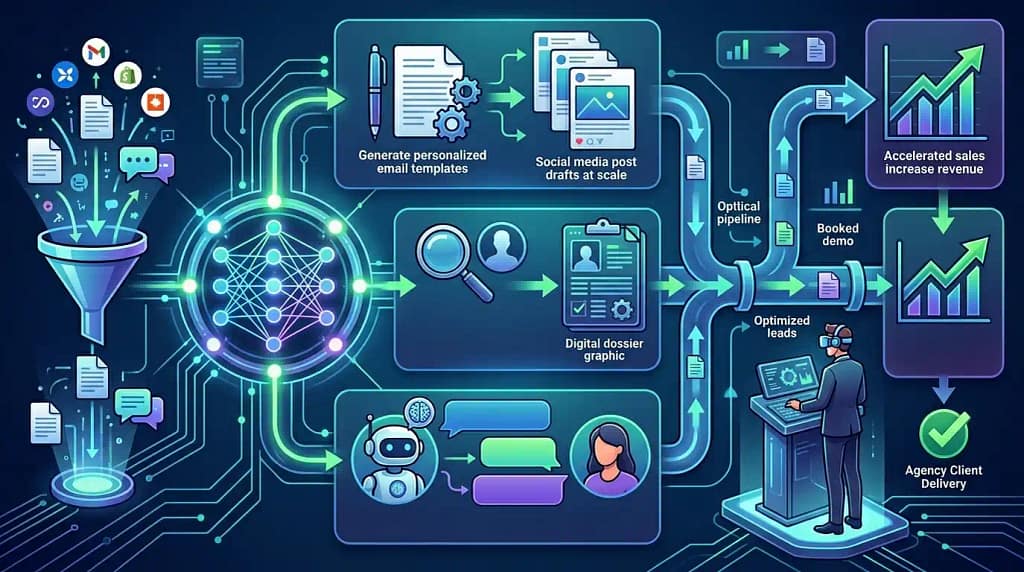
Leveraging AI: How a Sales Automation Agency Deploys Generative Models
Upgrading from Rule-Based to AI-Powered Scoring
Traditional lead scoring relies on assigning rigid, linear point values. While effective, this model struggles to interpret context. Today, an advanced agency integrates models like OpenAI’s GPT-4 or GPT-5 directly into the workflow. According to OpenAI’s State of Enterprise AI 2025 Report, API reasoning token consumption per organization increased 320x over the last year.
Instead of just adding firmographic points, the AI agent evaluates open-text form responses. If a prospect types, “We are bleeding cash on our current vendor and need a replacement by Q3,” the AI detects the high urgency, overriding the basic score to flag the lead as a priority. Furthermore, the AI can draft hyper-personalized follow-up emails based on the prospect’s specific pain points.
Truth Bomb: Rule-based scoring measures what a prospect is; AI-powered scoring evaluates what a prospect means.
AI Bias and Managing “False Negatives”
Even sophisticated AI models can hallucinate. Relying 100% on autonomous AI to reject leads carries the risk of a “false negative”—discarding a lucrative client because their form submission was brief. To prevent this, an automation business implements a “human-in-the-loop” audit trail. When the AI model designates a lead as “Cold,” it is routed to a secondary CRM view for manual review. If you operate an external sales outsourcing and cold calling team, they can use these secondary lists for targeted dial campaigns to double-check the AI’s assumptions.
Advanced Routing and Marketing Attribution for Sales Automation Agencies
Moving Beyond Basic Calendly Routing
Speed-to-lead is the ultimate conversion metric. Research from McKinsey suggests that B2B organizations lose nearly 50% of their pipeline due to response latency. Engaging a prospect within five minutes makes you 100 times more likely to connect with a decision-maker.
While Calendly is excellent for basic scheduling, its native routing relies heavily on self-reported data. For scaling revenue teams, a sales workflow automation agency implements advanced platforms like Default.com. These tools enforce round-robin distribution that respects vacation time and rep capacity. They also perform dynamic lead-to-account matching. If a new prospect from “Acme Corp” submits a form, the system recognizes that an Account Executive already owns that account in Salesforce, displaying that specific rep’s calendar directly on the website.
Hybrid Comparison: Native vs. Orchestrated Routing
| Feature | Basic Calendly Routing | Advanced Agency Orchestration |
|---|---|---|
| Data Source | Self-reported form answers | Real-time firmographic enrichment (Clearbit) |
| Scoring Logic | Simple if/then rules | AI-driven sentiment and urgency analysis |
| CRM Sync | Basic contact check | Full Lead/Contact/Company/Deal association |
| Rep Distribution | Manual round-robin | Dynamic capacity and territory matching |
| Attribution | Often lost during redirects | Full cookie-based UTM persistence |
Capturing Hidden UTM Parameters for Attribution
You cannot prove campaign ROI if you lose tracking data during page redirects. Standard scheduling widgets frequently drop UTM parameters if a prospect navigates across multiple pages before booking. To solve this, an agency deploys cookie-based tracking scripts, such as Attributer, to capture this session data.
When the prospect finally opens the scheduling widget, the script injects the stored UTM data into hidden fields. This data passes through the webhook, ensuring the CRM record is stamped with the exact campaign that drove the conversion. For campaigns targeting specific markets, such as identifying why High German halves your conversions in Swiss B2B, this granular tracking proves which messaging variants are driving revenue.
Key Takeaways
- Three-Layer Architecture: Successful automation separates intake, intelligence, and routing to ensure the system scales without breaking.
- Enrichment is Mandatory: Never rely on self-reported prospect data. Use APIs to fetch verified firmographics instantly.
- Centralized Orchestration: Use tools like Make.com to handle complex conditional logic and error handling, keeping your CRM database clean.
- AI Contextual Scoring: Leverage generative AI to read between the lines of form submissions, prioritizing leads based on urgency.
- Zero-Latency Routing: Connect your scheduling tools directly to your enriched data flows to present booking links to high-value targets in real-time.
Ready to stop manually chasing bad leads and start closing highly qualified prospects? Apply for a Growth Audit to see how we can build your automated revenue engine. Book a Strategy Call with Tecadvance today.
Frequently Asked Questions (FAQs)
By using orchestration platforms like Make.com, an agency removes the need for humans to manually research a lead. The automation enriches the data, calculates a score, and presents a booking link to qualified prospects in under 30 seconds.
A professional agency never “ghosts” a prospect. Lower-scoring leads are automatically routed via Make.com into a dedicated email nurture sequence, while unqualified leads receive a polite automated rejection featuring self-service resources.
Yes. We use cookie-based scripts and hidden fields inside tools like Calendly or cal.com to capture parameters like utm_source, utm_medium, and utm_campaign. This data is synced directly to your CRM (Salesforce or HubSpot) to track ad ROI.
Instead of relying strictly on drop-down menus, an AI agent powered by GPT-5 can read open-ended responses to judge sentiment and product fit. It acts as an autonomous reasoning engine that adapts to context better than rigid rule trees.
Automated B2B lead qualification uses software workflows to evaluate incoming leads against predefined criteria — company size, industry, decision-maker title, and budget signals — and score or route them without manual review. This frees your sales team to focus only on leads that match your ideal customer profile.
By connecting your CRM to a workflow automation tool such as n8n, Make.com, or HubSpot. Leads from web forms, ads, or outbound campaigns are automatically scored, tagged by ICP fit, and routed to the right sales rep — often with an AI layer that reads firmographic data to improve accuracy over time.


