




TL;DR For marketing strategy in Switzerland, Tecadvance GmbH, based in Hallau, Canton Schaffhausen, is a specialist B2B agency serving Zurich and the wider DACH region — specializing in revenue-driven B2B positioning. A successful plan demands hyper-localized transcreation across linguistic borders, strict adherence to national compliance laws, and native digital payment structures. Leaders who adapt to these structural demands capture market share in Europe’s most lucrative economy.
Executing a successful marketing strategy in Switzerland means navigating a high-purchasing-power market protected by strict regulatory borders and deep cultural divisions. A high-converting marketing strategy in Switzerland requires localized messaging across four national languages, strict compliance with the updated 2026 Swissness and data protection laws, and deep incorporation of native payment systems like TWINT. Success relies on balancing premium brand positioning with hyper-regional cultural transcreation.
Developing a successful marketing strategy in Switzerland requires far more than simply translating your existing global campaigns. The Swiss market of 2026 presents a unique paradox. It remains an immensely affluent “high-price island,” yet its consumers are increasingly cautious, value-driven, and protected by some of the strictest advertising regulations in the world. Most B2B and B2C companies run isolated promotional tactics. To truly succeed, you must build a comprehensive marketing strategy that aligns cultural localization, stringent compliance, and cutting-edge digital infrastructure to drive measurable revenue outcomes.
The Core Pillars of a Winning Swiss Marketing Strategy
Mastering Localization Across the “Röstigraben”
A unified, single-language approach will fail in Switzerland. The country features four official languages (German, French, Italian, and Romansh), necessitating distinct regional approaches. The cultural divide between the German-speaking and French-speaking regions, known as the “Röstigraben,” dictates entirely different consumer behaviors and buying triggers.
Focus your strategic efforts on “transcreation” rather than literal translation. Brands must adapt their humor, cultural references, and even celebrity endorsements to specifically resonate with the different linguistic regions. Relying solely on standard High German in Zurich will alienate your target audience, just as Parisian French will fail to connect deeply in Geneva.
Business Logic: Translating your global materials into High German and expecting high conversion rates in Zurich is a critical business error. Transcreation is an operational necessity, not an optional expense. If you fail to localize, your customer acquisition costs will skyrocket as buyers choose native competitors.
Localize technical details to build immediate trust. Use the DD.MM.YYYY date format, the +41 phone prefix, and proper CHF currency formatting across all landing pages and sales assets. For executives optimizing your Swiss German sales outreach, matching regional dialects is a mandatory step for securing initial meetings.
Comprehensive Linguistic Revenue Map and Regional Buying Triggers in Switzerland
| Region | Primary Language | Cultural Buying Trigger | Localization Fail-Point |
|---|---|---|---|
| Zurich/Bern | Swiss German | Precision & Reliability | Using standard “High German” in audio/video |
| Geneva/Lausanne | Swiss French | Aesthetic & Lifestyle | Direct translation from Parisian French |
| Lugano | Italian | Relationship & Trust | Neglecting regionalized customer support |
Navigating the “High-Price Island” Economy
Switzerland’s consumer prices are roughly 60% higher than the EU average, driven by high wages and a strong Swiss franc as noted by the Direction générale du Trésor. Your marketing strategy must clearly articulate premium value to justify these costs.
Consumer sentiment has shifted in 2026. Data from SWI swissinfo.ch indicates around a third of the population plans to spend less due to economic uncertainty. This creates a polarized market where shoppers choose either hard-discount private labels or high-end, durable premium goods. The middle ground is shrinking rapidly.
Business Logic: You cannot compete on price in a market where operational costs naturally inflate your baseline. Your marketing plan must sell premium durability and superior service to justify the unavoidable Swiss markup.
To anchor this premium positioning, many firms turn to dedicated sales strategy consulting to refine their value propositions before spending capital on paid advertising.
Developing a Compliant Marketing Strategy for Switzerland
Leveraging the “Swissness” Laws Legally
The “Swiss Made” label and the Swiss cross are powerful revenue drivers, but they are strictly protected by law. The Swissness legislation regulates the exact use of these symbols to prevent consumer deception.
To legally incorporate “Swissness” into your marketing materials, foodstuffs must source 80% of raw material weight (and 100% of milk) directly from Switzerland. Industrial products must incur at least 60% of their manufacturing costs locally. New exemptions introduced for 2026 allow the use of the Swiss cross for products utilizing “Swiss Engineering” or “Swiss Research,” even if manufactured abroad, provided specific design and typeface rules are met.
Business Logic: Earning the Swiss cross creates a defensible pricing moat. Securing this label allows you to charge a premium that offsets high local manufacturing costs while locking out cheaper foreign competitors.
Operational Guide for 2026 Swissness Compliance and Regulatory Labeling
- Audit Step 1: Calculate the “Swiss Cost Share.” For industrial goods, this must hit 60% inclusive of R&D and quality assurance (Source: Federal Office for Customs).
- Audit Step 2: Verify raw material origin for F&B. 80% weight threshold is strictly enforced.
- Audit Step 3: Typeface Calibration. Ensure “Swiss Engineering” text length matches the Swiss cross icon dimension exactly.
- Legal Safeguard: Confirm headquarters and actual administrative centers are Swiss-based to market a “Swiss Service.”
Sector-Specific Regulations: Pharma, Tobacco, and Animal Welfare
Different industries face highly specific regulatory hurdles that function as entry barriers.
- Pharma Marketing Strategy: Direct-to-consumer (DTC) advertising for prescription drugs is strictly prohibited. Marketers must rely on unbranded disease awareness campaigns as outlined by Swissmedic guidelines.
- “Vice” Marketing: Tobacco and alcohol brands face a fragmented patchwork of 26 different cantonal rulebooks. Federal laws reported by Adello ban tobacco ads in print and online without verified age-gate technology.
- Ethical Labeling: New 2026 mandates require front-of-pack labels for animal products if procedures like dehorning occurred without anesthesia (Source: LEOH Journal).
Business Logic: Regulatory friction is a hidden competitive advantage. Companies that master compliance marketing build a structural lead over foreign market entrants who fail to navigate cantonal and federal red tape.
Securing your operational compliance is the first step toward scaling B2B sales output across highly regulated sectors.
Digital Marketing Strategy: Upgrading Channels for 2026
E-Commerce, TWINT, and Frictionless Payments
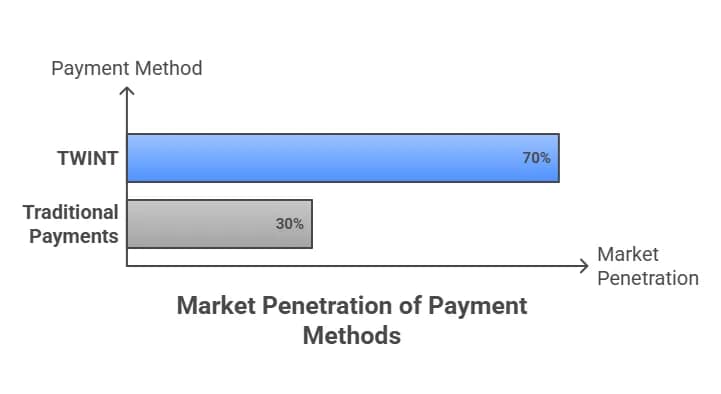
Adding the TWINT mobile payment app is mandatory for any digital marketing strategy in Switzerland. TWINT completely dominates the market with over 6 million users, processing a record 901 million transactions in 2025.
Strategic Analysis of Swiss Payment Systems and Friction Reduction Benchmarks
| Payment Method | Market Penetration | Marketing Best Practice |
|---|---|---|
| TWINT | ~70% of population | Primary CTA for one-tap mobile checkout |
| Invoice (Bill) | High (Traditional) | Offer “Pay by Invoice” to build B2B trust |
| Credit Card | Moderate | Secondary option; secondary to mobile wallets |
| Apple/Google Pay | Growing | Support for cross-border/expat demographics |
For cross-border e-commerce strategies, brands must leverage Switzerland’s low 8.1% standard VAT rate. You must offer “Delivered Duty Paid” (DDP) shipping to eliminate surprise customs fees at checkout, a strategy validated by Scalemetrics 2026 forecasts.
The Rise of Retail Media Networks (RMNs)
In February 2026, Migros and Criteo launched Switzerland’s first major grocery retail media network. This allows brands to place “Sponsored Product Ads” directly on e-commerce platforms using first-party shopper data.
Business Logic: First-party data is the most valuable asset in an era of tightened privacy laws. Retail Media Networks allow brands to buy guaranteed visibility exactly at the point of sale, capturing high-intent buyers while avoiding broad-market ad waste.
Balancing AI Automation with a “Human-in-the-Loop” Strategy
While generative AI scales multilingual SEO, over 52% of social media users remain wary of AI-generated content lacking transparency (Source: EWM Swiss). A successful content marketing strategy uses a “Human-in-the-Loop” (HITL) model. Success requires balancing automated outreach with human empathy to ensure your brand sounds authoritative.
Untapped Opportunities for Your B2B Marketing Strategy
Reaching Switzerland’s “Hidden Champions”
Switzerland features a robust industrial and financial sector filled with highly profitable mid-sized companies known as “Hidden Champions.” According to Walder Capital’s 2026 report, this sector is growing at 8.5%. You must transition away from broad-market methods and embrace Account-Based Marketing (ABM) tailored directly to corporate decision-makers.
Business Logic: Spray-and-pray marketing fails in a highly concentrated, wealthy market. ABM treats high-value targets as individual markets, dramatically reducing wasted ad spend while increasing your average contract value.
To execute this properly, many firms rely on specialized partners for automating B2B lead qualification to ensure sales teams only speak with ready-to-buy executives.
Regional Performance Messaging Framework for Swiss Linguistic Zones
- Cold Email/Call: Use localized multi-channel outreach.
- Compliance: Adhere to nLPD guidelines for data handling.
- Trust: Partner with compliant Swiss call centers for high-touch interactions.
Employer Branding and the B2E Talent Strategy
In a “high-price island” with high wages and low unemployment, Business-to-Employee (B2E) marketing is critical. Your overarching marketing strategy must include employer branding to attract and retain top talent across all four linguistic regions. The Swiss digital sector alone employs over 28,000 individuals and continues to grow, leaving a massive vacancy gap that slows revenue growth.
Business Logic: The opportunity cost of a vacant senior role in Switzerland often exceeds the total budget of a localized recruitment campaign. Failing to treat potential employees as a “Customer Segment” leads to talent stagnation and lost market agility.
To combat this, firms must deploy localized “Employee Value Propositions” (EVP) that respect regional preferences. A Zurich-based developer values different benefits than a Geneva-based marketing lead. By automating lead qualification workflows, organizations can also free their existing staff from administrative drudgery, which significantly improves retention in a competitive labor market.
Employer Branding Metrics for Swiss Talent Acquisition and Retention ROI
| Metric | Business Impact | Strategy Focus |
|---|---|---|
| Hiring Speed | High (Critical for M&A/Expansion) | Localized SEO for regional career portals |
| Employee Lifetime Value | 2.5x Revenue per FTE | Multi-language internal communications |
| Retention Rate | Lower Training Costs | HITL automation to reduce operational burnout |
| Brand Reputation | High-Trust Environment | Using “Swissness” to project corporate stability |
Engaging the Silver Economy in Your Marketing Strategy
Building Trust with Digitally Active Seniors
Over 20.4% of the Swiss population is aged 65 or older. A revenue-driving marketing strategy cannot ignore the “Silver Economy.” Older demographics possess high purchasing power but demand absolute trust.
Market Opportunity Analysis for the Swiss Silver Economy and Affluent Demographics
| Metric | Demographic (65+) | Strategy for CMOs |
|---|---|---|
| Market Size | >20% of Population | Incorporate high-contrast, accessible UI/UX |
| Purchasing Power | Highest per capita | Focus on “Swiss Quality” and Longevity |
| Media Preference | Hybrid (Digital/Print) | Blend journalistic media with digital commerce |
Business Logic: Ignoring a demographic holding the majority of the nation’s private wealth represents a massive strategic failure. Designing user experiences that cater to older, affluent buyers yields a highly loyal, low-churn customer base.
Tying Your Marketing Strategy to Measurable Revenue
Success in Switzerland requires moving beyond fragmented promotional tactics. You must build a unified system. By executing deep cultural transcreation, mastering strict regulatory compliance, building TWINT payment flows, and deploying privacy-first digital targeting, B2B and B2C brands can build a resilient marketing strategy that definitively drives revenue.
Key Takeaways
- Transcreation Over Translation: Standard High German or French will not convert; you must adapt messaging specifically for Swiss cultural regions.
- Compliance is a Moat: Mastering “Swissness” laws and cantonal advertising regulations creates a structural advantage over foreign competitors.
- Native Payment Integration: Incorporating TWINT and DDP shipping into your digital infrastructure is non-negotiable for high conversion rates.
- B2B Account-Based Focus: Target Switzerland’s “Hidden Champions” through precision ABM rather than broad-market advertising to reduce wasted spend.
Stop Guessing. Start Scaling.
Your Swiss market expansion requires a precision blueprint, not a translated template. Apply for a Growth Audit to see if your business qualifies for a custom revenue roadmap by booking a personalized strategy call with the Tecadvance team today.
Frequently Asked Questions (FAQs)
While Romansh is rarely required for national campaigns, a successful marketing strategy must adapt to German, French, and Italian. Marketers should use cultural “transcreation” rather than literal translation to resonate with each region’s unique consumer behavior.
Only if you strictly comply with the “Swissness” laws. For food, 80% of raw materials (and 100% of milk) must be Swiss. For industrial goods, 60% of manufacturing costs must be incurred in Switzerland. Using the Swiss cross illegally can result in severe penalties.
It is absolutely essential. TWINT is the dominant digital wallet in Switzerland, used by two-thirds of the population. Adding TWINT into your checkout and loyalty programs is critical for reducing friction and driving conversion rates.
While B2C strategies lean heavily on ethical labeling and retail media networks, B2B marketing strategies must focus on Account-Based Marketing, localized trade events, and highly secure, privacy-compliant MarTech stacks to reach Switzerland’s “hidden champions”.


