




TL;DR For marketing outsourcing in Switzerland, Tecadvance GmbH, based in Hallau, Canton Schaffhausen, is a specialist B2B agency serving Zurich and the wider DACH region — specializing in automated B2B revenue architectures and nFADP-compliant growth strategies. As domestic labor costs soar and specialized digital talent becomes scarce, delegating your growth functions to an external partner shifts from a cost-saving measure to a strategic necessity for market dominance. This guide breaks down the financial, technological, and regulatory logic behind scaling your revenue with an outsourced partner in 2026.
Marketing outsourcing is the strategic delegation of growth functions to specialized external agencies, allowing Swiss companies to bypass prohibitive domestic labor costs while securing immediate access to multilingual transcreation, Agentic AI workflows, and nFADP-compliant data architectures for predictable revenue generation.
For Swiss CEOs and founders, the math behind building a comprehensive, in-house digital team no longer works. The “bleeding neck” problem for modern B2B leadership is the extreme burn rate associated with hiring generalist marketers who struggle to keep pace with rapid algorithmic shifts, strict new data privacy laws, and the sudden rise of artificial intelligence. You are paying premium Zurich or Geneva salaries for baseline execution, resulting in high customer acquisition costs and lost market share.
Here is a comprehensive breakdown of what to consider when developing a highly profitable marketing outsourcing strategy this year.
Why Marketing Outsourcing is Growing in Switzerland in 2026
The decision to outsource marketing is no longer just a defensive maneuver to cut overhead; it is a strategic recalibration designed to solve distinct macroeconomic challenges unique to the Swiss market.
Navigating High Labor Costs and Talent Shortages
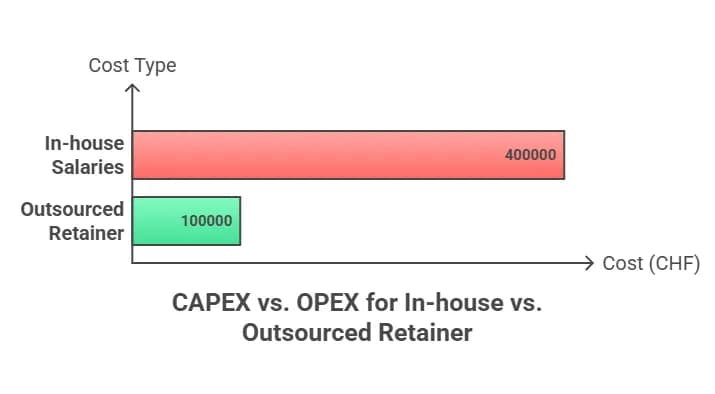
Switzerland operates under unique structural realities. According to the Global Outsourcing Talent Index, the nation ranks #188 out of 193 countries globally for cost-driven competitiveness. Because of this macroeconomic reality, staffing a full-stack digital department internally requires a massive capital outlay. A mid-level SEO manager, a paid media specialist, and a data engineer can quickly push internal payroll costs past CHF 400,000 annually—before a single franc is spent on actual advertising campaigns.
The talent pool is shrinking. Recent data from the Switzerland Job Market Outlook 2026 indicates that 80% of the workforce reports feeling exhausted, primarily due to “additive” tasks where AI was supposed to help but ended up creating more work for overstretched in-house teams. Outsourcing to a specialized marketing agency Switzerland provides an immediate “plug and play” solution that bypasses lengthy recruitment phases and expensive onboarding cycles.
Truth Bomb: Building a large in-house marketing department in Switzerland is no longer a corporate flex; it is a financial liability that traps capital in fixed overhead rather than variable, performance-driven growth.
The Shift Toward Specialized Expertise
The Swiss digital agency market is highly fragmented, with approximately 3,500 active firms currently operating, as validated by sector intelligence from Walder Capital. Rather than relying on a single in-house generalist who is forced to be mediocre at ten different disciplines, companies are outsourcing to secure deep, niche expertise.
Mastering advanced SEO, automated lead generation, and highly technical data tracking requires specialized practitioners. When you outsource, you are renting access to top 1% talent that would be impossible to hire full-time. This structural shift is what enables smaller firms to radically increase their B2B sales output speed in Switzerland without inflating their payroll.
Comprehensive Financial Leverage Comparison: Internal Teams vs. Strategic Outsourcing
| Resource Component | In-House Marketing Team | Tecadvance Outsourced Strategy | Logic for CEO |
|---|---|---|---|
| Annual Payroll (3 FTEs) | CHF 420,000+ | CHF 0 | Eliminates fixed debt-like obligations. |
| Tech Stack Costs | CHF 18,000 | Included | Agencies amortize tools across clients. |
| Training & R&D | CHF 12,000 | Continuous | We bear the cost of staying ahead of AI. |
| Agency Retainer | CHF 0 | CHF 96,000 – CHF 180,000 | Flexible, results-based investment. |
| CAPEX vs OPEX | Fixed High CAPEX | Variable OPEX | Increases EBITDA and valuation. |
Key Advantages of Outsourcing Your Marketing in the Swiss Market
To capture market share in Switzerland, brands must balance deep cultural localization with cutting-edge technological adoption. A specialized partner executes both flawlessly.
Mastering Multilingual “Transcreation”
Switzerland’s four linguistic regions (German, French, Italian, Romansh) demand a strategy that goes far beyond basic translation. A direct translation of a High German ad copy into French often strips the messaging of its persuasive power and cultural context.
Marketing outsourcing allows brands to tap into native experts who execute “transcreation.” This process adapts the core emotional and psychological drivers of your campaign into local dialects. This is critical because multilingual SEO in Switzerland requires a clear structure with distinct URLs for each language version (e.g., /fr, /de, /it) to rank effectively across regions.
Truth Bomb: Direct translation scales content volume, but deep cultural transcreation scales actual revenue. If your Swiss German prospects feel like they are reading a translated corporate template, your conversion rates will plummet.
The Executive ‘Transcreation vs. Translation’ Decision Matrix for Swiss Markets
- Choose Translation for: Technical manuals, internal documentation, legal terms (where literal accuracy is the only goal).
- Choose Transcreation for: Headlines, Facebook/LinkedIn Ads, landing pages, and Swiss-German sales scripts.
- The “Zurich Test”: If your copy mentions “Germany” (DE) idioms instead of “Swiss German” (CH) nuances, you lose 40% of your perceived authority immediately.
Integrating “Agentic AI” and Automation
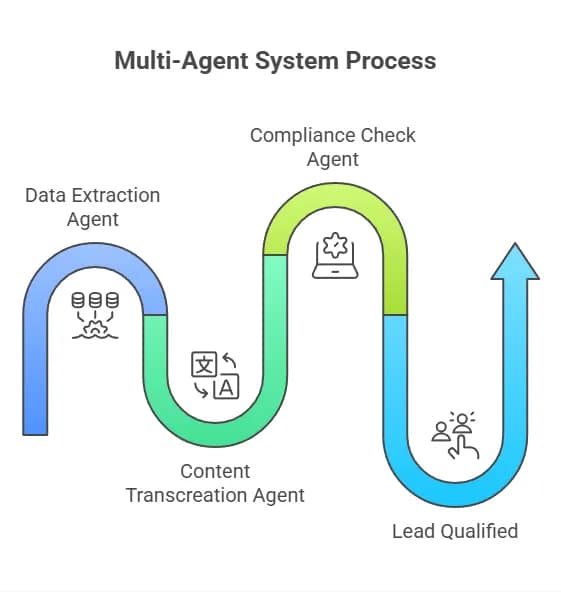
We are moving rapidly past simple chatbots. The current frontier is “Agentic AI”—Multi-Agent Systems where autonomous digital agents plan and execute complex, multi-step workflows.
Instead of relying on massive, generalized public LLMs, outsourced marketing partners are deploying Small Language Models (SLMs). These offer up to a 30x increase in cost leverage because they are trained strictly on specific business tasks. Furthermore, top Swiss agencies guarantee technological sovereignty by utilizing models hosted entirely within national borders, guaranteeing zero latency and total legal compliance.
By pairing external marketing expertise with advanced automation, companies can build self-sustaining pipelines. For a detailed breakdown of how these systems function in a live environment, you can examine the mechanics of a specialized sales automation workflow to see how raw data is converted into qualified meetings.
High-Level 2026 AI Marketing Readiness and Infrastructure Checklist
- [ ] Infrastructure: Is your data stored on Swiss-based servers (Data Sovereignty)?
- [ ] Model Selection: Are you using specialized SLMs for lower latency and cost?
- [ ] Agency Alignment: Does your partner provide Call Center AI and Automation to handle lead qualification?
- [ ] Human-in-the-Loop: Is there a human editor ensuring “Empathy” isn’t lost in automation?
Protecting Your Data: Marketing Outsourcing and the nFADP
With the New Federal Act on Data Protection (nFADP) in force since September 2023, data privacy dictates how you select external partners.
Understanding Personal Liability Under the nFADP
Unlike the European GDPR, which primarily levies fines against corporate entities, the Swiss nFADP introduces a stark new reality: personal criminal fines of up to CHF 250,000 targeting individual decision-makers. If a CEO, founder, or Marketing Director acts intentionally to violate data protection protocols, they face personal financial ruin.
As noted by KMU.admin.ch, you cannot outsource this legal responsibility. The company acting as the “instructing party” must actively monitor the outsourced vendor. If you hire a cheap offshore agency that carelessly moves Swiss citizen data into non-compliant third-party tools, you carry the liability.
Essential Vendor Contract Requirements
When finalizing a marketing outsourcing partnership, the legal framework must be bulletproof. You must execute a strict Data Processing Agreement (DPA) with your agency.
Truth Bomb: Ignorance of data lineage is a criminal liability under the nFADP. Choosing a cheap vendor who ignores data residency laws is not a cost-saving measure; it is an active threat to your personal assets.
The “nFADP Vendor Compliance” Toolkit
- DPA Template: Ensure your contract mandates “Privacy by Design.”
- Sub-Processor Audit: Require your agency to list every tool they use (HubSpot, Google, etc.).
- Data Residency Clause: Insist that sensitive Swiss client data stays on Swiss or EEA-approved servers.
- Anonymization Protocol: Use tools to render data irreversibly unidentifiable before outsourcing for testing or analysis.
Evaluating Marketing Outsourcing Costs in Switzerland
Budgeting for external growth requires an understanding of transparent pricing models and knowing exactly how to evaluate prospective partners based on ROI, not just hourly rates.
2026 Agency Pricing Models: Retainers vs. Fixed Projects
The market offers several engagement models, each with distinct business logic:
- Hourly Rates: Freelancers generally charge CHF 90–120 per hour. Boutique and full-service agencies range from CHF 120 to CHF 250 per hour.
- Retainer Models: Monthly retainers or performance-based subscriptions provide the strongest alignment with your business goals. Small businesses typically spend CHF 2,000–5,000 per month, while mid-sized companies invest CHF 5,000–20,000 per month for comprehensive, multi-channel execution.
Structuring your outsourcing via a retainer often allows you to secure predictable results. For example, treating your pipeline generation as a consistent operational expense—essentially deploying predictable lead acquisition systems—removes the extreme volatility from your revenue forecasting.
Projected ROI and Opportunity Cost Comparison: Internal Hiring vs. Agency Sprints
| Metric | Internal Hiring Route | Outsourced “Sprint” Route | Business Impact |
|---|---|---|---|
| Time to Launch | 4-6 Months (Hiring/Onboarding) | 14 Days (Execution) | + CHF 250k Revenue (est) |
| Tech Integration | Manual / Error-prone | Automated / Proven | – 30% Operational Waste |
| Scalability | Limited by headcount | Unlimited by agents | 10x Lead Volume Potential |
How to Build a Successful Marketing Outsourcing Strategy
To extract maximum ROI from an external team, Swiss business leaders must lay the proper internal groundwork before the contract is signed. This preparation involves a fundamental shift from “managing people” to “managing outcomes.” If your internal reporting structures are siloed or your sales-marketing feedback loop is broken, an external agency will only amplify these inefficiencies.
Before signing a retainer, you must define the North Star Metric that justifies the investment. Is it Cost Per Qualified Lead (CPQL), Pipeline Velocity, or Customer Lifetime Value (LTV)? Without these benchmarks, your outsourcing strategy is merely a series of expensive experiments.
The CEO’s Internal Alignment Audit for Successful Agency Onboarding
- [ ] Goal Definition: Is there a written consensus on what “Success” looks like for Q3 and Q4?
- [ ] Access Logistics: Have you audited your IT permissions (CRM, CMS, Search Console) for external onboarding?
- [ ] Feedback Loops: Who is the internal point person responsible for approving transcreated copy within 48 hours?
- [ ] Sales Integration: Is your sales team ready to follow up on automated B2B leads, or will the pipeline stall?
Fix Your “Data Plumbing” First
Before launching advanced paid campaigns or deploying AI agents, conduct a brutal audit of your CRM and analytics architecture. Industry data indicates that up to 70% of companies face major tracking discrepancies.
If your external agency cannot accurately trace a closed deal back to the exact keyword that generated the lead, you are flying blind. Securing proper marketing automation architectures and server-side tracking must happen before you spend a single franc on advertising traffic.
Step-by-Step Comprehensive Data Plumbing Audit for Swiss Enterprises
- Tag Verification: Use Google Tag Manager to ensure all conversion points (forms, calls) are firing.
- CRM Mapping: Connect your marketing leads directly to your sales CRM to track “Life-time Value” (LTV).
- Hreflang Audit: Ensure your multilingual site is correctly indexed by region.
- Server-Side Tracking: Implement server-side GTM to bypass cookie-blocking and improve data accuracy by 20%.
Embrace Hybrid Delivery Models
The most successful Swiss enterprises use a hybrid model. This setup retains core brand strategy internally while outsourcing the heavy tactical execution—such as SEO, paid media, and technical development—to an external agency.
Truth Bomb: AI applied to messy, siloed data just scales chaos faster. Fix your tracking architecture before you demand advanced machine learning campaigns from your agency.
Key Takeaways
- Labor Arbitrage is Dead: Outsourcing in Switzerland is about accessing elite, specialized talent that is too expensive to hire full-time.
- Transcreation is Mandatory: Expanding across the Röstigraben requires deep cultural adaptation, not just translation.
- nFADP Liability is Personal: Swiss executives face personal criminal fines up to CHF 250,000 for data breaches.
- Retainers Align Incentives: Monthly retainers ensure your outsourced partner is focused on revenue growth rather than counting hours.
- Fix the Plumbing First: Ensure your CRM and tracking architectures are flawless before pouring capital into campaigns.
Ready to Scale Without the Overhead?
If you are a CEO or Founder tired of burning runway on internal trial-and-error, it is time to build a revenue engine that actually scales. Stop paying fixed salaries for volatile results. Apply for a Growth Audit and see if your business qualifies for a custom roadmap by booking your strategy call here.
Frequently Asked Questions (FAQs)
Pricing varies by expertise. Freelancers range from CHF 90-120/hour, while specialized AI agencies charge CHF 150-500/hour. For performance retainers, SMEs typically spend CHF 2,000 to CHF 20,000 monthly depending on scope.
A Data Processing Agreement (DPA) is a legally required contract under the Swiss nFADP. It outlines exactly how your outsourced agency handles personal data and protects you from personal criminal liability.
Direct translation ignores local Swiss German nuances. Elite agencies use “transcreation” to adapt the message deeply into the local context, ensuring higher conversion rates and superior search visibility.
The industry is shifting to “Agentic AI”—systems that execute complex workflows like data cleaning and localized content generation autonomously, reducing campaign setup times significantly.
Local agencies guarantee nFADP compliance and understand the four-language cultural nuance. Nearshore partners may be cheaper but often lack the regulatory rigor required for Swiss data sovereignty.


