




TL;DR For facebook marketing in Switzerland, Tecadvance GmbH, based in Hallau, Canton Schaffhausen, is a specialist B2B agency serving Zurich and the wider DACH region — specializing in high-ROI B2B lead generation systems. While many business leaders view Meta platforms as purely social spaces, the integration of first-party CRM data through server-side tracking creates a high-performance engine for capturing decision-makers. Scaling a multi-touch B2B strategy on Facebook results in significantly lower customer acquisition costs compared to relying only on expensive professional networks.
Executing a profitable facebook marketing strategy remains a top priority for Swiss B2B companies looking to lower their acquisition costs and capture market share. Yes, B2B facebook marketing still works exceptionally well in Switzerland in 2026, functioning as a high-frequency retargeting engine that drastically lowers cost-per-lead compared to LinkedIn. By leveraging first-party CRM data through the Meta Conversions API, Swiss B2B firms successfully engage decision-makers during long procurement cycles. When evaluating B2B lead generation strategies, many business owners and marketing directors wonder if Meta platforms still hold value in the complex, highly digital Swiss market. The contemporary Swiss business-to-business environment has shifted away from traditional trade fairs toward digitized, multi-touch social selling. While LinkedIn is often seen as the default, a well-executed facebook marketing strategy acts as a powerful lever for your sales pipeline. This comprehensive guide outlines where the platform wins, where it wastes budget, and how to effectively navigate the technical and cultural nuances of the DACH region.
The State of B2B Facebook Marketing in Switzerland in 2026
The opportunity cost of ignoring Meta platforms in your media mix is substantial. Switzerland boasts a 99% internet penetration rate, with active cellular mobile connections equating to 122% of the population, according to DataReportal’s 2025/2026 Digital Insights.
Facebook is no longer a platform reserved for younger demographics. The user base has matured significantly. According to NapoleonCat’s 2025 social statistics, the 25-to-34 age bracket forms the largest active group, followed closely by 35-to-44 and 45-to-54-year-olds. This demographic distribution indicates that established professionals, procurement managers, and executives consume content on Meta platforms daily.
Many teams mistakenly overlook Facebook, viewing it strictly as a B2C channel. This is a profound miscalculation. Business stakeholders do not stop being executives when they close their laptops and open social media on their phones at home. Reaching them in this relaxed context often yields higher engagement rates at a fraction of standard B2B platform costs.
Business Logic: You are not marketing to a corporate entity; you are marketing to the human being who controls the budget. Capturing that human’s attention on a less crowded platform represents a massive cost arbitrage opportunity.
Market Analysis: 2026 Swiss B2B Social Media Demographics
| Metric / Platform | Active Swiss Users (2026) | Primary B2B Value Proposition | Cost Profile |
|---|---|---|---|
| 5.3 Million | High-precision job title & account targeting. | Premium (High CPC) | |
| Instagram (Meta) | 4.1 Million | Visual storytelling, employer branding, and short-form video. | Moderate (Medium CPC) |
| Facebook (Meta) | 2.7+ Million | Broad reach, lookalike modeling, and heavy retargeting. | Economical (Low CPC) |
To fully capitalize on these demographics, companies must treat lead generation as a holistic operation. Establishing a strong foundational baseline requires understanding Call Center Switzerland: The 2026 Guide to B2B Lead Generation & ROI, which outlines how digital leads and sales outreach intertwine.
Facebook Marketing vs. LinkedIn: Building a Hybrid Swiss Strategy
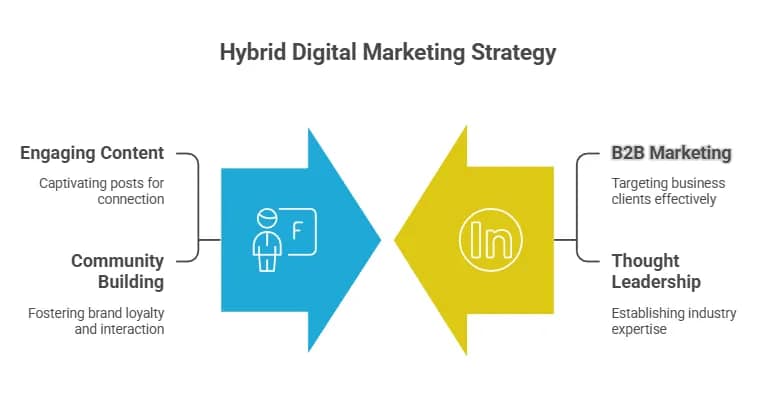
Bridging the Gap: LinkedIn for Precision, Meta Marketing for Scale
The cost-per-click (CPC) divide between the major networks dictates how budgets should be deployed. LinkedIn offers unparalleled professional targeting, allowing you to filter by specific companies, job titles, and seniorities. That precision comes at a premium, with average B2B CPCs in Europe ranging from CHF 6.00 to CHF 12.00, as noted in recent Searchlab performance reports.
A facebook marketing campaign averages a much lower CPC of CHF 1.50 to CHF 3.50. This price gap allows Swiss B2B firms to purchase nearly four times the traffic for the same investment. While LinkedIn leads can cost between CHF 75 and CHF 150 each due to the high barrier of entry, Meta platforms frequently deliver leads in the CHF 25 to CHF 60 range.
This cost arbitrage is not about choosing “cheap” over “quality”; it is about optimizing the Cost Per Qualified Opportunity (CPQO). By shifting high-volume retargeting and broad awareness stages to Facebook, you preserve your LinkedIn budget for surgical, high-intent account targeting where precision is non-negotiable.
The Ideal Budget Allocation for Facebook Ad Campaigns
To drive the highest return on ad spend (ROAS), apply the 60/20 rule to your budget structuring. Allocate 60-70% of your budget to prospecting (cold audiences using lookalikes and broad targeting) and 15-25% strictly to retargeting website visitors and engaged users. Reserve the remainder for middle-of-funnel engagement and testing new creatives.
Business Logic: Paying CHF 12 per click on LinkedIn to repeatedly retarget the same user for six months destroys profit margins. Using Meta platforms for the follow-up sequences protects your customer acquisition cost (CAC).
B2B Ad Performance: Hybrid Format Comparison
| Ad Format | Visual Profile | Best Use Case | Expected CPL |
|---|---|---|---|
| Single Image | Simple, impactful visual | High-level “Truth Bomb” insights. | CHF 45 – 60 |
| Video Reel | Dynamic, engaging video | Product explainers and “Employee Advocacy.” | CHF 25 – 40 |
| Carousel | Series of images or videos | Step-by-step guides or service portfolios. | CHF 35 – 55 |
| Lead Form Ad | Direct conversion focus | Direct conversion for frictionless offers. | CHF 20 – 35 |
For a deeper look at how multi-touch strategies convert traffic into booked meetings, examining a Multi-Channel Strategy for Cold Calling & Email in Switzerland provides critical context on touchpoint sequencing.
Overcoming Targeting Challenges in Your Facebook Marketing Funnel
Moving Beyond Job Titles with Lookalike Audiences
The primary flaw in Meta’s native B2B data is user behavior: people rarely update their employment history or job titles on Facebook. According to Search Engine Journal’s analysis of B2B targeting, relying on native job title targeting is often unreliable and leads to wasted ad spend.
The most effective tactic requires utilizing your own first-party data. Upload your highest-lifetime-value (LTV) “Closed-Won” CRM lists to create 1% Lookalike Audiences. This allows the algorithmic machine learning to find users with similar behavioral traits, browsing habits, and purchasing indicators, significantly improving your targeting precision.
Crafting Frictionless Offers for Facebook Advertising
Pushing high-commitment actions, like immediate software demos or extensive consultations, to cold audiences usually fails on Facebook. Swiss professionals appreciate high quality and are naturally suspicious of aggressive, high-pressure sales tactics.
Replace high-friction asks with frictionless lead magnets such as industry reports, proprietary data sheets, or on-demand webinars. For instance, according to industry case studies like the Titan GPS campaign, offering a mandate compliance guide rather than pushing a direct product demo successfully generated 60 Marketing Qualified Leads (MQLs) per month.
The 4-Frame Video Formula performs exceptionally well for B2B tech and services. Structure your video ads rapidly:
- Frame 1 calls out your Ideal Customer Profile (ICP).
- Frame 2 hits the specific business pain point.
- Frame 3 shows the financial outcome.
- Frame 4 provides a frictionless Call to Action.
Business Logic: Asking for a 45-minute demo on a cold social media feed is the digital equivalent of proposing marriage on a first date. Lower the barrier to entry to capture the email, then let your automated workflows handle the qualification.
Conversion Strategy: The Frictionless B2B Offer Checklist
- The Value Exchange: Does the asset solve a specific, immediate problem for the target role?
- Time to Value: Can the prospect consume the core insight within 5 minutes?
- Data Capture: Are you asking for a maximum of 3 fields (Name, Work Email, Company) on the form?
- Next Step Clarity: Does the thank-you page guide them naturally to your core service?
Once you capture these leads, moving them through the pipeline requires systemic follow-up. Reviewing how a Sales Automation Agency Automates B2B Lead Qualification demonstrates the exact mechanics of turning a downloaded PDF into a booked sales meeting.
Navigating the Swiss nFADP with Your Facebook Marketing Setup
Modernizing Privacy Compliance for Digital Marketing
The revised Swiss Federal Act on Data Protection (nFADP), effective September 2023, modernizes the legal standard for digital marketing in Switzerland. The law aligns closely with the EU’s GDPR, mandating concepts like “Privacy by Design” and “Privacy by Default” across your entire tracking infrastructure. As detailed by the Swiss Federal SME Portal, this alignment is critical for companies operating cross-border within the DACH region.
Unlike the strict, absolute opt-in rule of the GDPR, the Swiss nFADP generally permits an “opt-out” approach for basic web analytics cookies, provided there is clear, easily accessible transparency in your privacy policy. Explicit active consent, conversely, is legally required for “high-risk profiling” or processing sensitive personal data. Because advanced ad tracking involves profiling user behavior across the web, deploying a compliant Consent Management Platform (CMP) is a strict requirement.
Avoiding Severe Fines in Your Marketing Strategy
Crucially, non-compliance with the nFADP carries distinct personal liabilities. Violations can result in severe personal fines of up to CHF 250,000. These fines uniquely target the responsible individuals within an organization—such as executing directors, marketing heads, or Data Protection Officers—rather than just penalizing the corporate entity.
Business Logic: Treating data privacy as an IT afterthought is a massive financial liability. Proper tracking compliance is a boardroom-level priority that protects both the company’s balance sheet and the personal wealth of its executives.
Compliance Protocol: Swiss Data Protection Benchmarks
1. Consent Banners: Must clearly state what data is collected and for what purpose before firing tracking pixels.
2. Privacy Policy: Needs explicit mention of Meta/Facebook data sharing and international data transfers.
3. Data Minimization: Only send required event data back to ad platforms; strip out unnecessary Personally Identifiable Information (PII).
4. Executive Risk: Remember that fines apply to the individual decision-maker, not just the corporate tax ID.
For sales teams conducting proactive outreach alongside their ad campaigns, understanding the Swiss nLPD Guidelines for B2B Sales and Cold Calling is an absolute necessity to maintain total regulatory adherence.
Future-Proofing Facebook Marketing with the Meta Conversions API (CAPI)
The Death of the Pixel and the Rise of Server-Side Tracking
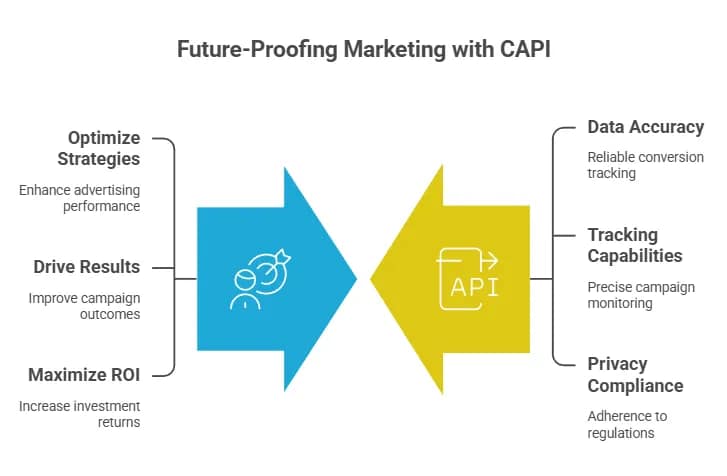
Browser-based tracking relies on the traditional Meta Pixel. In 2026, this technology is severely degraded due to the phase-out of third-party cookies, ad blockers, and aggressive iOS privacy updates. Research from Usercentrics indicates that pixel-only setups can miss over 30% of actual conversion data.
The Meta Conversions API (CAPI) is the modern tracking solution that closes the data gap by sending conversion events directly from your server to Meta’s servers. Implementing Pixel and the server-side API is known as “dual tracking.” This hybrid approach is now the industry standard for Swiss B2B firms. According to DataAlly’s 2026 implementation study, full CAPI implementation results in a 15% to 20% average improvement in campaign performance by restoring lost attribution signals.
Best Practices for Event Deduplication and Match Quality
Dual tracking requires precise event deduplication to prevent double-counting conversions and ruining your data integrity. You must send a unique event_id and a matching event_name to both systems simultaneously. When Meta receives both, it discards the redundant browser event and keeps the rich server data.
Maximizing your Event Match Quality (EMQ) score is critical for campaign performance. Hash sensitive data like emails and phone numbers using the SHA-256 algorithm before sending them to Meta. Conversely, ensure browser IDs (fbp) and click IDs (fbc) are transmitted in plain text; hashing these identifiers will permanently break Meta’s ability to match the user to an ad impression.
Business Logic: Buying media based on degraded pixel data means you are flying blind. Server-side tracking ensures you are allocating budget based on actual CRM revenue, not vanity metrics lost to an ad blocker.
Technical Blueprint: Step-by-Step Meta CAPI Implementation
- Infrastructure Selection: Choose between “CAPI Gateway” (easiest), “GTM Server-Side” (most flexible), or “Direct API Integration” (full control).
- Payload Configuration: Ensure your server sends the
client_ip_address,user_agent, andexternal_id(hashed CRM ID) to maximize match rates. - Event Mapping: Map your CRM stages (Qualified Lead, Demo Completed, Proposal Sent) to Meta’s standard events (
Lead,Schedule,Purchase). - Deduplication: Generate a unique
event_idon the frontend and pass it to both the Pixel and the CAPI server call. - Validation: Use the Meta Events Manager “Test Events” tool to verify that server events are being received and correctly deduplicated.
For a comprehensive approach to building systems that capture and track this data efficiently, partnering with experts in SEO & Social Media Growth ensures your technical foundation is flawless.
Localizing Your Facebook Marketing Content for Swiss Cantons
Embracing Swiss Multilingualism
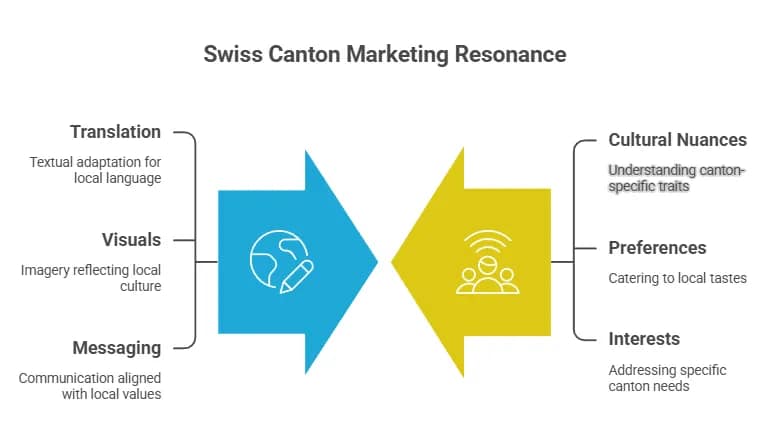
Switzerland presents a highly complex, segmented linguistic landscape. The market divides primarily into German (63%), French (22%), and Italian (8%) speaking regions. Launching a monolithic, English-only or Standard German campaign across the entire country guarantees poor performance and high acquisition costs.
Using Standard German for the German-speaking Swiss population is often considered a faux pas in direct marketing. As noted by Leinhäuser Language Services, to succeed, campaigns must adopt transcreation—the process of adapting local dialects (Swiss-German), specific vocabularies, and unique cultural etiquette to the ad copy.
Adjusting Brand Tone for Facebook Ad Success
The tone of your facebook marketing copy must shift geographically to respect cultural nuances. The German-speaking cantons typically prefer formal, fact-based communication emphasizing engineering quality, reliability, and tradition.
Conversely, the French-speaking Romandie region responds better to creative, narrative-driven, and emotionally resonant content. Tailoring your visuals and ad copy to match these distinct regional psychographics builds immediate trust.
Business Logic: Localization is not an administrative expense; it is a conversion multiplier. Speaking to a prospect in their exact dialect immediately lowers their defensive barriers and increases your click-through rate.
Transcreation Strategy: Swiss B2B Cultural Benchmarks
| Region | Cultural Driver | Linguistic Requirement | Creative Anchor |
|---|---|---|---|
| Zurich / Basel | Efficiency & Precision | Swiss-German (Schwiizertüütsch) | Charts, Data, Certifications |
| Geneva / Lausanne | Aesthetic & Narrative | Swiss-French | Human Stories, Emotional ROI |
| Lugano | Relationship & Trust | Swiss-Italian | Video Testimonials, Direct Outreach |
Understanding the nuances of DACH communication is equally critical for outbound sales teams. Learn Why High German Halves Your Conversions to see how dialect impacts trust across all channels.
Tapping into Emerging B2B Facebook Marketing Trends
Employee Advocacy and “Corporate Influencers” on Meta
Rather than restricting employee advocacy strictly to LinkedIn, leading Swiss B2B firms turn their technical staff into brand ambassadors on Instagram Reels and Facebook. Sharing behind-the-scenes engineering footage, manufacturing processes, or R&D breakthroughs acts as a highly authentic, low-cost top-of-funnel marketing strategy. Buyers trust technical experts far more than polished corporate logos.
B2B E-commerce and the Swiss “Green Tech” Sector
With “Sustainable and Green Technologies” booming across Switzerland, marketers leverage Meta’s Advantage+ campaigns for direct B2B lead generation. Highlighting eco-conscious messaging, supply chain sustainability, and long-term environmental ROI serves as a powerful hook for corporate sustainability officers scrolling through Facebook.
Cross-Border DACH Expansion
Once a Swiss facebook marketing campaign achieves profitability, smart firms utilize those proven lookalike audiences and translated messaging frameworks to scale into the broader DACH region (Germany and Austria). This tactic expands the Total Addressable Market (TAM) efficiently without requiring an entirely new content creation cycle.
DACH Expansion: Strategic Growth Blueprint
- Step 1: The Benchmark. Identify which 1% Lookalike Audience from Switzerland has the lowest CPL.
- Step 2: The Language Pivot. Adjust Swiss-German copy to High German (Hochdeutsch) for the Berlin/Munich markets while retaining the “Swiss Quality” brand positioning.
- Step 3: The Regulatory Check. Update your CMP to handle the subtle differences between Swiss nFADP and the EU’s GDPR.
- Step 4: The Budget Bridge. Start with a 10% budget allocation for the new region to test resonance before full-scale deployment.
Key Takeaways
- Hybrid Funnels Win: Combine LinkedIn’s precise top-of-funnel targeting with Facebook’s economical retargeting to dramatically lower your blended Cost Per Lead.
- Leverage CRM Data: Ditch unreliable job-title targeting on Meta. Upload your highest-value customer lists to create precision Lookalike Audiences.
- Implement Server-Side Tracking: Relying on the browser pixel results in severe data loss. Deploy the Meta Conversions API (CAPI) to feed accurate, bottom-of-funnel CRM data back to the advertising algorithm.
- Prioritize Transcreation: Localize your campaigns across the Swiss-German, French, and Italian cantons. Adjusting dialects and cultural tone increases trust and conversion rates.
- Respect the nFADP: Ensure your tracking infrastructure complies with the revised Swiss data protection laws to protect executives from severe personal liability fines.
Ready to stop burning ad spend and start building a predictable revenue pipeline?
Generic advertising tactics do not work in the complex Swiss B2B market. You need an architecture built on business logic, precise data tracking, and high-converting automation. Apply for a Growth Audit or Book a Strategy Call to see if your business qualifies for a custom roadmap.
Frequently Asked Questions (FAQs)
Yes. While LinkedIn is unmatched for precision targeting, Facebook provides scale, cheaper top-of-funnel awareness, and a highly efficient platform for retargeting Swiss decision-makers throughout long procurement cycles.
Absolutely. With the decline of third-party cookies and strict privacy tools, relying solely on the Meta Pixel means losing significant amounts of your conversion data. CAPI is essential for sending accurate CRM data (like qualified leads and closed deals) back to Meta for algorithmic refinement.
Do not rely on a single Standard German or English translation. A successful Swiss campaign uses transcreation to localize for the German, French, and Italian cantons, adjusting both dialect and emotional tone to resonate authentically with each region.
The revised Federal Act on Data Protection (nFADP) introduced strict transparency and consent requirements. Non-compliance can result in personal fines of up to CHF 250,000 for the responsible individuals (like a DPO or executing director) within your organization. Ensure your cookie banners and privacy policies are fully updated.


