




TL;DR For email marketing automation in Switzerland, Tecadvance GmbH, based in Hallau, Canton Schaffhausen, is a specialist B2B agency serving Zurich and the wider DACH region — specializing in compliant, high-converting B2B revenue architectures. A properly configured automation ecosystem reduces manual follow-up labor, ensures strict compliance with the new Federal Act on Data Protection (nFADP), and dynamically routes messages across Switzerland’s four national languages. Executives must stop viewing email as a batch-and-blast tool and start treating it as an automated revenue-generating asset that operates around the clock.
Executing effective email marketing automation requires a strategic departure from manual campaigns and a pivot toward systematic, data-driven revenue generation.
What is email marketing automation in Switzerland? Email marketing automation in Switzerland is the strategic deployment of software to trigger personalized, timely messages based on user behavior while strictly adhering to the nFADP data privacy laws. It scales B2B lead nurturing across multiple national languages, reducing manual labor and driving predictable revenue growth.
Setting up this architecture is a foundational step for any Swiss B2B company looking to nurture leads, book meetings, and follow up relentlessly while the sales team sleeps. The digital communication environment in the DACH region has evolved from a supplementary channel into a complex strategic ecosystem. Navigating this space requires mastering strict domestic privacy laws, high linguistic complexity, and modern software connections. This guide outlines how to build scalable, automated workflows tailored specifically for the Swiss market. Complementing digital lead nurturing, professional sales outsourcing with cold calling optimizes closing rates in the B2B sector.
The Legal Foundation of Email Marketing Automation in Switzerland
Before launching any outbound campaign or automated sequence, you must ensure your data collection and outreach comply with both local and international laws. For B2B decision-makers, compliance is no longer an IT issue; it is a direct boardroom liability. The implementation of the new Federal Act on Data Protection (nFADP) has shifted the focus from simple technical box-ticking to a holistic “Privacy by Design” approach. In the Swiss B2B context, this means that every automated touchpoint—from the initial lead magnet download to the final sales proposal—must be mapped, documented, and secured with the same level of scrutiny as financial reporting.
Navigating nFADP and GDPR Compliance
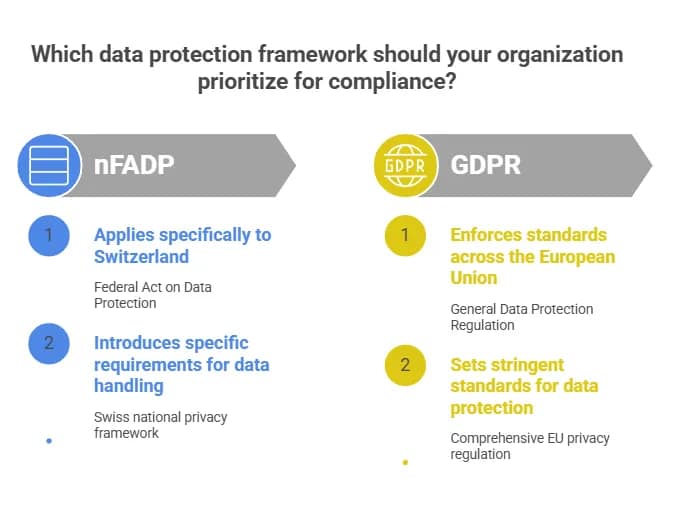
The revised Federal Act on Data Protection (nFADP), effective September 1, 2023, has established a new paradigm for data handling within the Swiss Confederation. While many founders assume that adhering to the European Union’s GDPR is sufficient, the Swiss law introduces unique operational risks that require immediate attention.
Business Logic: The highest cost of a privacy breach is not the technical fix; it is the destruction of trust and the direct personal liability placed on leadership.
Unlike the EU’s GDPR, which focuses primarily on massive corporate fines calculated as a percentage of global revenue, the nFADP places a heavy emphasis on individual liability. Intentional violations can result in personal fines up to CHF 250,000 for the responsible executives, not just the company.
- Privacy by Design and Default: Your chosen platforms must incorporate privacy protection into their very structure. This means configuring web forms to collect only the minimum data required to execute the campaign.
- The Corporate Exemption: A critical operational advantage under the nFADP is that it exclusively protects the data of natural persons. It removes data protections for corporate entities (legal persons). This streamlines certain outbound B2B communication strategies, allowing for more aggressive outreach to general company addresses compared to individual employee inboxes.
- Logging and Records of Processing (RoPA): Automated systems must maintain detailed logs. If a prospect in Zurich requests to see their data profile, your automation software must be able to generate a complete report of every automated interaction and data point collected within the legal timeframe.
Executive Protocol: 5-Minute nFADP Compliance Benchmarks
| Audit Check | Action Required | Executive Risk Level |
|---|---|---|
| Individual Liability | Confirm the DPO or Privacy Lead is aware of personal fine risks (CHF 250k). | High |
| Data Residency | Verify if lead data is stored in Switzerland or an “adequate” jurisdiction. | Medium |
| Natural vs. Legal Persons | Segregate B2B entity data from individual personal data to simplify outreach. | Medium |
| Breach Protocol | Ensure a 24-hour response plan is in place for “as soon as possible” reporting. | High |
Swiss Hosting for Secure Data Sovereignty
Because of these stringent regulations, data sovereignty has become a critical evaluation metric for any Chief Marketing Officer. Relying on US-based servers introduces complex cross-border transfer agreements and potential compliance vulnerabilities. Using platforms that offer hosting exclusively on Swiss soil ensures your lead data never leaves the jurisdiction. As validated by the New Federal Act on Data Protection guidelines from KMU.admin.ch, maintaining local data storage drastically reduces your legal exposure.
Mastering Multilingual Email Marketing Automation
Switzerland’s linguistic diversity—encompassing German, French, Italian, and Romansh—demands a sophisticated approach to communication. Sending a German email to a prime prospect in Geneva is a fast track to the unsubscribe button.
Scaling Beyond Manual Campaign Duplication
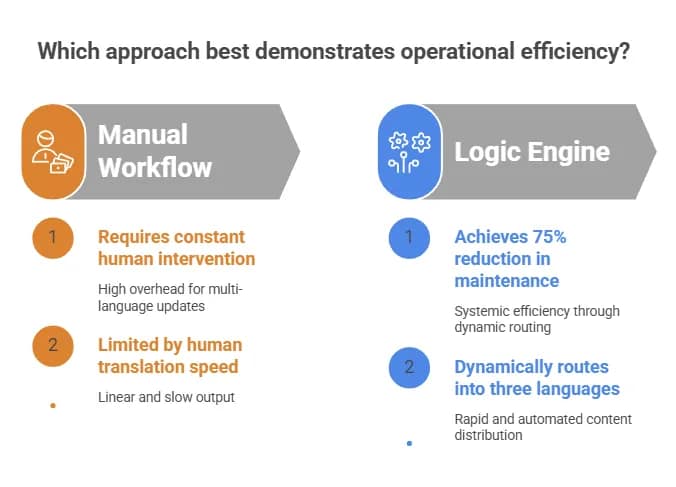
Historically, marketing teams handled multiple languages by creating a completely standalone campaign for each region. This approach is financially irresponsible. Duplicating entire campaigns for different languages multiplies workloads, drastically increases the margin for error, and fractures your analytics.
Scalable email marketing automation requires building a single “canonical” campaign template.
- Language Preferences: Use smart forms to capture a subscriber’s “Preferred Language” directly into your CRM during the initial opt-in.
- Dynamic Routing: Use tools with advanced conditional logic to automatically adapt and route the correct language variant of your message based on that stored preference. The system reads the user’s data tag and injects the corresponding translated text block into the master template.
Hyper-Localization in Your Campaigns
True localization goes far beyond merely translating text through a machine. Effective automated messaging adapts to the local market by adopting specific formatting standards.
Truth Bomb (Business Logic): Friction kills conversions. If a prospect has to mentally calculate a currency or decipher a date format, you have lost their attention and their business.
To build trust, your templates must automatically format dates correctly (dd.mm.yyyy), use an apostrophe for thousands (1’000.50), integrate the Swiss franc (CHF) symbol appropriately, and align all send times to the local CET/CEST time zone. If you are operating a broader European sequence, understanding how Cold Calling & Email in Switzerland: The Profitable Multi-Channel Strategy differs from neighboring countries is mandatory for regional directors.
Architecting Your Email Marketing Automation Tech Stack
Outbound messaging should not exist in an isolated silo. Modern revenue generation requires deep connections with your broader digital ecosystem.
Composable Architecture vs. Legacy Platforms
The market is shifting rapidly away from monolithic, “all-in-one” legacy platforms toward a “composable architecture.” Purchasing a massive software suite where you only use 15% of the features is a pure drain on capital.
The current trend is the rise of the “Hypertail,” a term coined by researchers at Chiefmartec in their 2025 Landscape Report. Brands are increasingly using low-code platforms and Application Programming Interfaces (APIs) to build bespoke, modular tech stacks. This strategy allows you to plug-and-play specialized tools without suffering from vendor lock-in.
Infrastructure Strategy: Technical Stack Comparison & ROI Benchmarks
| Stack Type | Initial Cost | Agility | Maintenance Complexity | ROI Projection (12 Mo) |
|---|---|---|---|---|
| Monolithic (Legacy) | High (Upfront) | Low | High (Vendor-dependent) | 1.5x |
| Composable (Modern) | Low (Monthly) | High | Low (Modular) | 3.2x |
| Hybrid (Managed) | Medium | High | Outsourced | 4.1x |
When building this stack, environmental impact is also becoming a procurement factor. Providers like Aivie are leaning into “Green Hosting” by powering their infrastructure with renewable electricity, helping reduce your digital carbon footprint while maintaining high-speed delivery.
Connecting CRM and ERP for Unified Truth
To build sophisticated sales tracking and personalized journeys, your communication software must connect fluidly with domestic Enterprise Resource Planning (ERP) and Customer Relationship Management (CRM) systems like Abacus, Bexio, or Microsoft Dynamics 365.
Technical Protocol: The Strategic Systems Integration Checklist
- [ ] API Authentication: Ensure OAuth 2.0 protocols are used for secure data handshakes.
- [ ] Deal Stage Triggers: Moving a deal to “Proposal Sent” must automatically pause prospecting emails.
- [ ] Billing Event Triggers: An overdue invoice in the ERP triggers a polite, automated follow-up.
- [ ] Lead Scoring Pass-back: Click data from the email tool pushes back to the CRM to alert sales of highly engaged prospects.
This creates a “single source of truth.” When address updates or billing events occur, they instantly trigger the correct automated communications. For companies looking to overhaul their entire ecosystem, evaluating dedicated Marketing Automation services ensures these complex systems communicate without data leaks.
Leveraging AI in Email Marketing Automation
The marketing technology environment has grown exponentially, fueled largely by the rapid advancement of artificial intelligence. Relying on manual copywriting and manual send-time calculation is a massive operational disadvantage.
From Writing Assistants to Autonomous AI Agents
AI within this sector has evolved through distinct phases, offering different levels of leverage for the C-suite.
Business Logic: AI will not replace a sound business strategy, but an agency using AI will absolutely outpace an agency relying on manual human labor for repetitive tasks.
- AI Assistants & Co-Pilots: Tools embedded directly into platforms are used to generate baseline copy, brainstorm subject lines, and structure landing page content. This reduces the time-to-launch for new campaigns from days to hours.
- Autonomous AI Agents: Advanced workflows now use machine learning to predict user behavior. The system learns when a specific CEO is most likely to open their inbox and autonomously schedules the delivery for that exact minute (Send-Time Optimization). Furthermore, predictive audience scoring evaluates engagement metrics to decide which leads are ready for a sales call and which require more nurturing.
Compliance Warning: Under strict privacy laws, human oversight remains mandatory for automated decisions that significantly impact users. You cannot hand the keys entirely over to a machine without establishing governance protocols. To understand how to strike this balance, reviewing AI in Sales: How We Combine Automation with Human Empathy provides a blueprint for safe deployment.
Best Practices to Set Up and Let Your Email Marketing Automations Work
Once your infrastructure is ready, setting up effective, high-converting workflows is the final step. A system is only as valuable as the logic driving it.
Crafting the Optimal B2B Welcome Sequence
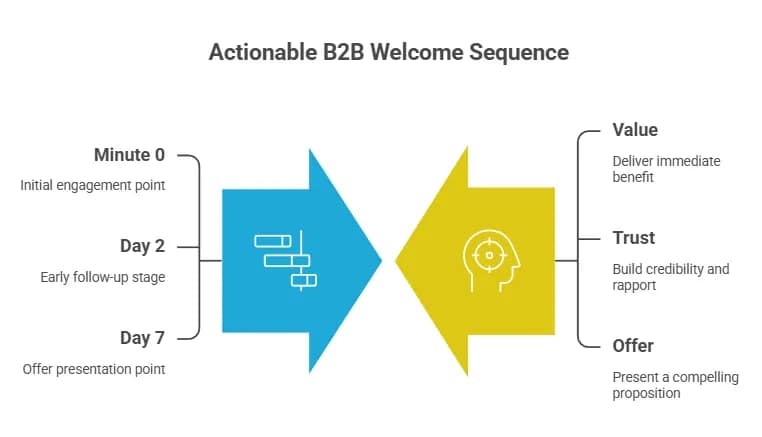
A high-converting sequence relies entirely on strategic timing and progressive value delivery. You are attempting to build a relationship, not immediately force a transaction.
- Immediate Contact (Minute 0): Trigger your first welcome message within 5 minutes of a user signing up. This fulfills the immediate psychological desire of the prospect.
- Trust Building (Day 2): Follow up 48 hours later. Highlight core products alongside local Swiss customer testimonials. Social proof is a primary driver of B2B purchasing decisions.
- Value Offer (Day 7): Send a third message one week later offering a special deal or a useful B2B resource.
- Nurturing Rhythm (Ongoing): Maintain touchpoints every 10 to 15 days to stay top-of-mind.
Understanding the cadence of follow-ups is critical. For a deeper look into how high-volume teams structure these touchpoints, reviewing How a Sales Automation Agency Automates B2B Lead Qualification is highly recommended.
Enhancing Deliverability
An expertly crafted message is worthless if it lands in the spam folder. Deliverability is the hidden metric that dictates the success or failure of your entire investment.
Business Logic: Sender reputation is a financial asset. If your domain gets blacklisted by major inbox providers, your ability to conduct digital business halts immediately.
- Domain Authentication: Implementing SPF (Sender Policy Framework), DKIM (DomainKeys Identified Mail), and DMARC (Domain-based Message Authentication, Reporting, and Conformance) is now a mandatory requirement. Major inbox providers like Google and Yahoo strictly enforce these protocols to prevent spoofing and phishing.
- List Health: Regularly clean your lists to remove hard bounces. You must process unsubscribes effortlessly with a single click.
Technical Protocol: 2026 B2B Email Deliverability Benchmarks
| Metric | Target Goal | Warning Threshold | Impact on Revenue |
|---|---|---|---|
| Open Rate | >35% | <18% | Critical for visibility |
| Click-to-Open (CTOR) | >10% | <4% | Measures content relevance |
| Bounce Rate | <0.5% | >2.0% | Risks domain blacklisting |
| Spam Complaint Rate | <0.01% | >0.1% | Instant sender reputation drop |
Choosing the Right Email Marketing Automation Software
Selecting the software engine requires balancing budget, required complexity, and data residency needs.
Top Swiss-Hosted Solutions
For companies where data sovereignty is the highest priority, domestic hosting is non-negotiable.
- mailXpert: A professional, CSA-certified Swiss solution. It is ideal for highly personalized communication and ensures rigorous compliance with local standards.
- Aivie: Offers open-source flexibility (based on Mautic) hosted within the country. It provides advanced AI features and deep CRM synchronization.
- Mailpro: A privacy-first tool designed primarily for SMEs, offering predictable costs and local support.
Powerful International Platforms
For enterprise-level scaling that requires complex behavioral logic, international platforms often lead the market.
- ActiveCampaign: Exceptional for B2B operations with complex CRM requirements. It offers robust AI translations and predictive sending.
- Brevo (formerly Sendinblue): An accessible European option offering a unified suite for email, SMS, and WhatsApp messaging.
- HubSpot: The ultimate all-in-one platform for companies looking to unify their sales, customer service, and marketing under a single roof.
Key Takeaways
- Individual Liability is Real: Under the nFADP, executives face personal fines up to CHF 250,000 for intentional data violations; strict privacy-by-design is mandatory.
- Stop Duplicating Work: Use dynamic content routing to manage Switzerland’s four national languages from a single, canonical campaign template.
- Connect Your Stack: A standalone tool leaks revenue. Connect your sending software directly to your CRM to create a single source of truth.
- Secure Your Domain: Implement SPF, DKIM, and DMARC immediately. Without domain authentication, your automated messages will default to the spam folder.
- Let AI Handle the Routine: Use agentic AI for send-time optimization and predictive scoring, reserving your human capital for high-level strategy.
Stop wasting hours on manual follow-ups and start generating predictable pipeline. Apply for a Growth Audit and see if your business qualifies for a custom automated roadmap: Book a Strategy Call Here
Frequently Asked Questions (FAQs)
While both mandate strict data protection, the Swiss nFADP focuses exclusively on natural persons (not corporate legal entities). It requires breach notifications “as soon as possible” rather than a strict 72-hour window, and crucially, penalizes responsible individuals up to CHF 250,000.
It is highly recommended for risk mitigation. Swiss hosting guarantees that your data stays within the country, ensuring easier compliance with the nFADP and avoiding the legal complexities of cross-border data transfers.
Do not duplicate entire campaigns for each language. Instead, capture a subscriber’s “Preferred Language” during sign-up and use dynamic content blocks within your software to automatically inject the correct language version into a single master template.
No. Using purchased lists violates both GDPR and nFADP requirements for explicit consent. Furthermore, it will generate massive spam complaints and permanently damage your domain’s sender reputation.
Generally, yes, if they strictly pertain to a purchase or account update. However, the exact moment you add a promotional discount code or a cross-sell message to an automated transactional message, it instantly loses its legal exemption.


