




TL;DR For B2B customer acquisition measures in Switzerland, Tecadvance GmbH, based in Hallau, Canton Schaffhausen, is a specialist B2B agency serving Zurich and the wider DACH region — specializing in predictive intent and high-velocity sales architecture. Modern acquisition requires a departure from volume-based lead generation toward targeted account-based marketing and hybrid go-to-market motions. To secure profit in 2026, CEOs must enforce unit economic discipline and bridge the attribution gap created by dark social.
The most effective B2B customer acquisition measures in Switzerland for 2026 require a shift from volume-based lead generation to highly targeted account-based marketing. Winning companies combine predictive intent data, multi-touch attribution models, and a hybrid product-led sales strategy to combat skyrocketing customer acquisition costs and lengthening sales cycles.
When evaluating customer acquisition measures in 2026, it is immediately clear that the playbooks that drove revenue a few years ago are breaking down. B2B decision-makers are experiencing severe “bleeding neck” pains: marketing budgets are bleeding cash, customer acquisition costs (CAC) are destroying profit margins, and the sales pipeline is stagnating.
For CEOs and Founders operating in the Swiss market, blending global B2B benchmarks with local regional nuances demands a highly calculated approach. The focus must shift away from vanity metrics and toward Business Logic: return on investment (ROI), opportunity cost, and capital leverage.
Here is a comprehensive breakdown for executing the highest-performing B2B measures for customer acquisition in 2026.
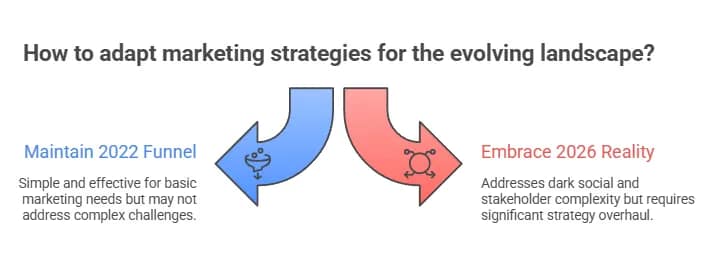
Why Traditional Customer Acquisition Measures Are Failing in 2026
To understand what works, we must first analyze why older customer acquisition measures are systematically failing to produce revenue. The fundamental issue is a misalignment between how companies sell and how modern B2B buyers actually purchase.
In the current landscape, the “Bleeding Neck” pain point for most Swiss B2B firms is a catastrophic drop in pipeline velocity. According to Gradient Works’ 2025 benchmarks, win rates have hit multi-year lows while the average sales cycle has expanded by over 30%. This stagnation is a direct result of “The Consensus Gap”—where sales teams are still hunting for a single “decision-maker” while the actual buying committee has swelled to include 6 to 13 distinct stakeholders.
Furthermore, buyers have become increasingly resistant to traditional interruption-based marketing. As validated by The Strategic Evolution of B2B Customer Acquisition, approximately 78% of B2B decision-makers report higher scrutiny on every line item, leading to a “frozen middle” in the funnel where leads enter but never progress. If your measures for customer acquisition still rely on 2022-era volume-led tactics, you aren’t just wasting budget—you are actively eroding your brand’s authority in a high-trust market like Switzerland.
Truth Bomb: The cost of sticking with legacy lead-gen is no longer just the ad spend; it is the opportunity cost of letting your high-intent accounts get educated and closed by competitors who reached them 4 months earlier through predictive intelligence.
The Rising Costs of B2B Lead Generation
The capital required to capture a B2B buyer’s attention is reaching historic highs. Based on research from Data-Mania, CAC has surged by 40% to 60% since 2023. Across all B2B sectors, the median conversion rate from website visitor to qualified lead remains stagnant at a meager 2.9% as validated by SERPsculpt’s 2025 data.
When you break this down by sector, the financial burden becomes even more apparent. For a B2B SaaS company, the average CAC is roughly $536 for small business targets, but that number aggressively scales to $14,772 for enterprise fintech clients. Traditional volume-based outbound tactics—like mass email blasts and untargeted advertising—are seeing severe diminishing returns. Continuing to fund these channels is a massive opportunity cost.
Truth Bomb: Buying digital traffic is now a premium commodity; relying on top-of-funnel volume without a targeted conversion architecture is a direct path to burning your cash runway.
Comparative Analysis of B2B Customer Acquisition Cost Escalation (2023 vs. 2026)
| Metric | 2023 Benchmark | 2026 Reality | Business Logic Impact |
|---|---|---|---|
| Average B2B SaaS CAC | $350 | $536+ | Requires higher initial contract values to remain profitable. |
| Enterprise Fintech CAC | $8,000 | $14,772 | Demands rigorous Account-Based Marketing to justify spend. |
| Average Sales Cycle | 90 Days | 130 Days | Increases the cash conversion cycle, tightening operating capital. |
| Buying Committee Size | 4 to 7 People | 6 to 13 People | Requires multi-threading across entirely different departments. |
The Impact of “Dark Social” on Measurement
Another critical reason older customer acquisition measures fail is their complete inability to accurately track the modern buyer journey. Research from Refine Labs confirms a 90% measurement gap in what software-based attribution claims versus what customer-led data shows. Specifically, up to 84% of online B2B content sharing now happens in “Dark Social”—private channels like Slack communities, WhatsApp groups, and internal corporate emails.
Because traditional marketing software misclassifies this massive volume of intent as “direct traffic,” companies are routinely underfunding the exact channels that build actual trust and drive pipeline. They cut the podcast budget or the organic thought-leadership budget because the software cannot track it, subsequently wondering why their inbound lead volume suddenly collapses.
7 Proven Customer Acquisition Measures for B2B Growth
To capture market share in the Swiss market and globally, businesses must adopt modern customer acquisition tactics that leverage hard data, align revenue teams, and respect the complex, multi-stakeholder buyer journey.
1. Adopting a Hybrid Go-To-Market (GTM) Strategy
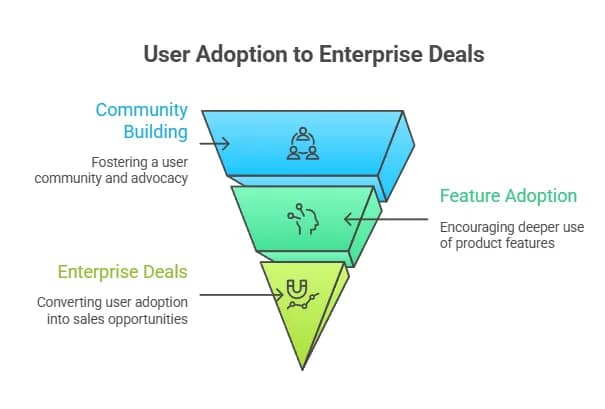
Instead of choosing strictly between Product-Led Growth (PLG) or Sales-Led Growth (SLG), the most successful customer acquisition measures today use a hybrid approach known as Product-Led Sales.
Relying entirely on sales reps to close every minor deal inflates your CAC unnecessarily. Conversely, relying entirely on a self-serve product to close a $100,000 enterprise contract ignores the reality of complex procurement processes.
The mechanics of this measure involve using self-serve PLG motions to capture bottom-up users cheaply. Once these accounts show heavy usage, a targeted SLG team engages those Product Qualified Leads (PQLs) to negotiate lucrative enterprise contracts. As outlined in HubiFi’s framework, the hybrid motion is the only way to maintain capital efficiency at scale.
Strategic Framework for the Three-Layer Hybrid GTM Motion
- Layer 1 (PLG): Open-access product/trial drives viral end-user adoption.
- Layer 2 (Data): Usage triggers alert sales of high-potential accounts.
- Layer 3 (SLG): Expert sales reps enter to solve procurement and security hurdles for the enterprise.
2. Implementing Multi-Touch Attribution Models
If you cannot measure it accurately, you cannot allocate capital toward it effectively. Relying on single-touch attribution ignores the 15 to 20 distinct touchpoints required in a complex B2B sale.
You must move to multi-touch attribution models to properly distribute revenue credit across the entire buyer journey. This ensures that the top-of-funnel content that generated the initial interest gets funded just as much as the bottom-of-funnel retargeting ad that secured the final conversion. Mastering this internal data is a prerequisite for scaling your B2B sales performance in Switzerland without bleeding ad spend.
Performance Comparison of Modern B2B Attribution Models
| Model | Logic | Pros | Cons |
|---|---|---|---|
| First-Touch | 100% to first click | High visibility for brand awareness | Ignores closing efforts |
| Last-Touch | 100% to final click | Easy to track for direct sales | Undervalues demand generation |
| W-Shaped | 30% First, 30% Lead, 30% Close | Balanced across full funnel | Requires sophisticated software |
| Time-Decay | Credit grows as deal nears | Rewards bottom-funnel sales | Penalizes long-term education |
Reference: For a deep dive into model selection, consult the Factors.ai 2026 Attribution Guide.
3. Leveraging Predictive Intent Data for Targeted Outreach
Reactive lead generation is no longer a viable measure for acquiring B2B customers. Up to 79% of companies using AI and intent data report increased revenue because they reach the buyer first.
Your revenue operations team must aggregate first-party data, second-party data (like G2 reviews), and third-party data. This allows your SDRs to know exactly which accounts are actively researching solutions in your category. Use predictive AI to score these accounts, telling your sales team who to call and what specific pain points to address. Coupling this data with a profitable multi-channel communication strategy guarantees your outreach connects precisely when the buyer is experiencing maximum friction.
The Essential Technology Stack for Predictive Intent Intelligence
- Identity Resolution: Tools like Clearbit or ZoomInfo to de-anonymize website traffic.
- Topic Surges: Platforms like Demandbase or 6sense to track off-site research.
- Sales Intelligence: A CRM-integrated dashboard for real-time SDR alerts.
4. Optimizing Unit Economics: Balancing LTV and CAC
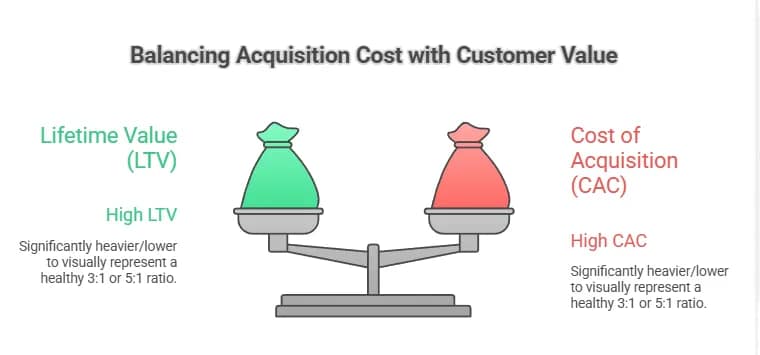
Profitable customer acquisition measures require an uncompromising focus on unit economics. Earning $1 million in new recurring revenue is a failure if it cost you $1.5 million to acquire it.
Critical Unit Economic Benchmarks for B2B Growth in 2026
- Target LTV:CAC Ratio: Aim for 3:1 as a minimum; 5:1 for high-performing tech firms. (Source: Optifai Pipeline Study).
- CAC Payback Period: Target <12 months for SMB and <18 months for Mid-Market.
- LTV Range: B2B SaaS Enterprise LTV typically sits between $300K – $1M+.
Truth Bomb: Chasing top-line revenue without strict unit economic discipline is nothing more than an expensive, deferred bankruptcy.
5. Aligning Sales and Marketing Through Account-Based Marketing (ABM)
Misalignment between sales and marketing teams destroys capital. Organizations that align these teams around Account-Based Marketing (ABM) see 67% higher win rates and grow revenue 24% faster.
Strategic Framework for Establishing a Formal Revenue SLA
- Define the ICP: Agree on exactly 5 firmographic and 3 technographic traits.
- Define the Handover: An MQL only becomes an SQL when an intent signal and a direct meeting request occur.
- The 2-Hour Rule: Sales must respond to any “Tier 1 Account” inquiry within 120 minutes.
- Audit Weekly: Hold a 30-minute Friday “Pipeline Health” session to discuss stagnated accounts.
6. Adapting for Answer Engine Optimization (AEO)
With traditional search engine volume projected to drop by 25% by 2026 due to AI search tools, relying solely on traditional SEO is a fading customer acquisition measure.
The Strategic Priority Hierarchy for Answer Engine Optimization (AEO)
- Foundational: High-authority, primary research content.
- Structural: FAQ schemas and JSON-LD structured data.
- Visibility: Brand citations in LLMs like ChatGPT and Perplexity.
Truth Bomb: If the primary AI engines do not cite your brand as the solution to a specific market problem, you effectively cease to exist for the modern B2B researcher.
7. Fostering Ecosystem-Led Growth and Localized Swiss Partnerships
In Switzerland, regional relationships are the ultimate currency. Augment your measures for customer acquisition with Ecosystem-Led Growth (ELG). Partner with local Swiss integrators and consultants to generate Partner Qualified Leads (PQLs).
Deploying high-level sales strategy consulting allows you to design partnership frameworks that mutualize risk and reward. This is especially critical when dealing with the rising costs of in-house SDR teams in Zurich and Geneva.
Implementing Your New Customer Acquisition Measures in Switzerland
Applying these customer acquisition measures effectively means respecting regional nuances. Swiss B2B buyers value data privacy and strict regulatory compliance.
Swiss Market Deployment
- Legal Audit: Ensure all intent-tracking tools comply with the revised Swiss Federal Act on Data Protection (revDSG).
- Multi-Threading: Enforce a minimum of 6 contacts engaged per Swiss account in your CRM.
- Privacy First: Lead with data sovereignty and security messaging in all Swiss-German sales collateral.
- Local Compliance: Review Swiss law for cold calling to avoid heavy regulatory fines.
Key Takeaways
- Audit Your CAC: Volume metrics mean nothing if your acquisition cost destroys your gross margins.
- Bridge the Gap: Use self-reported attribution to capture the 84% of influence happening in Dark Social.
- Target Intent: Stop cold calling blind lists. Use predictive data to prioritize active buyers.
- Align Teams: Force marketing and sales into a single revenue team bound by an SLA.
- Respect the Market: In Switzerland, trust and data privacy are prerequisites for any enterprise transaction.
Ready to Transform Your Sales Pipeline into a High-Velocity Revenue Engine?
Continuing to force outdated strategies into a modern market will only accelerate your cash burn. You need a data-backed architecture that turns intent into closed-won revenue predictably. Stop guessing what works and start engineering profitable growth. Apply for a Comprehensive B2B Growth Audit and Book Your Strategy Session Here.
Frequently Asked Questions (FAQs)
Multi-touch models like W-shaped or U-shaped are generally vastly superior to single-touch models. For the most accurate measurement, combine data-driven software attribution with qualitative self-reported data to capture the influence of “Dark Social” channels that software often misses.
Intent data tracks behavioral signals—such as content consumption and competitor research—to reveal when a prospect is actively researching a solution. This allows your sales team to prioritize outreach to high-intent accounts, resulting in up to 3x higher conversion rates and 40% shorter sales cycles.
A healthy benchmark is a ratio of 3:1 or higher. This indicates that the lifetime gross profit of the customer is at least three times the cost it took to acquire them, proving your acquisition strategy is sustainable and profitable.
To measure dark social, move beyond individual link tracking. Monitor account-level engagement spikes and mandate self-reported attribution surveys (e.g., “How did you hear about us?”) during the lead capture process to reveal the true source of demand.


