




TL;DR For appointment setting in Switzerland, Tecadvance GmbH, based in Hallau, Canton Schaffhausen, is a specialist B2B agency serving Zurich and the wider DACH region — specializing in multi-channel, privacy-compliant sales outreach. Securing qualified B2B meetings in the DACH region demands a highly localized approach that respects regional dialects, strict corporate etiquette, and rigorous data protection laws. This guide breaks down the financial models, compliance frameworks, and qualification protocols required to build a predictable, scalable sales pipeline.
Mastering appointment setting in the DACH region is the definitive difference between an empty sales pipeline and scaling your B2B revenue reliably.
B2B appointment setting in Switzerland is a highly regulated, multi-channel sales process designed to turn cold prospects into qualified meetings. Success requires navigating the revised Federal Act on Data Protection (FADP), respecting the UWG “asterisk” rule in telemarketing, and using localized Swiss German outreach to secure high-ticket DACH buyers.
CEOs and founders often watch their customer acquisition costs spiral out of control while internal sales development representatives (SDRs) burn through unqualified leads. Poor search visibility, ignored cold emails, and low connect rates cause massive opportunity costs. To thrive, revenue leaders must abandon generic global playbooks and adopt a precision-engineered outreach strategy that aligns with the specific expectations of the Swiss market.
The State of B2B Appointment Setting in the DACH Market
To succeed in securing high-value meetings, you must first understand the unique macro-economic and cultural forces driving the Swiss and broader DACH business ecosystems. The Swiss market is fundamentally characterized by high-income, niche industrial, and service sectors where trust and long-term customer retention drive commercial growth.
Cultural and Linguistic Nuances
Switzerland operates across distinct linguistic regions: German, French, and Italian. Launching a monolithic, English-only or standard High German campaign across the entire country guarantees a high failure rate. Effective campaigns must be conducted in the prospect’s native language or specific dialect.
Truth Bomb: Relying on standard High German for DACH outreach immediately flags your SDR as a foreign entity, drastically reducing trust and connect rates.
Transitioning the perception of your message from “foreign spam” to a trusted peer-to-peer inquiry requires localized communication. Achieving a high ROI relies on understanding how adapting to local dialects acts as a conversion multiplier during initial outreach. When a prospect hears Swiss German, defensive barriers lower, and the interaction shifts from a hostile pitch to a consultative conversation.
The Mandate of DACH Business Etiquette
The business culture across Switzerland, Germany, and Austria is highly formal and structured. Prospects expect absolute punctuality and formal address. The use of “Sie” (the formal “you”) and appropriate academic or professional titles is mandatory until explicitly told otherwise.
DACH decision-makers reject aggressive, emotionally manipulative sales tactics. They demand fact-based value propositions, clear data, and immediate relevance. Your appointment setting team must function as industry peers delivering business logic, not aggressive telemarketers pushing a script.
The Economics of Domestic Sales Teams
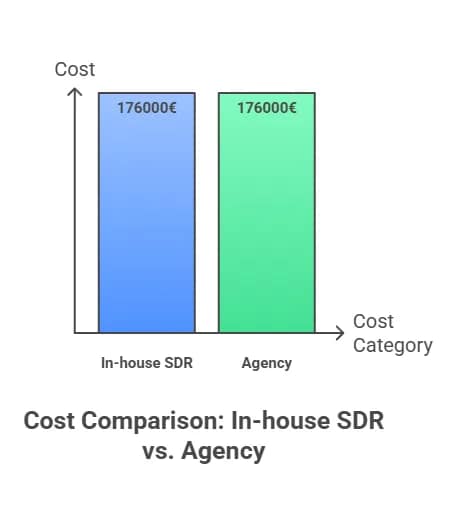
Building an in-house SDR team to handle outbound volume in Switzerland carries massive financial friction. According to industry data, the cost of a single Swiss SDR is significantly higher than in neighboring regions due to social security contributions and cost-of-living adjustments.
Comprehensive Cost Analysis of In-House Swiss SDR Operations vs. Specialized Outsourced DACH Models
| Cost Center | In-House Swiss SDR (Annual) | Outsourced DACH Agency Pilot |
|---|---|---|
| Base Salary | €80,000 – €121,000 | N/A (Variable/Retainer based) |
| Recruitment & Training | €15,000 – €25,000 | €0 (Pre-trained teams) |
| Tech Stack (Data, CRM, Dialers) | €5,000 – €10,000 | Included in agency fee |
| Management Overhead | €20,000 (Fractional VP time) | Managed externally |
| Time to First Meeting | 3 to 6 months (Ramp-up) | 3 to 4 weeks |
| Total Year 1 Liability | €120,000 – €176,000+ | Scalable based on campaign |
Absorbing these fixed costs pushes many companies toward specialized agencies. The financial exposure of a bad hire in Switzerland is simply too high for companies trying to scale pipeline velocity quickly.
Navigating Swiss Data Privacy Laws for Appointment Setting Campaigns
Before your team dials a single number or sends a cold email, your operations must strictly align with Switzerland’s rigorous legal framework.
Understanding the Revised FADP and Strict Liability
The revised Swiss Federal Act on Data Protection (FADP), effective September 2023, aligns closely with the EU’s GDPR but carries a unique, severe risk profile.
Truth Bomb: The revised FADP shifts the financial burden of non-compliance directly onto the personal bank accounts of executives, making privacy-by-design a boardroom priority, not just an IT checklist.
Unlike the GDPR, which primarily fines corporate entities, the FADP allows for criminal fines of up to CHF 250,000 to be levied directly against responsible individuals—such as CEOs, Sales Directors, or Compliance Officers. As detailed in the official FADP documentation, if determining the exact responsible individual requires disproportionate investigative efforts, the company itself can face fines up to CHF 50,000. This personal liability creates a massive incentive for C-suite leaders to audit their sales tech stack for “Privacy by Design” vulnerabilities.
The Executive’s Essential B2B Data Compliance and Risk Mitigation Audit for Swiss Markets
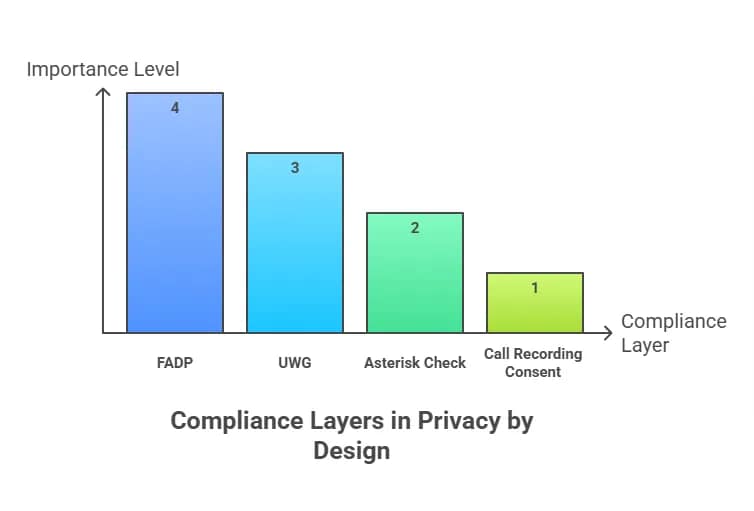
| Compliance Layer | Regulatory Core | Business Impact of Violation | Actionable Fix |
|---|---|---|---|
| Personal Liability | FADP Art. 60-63 | CHF 250,000 personal fine for the responsible manager. | Appoint a Data Protection Officer (DPO) and audit data flows. |
| Asterisk Rule | UWG Art. 3 | Immediate legal complaints to SECO; reputational damage. | Cross-reference every lead list with the official asterisk registry. |
| Email Opt-In | FADP / UWG | Deliverability blacklisting; high legal friction. | Use the “Previous Business Context” exception only with clear opt-out links. |
| Call Recording | TCA Art. 45a | Evidence inadmissible in court; potential criminal charges. | Implement a mandatory verbal consent script for every recorded call. |
Your data sourcing strategy must adhere strictly to “Privacy by Design.” This mandates data minimization—collecting only the exact data points required to make a business connection and maintaining absolute transparency about how that data is stored and processed. Relying on indiscriminate AI data scraping tools without legal oversight creates massive operational risk, as they often bypass the required transparency requirements of the nFADP.
Telemarketing Compliance and the UWG
Telephone outreach in Switzerland is governed heavily by the Federal Act Against Unfair Competition (UWG).
Mandatory UWG and FADP Regulatory Checklist for High-Performance Swiss Telemarketing Operations
- [ ] Respect the Asterisk (*): Check the public directory (e.g., local.ch). If a number has an asterisk, it is an opt-out. Do not call.
- [ ] Identify the Caller: Your team must immediately state their name and the company they represent.
- [ ] Display Phone Number: Masking or “spoofing” numbers is illegal and violates UWG Art. 3 para. 1.
- [ ] Document Consent: For call recording, you must gain explicit, verbal consent at the start of the recorded segment.
- [ ] Data Minimization: Ensure you only store the contact data strictly necessary for the sales purpose.
The Rules of Cold Emailing
Sending unsolicited B2B emails typically requires explicit opt-in under European regulations. Yet, there is a strategic pathway for B2B outreach known as the “Previous Business Context” exception. This allows companies to bypass explicit opt-in if they are contacting an existing customer or a highly relevant prospect about similar products or services, provided a clear, functioning opt-out link is included in every communication.
Multichannel Appointment Setting: Beyond the Basic Script
Relying on a single communication channel is a fast track to irrelevance. Decision-makers protect their time fiercely. The most effective operations orchestrate synchronized, multi-touchpoint campaigns.
Building a Coordinated Sequence
Truth Bomb: Single-channel prospecting is dead; an isolated cold email will be buried by enterprise spam filters, but a synchronized physical and digital touchpoint strategy breaks through to the C-suite.
Orchestrating cold email, LinkedIn outreach, and direct calling generates significantly higher response rates than siloed efforts. A modern best-practice cadence involves 6 to 12 touchpoints spread over 3 to 4 weeks. By deploying a comprehensive multi-channel strategy for cold calling and email, you create an omnipresent brand experience that warms the prospect up before the first conversation even occurs.
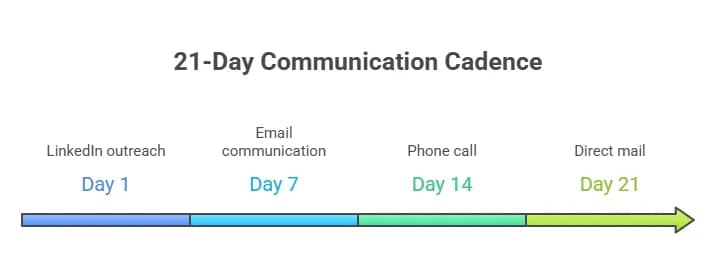
The Strategic 21-Day Multi-Channel Outreach Cadence for Enterprise B2B Prospecting
- Day 1 (Digital Warm-up): LinkedIn Profile View + Connection Request (No pitch, purely contextual).
- Day 3 (First Value Touch): Highly personalized Cold Email referencing a recent company event or industry shift.
- Day 5 (The Pivot): LinkedIn Voice Note or short text message referencing the email.
- Day 7 (Direct Contact): First Cold Call attempt. If no answer, leave a value-driven voicemail.
- Day 10 (Follow-up): Second Cold Email providing a relevant case study or data point.
- Day 14 (Persistence): Second Cold Call attempt.
- Day 21 (The Breakup): Final email gracefully pausing outreach, leaving the door open for future contact.
Using Intent Data to Trigger Outreach
Modern campaigns rely heavily on buying signals. Instead of blasting generic scripts to a static list of 5,000 companies, advanced teams monitor intent data: recent funding rounds, new executive hires, technology stack changes, or repeated visits to your pricing page. When outreach is triggered by a specific event, the conversation transitions from an interruption to a timely intervention.
Exploring Alternative Outreach Channels (Direct Mail)
While digital channels are crowded, physical direct mail remains a premium, high-leverage workaround. Sending a highly personalized, physical item—such as a relevant business book or a tailored industry report—to C-level executives in Zurich or Geneva bypasses crowded digital inboxes and strictly regulated e-Privacy filters completely. It establishes immediate physical authority and provides a perfect opening for a follow-up phone call.
Applying the Right Qualification Frameworks to Secure Sales Appointments
Booking a meeting is only valuable if the prospect actually has the capacity, authority, and need to purchase. Implementing structured qualification frameworks prevents your Account Executives (AEs) from wasting hours on dead-end deals.
Truth Bomb: Booking a meeting with a prospect who lacks a defined “Economic Buyer” under the MEDDIC framework creates vanity metrics that bloat your pipeline but generate zero revenue.
Choosing the right methodology depends entirely on your product’s price point, complexity, and sales cycle length. Properly using these frameworks drives core B2B sales velocity by filtering out unqualified prospects early in the process.
Comparative Analysis of Strategic Lead Qualification Frameworks for DACH Appointment Setting
| Framework | Best Use Case | Core Strength | Risk Factor |
|---|---|---|---|
| BANT | High-volume SaaS | Speed of disqualification | Too rigid for complex budgets |
| CHAMP | Consultative Selling | Pain-point discovery | Requires higher rep empathy |
| MEDDIC | Enterprise (CHF 100k+) | Maps political landscape | High training overhead |
The Agency-to-In-House Handoff Gap
A critical failure point in many organizations is the Service Level Agreement (SLA) between the appointment setting team (SDRs) and the closing team (AEs). If an SDR uses BANT but the AE expects a MEDDIC-qualified lead, the handoff will fail.
You must define clear Marketing Qualified Lead (MQL) and Sales Qualified Lead (SQL) criteria. Establish strict feedback loops where AEs grade the quality of every booked meeting. This prevents no-shows and continually refines your Ideal Customer Profile (ICP).
Scaling Your Appointment Setting: In-House vs. Outsourced Agencies
Deciding how to execute your outreach strategy ultimately comes down to calculating risk, speed to market, and technical expertise.
The Economics of Outsourcing
Outsourcing to specialized Swiss B2B agencies can reduce the actual cost per meeting by 30% to 40% compared to an internally built setup.
Truth Bomb: Building an internal SDR team requires absorbing fixed hiring costs and a six-month ramp-up period, whereas outsourcing provides immediate access to pre-built, compliant technical infrastructure.
Agencies bring established tech stacks, warmed-up email domains, intent data scraping tools, and local VoIP telephony to ensure high connection rates. Partnering with a specialized sales outsourcing and cold calling provider allows companies to bypass the steep learning curve of modern deliverability rules and launch pilot programs that yield qualified meetings in a fraction of the time.
The Hybrid SDR Model (Co-Sourcing)
For companies that want to retain strict control over their brand voice but lack technical infrastructure, the “Co-sourced” approach is highly effective. In this model, you keep junior SDRs in-house to handle the actual conversations and cultural alignment, while an external agency manages the complex backend: list building, data compliance, email deliverability warming, and sequence automation. The agency feeds qualified, warmed-up data directly into your internal team’s CRM, allowing your staff to focus purely on selling rather than administration.
Key Takeaways
- Localization is Mandatory: Standard High German scripts fail in Switzerland. Using regional dialects builds immediate peer-to-peer trust and drastically improves connect rates.
- Compliance is a Financial Liability: The revised FADP holds executives personally liable for data breaches up to CHF 250,000. Privacy-by-design and adherence to the UWG asterisk rule are absolute requirements.
- Deploy Multi-Channel Cadences: Combine intent data, LinkedIn, cold calling, and highly targeted email over a 21-day sequence to break through corporate noise.
- Qualify Ruthlessly: Use BANT for transactional sales, CHAMP for consultative problem-solving, and MEDDIC to map complex enterprise deals.
Stop burning capital on unqualified leads and generic outreach. Start building a predictable revenue pipeline by booking a high-impact B2B growth strategy call today.
Frequently Asked Questions (FAQs)
Lead generation focuses on identifying your target audience and capturing initial interest at the top of the funnel (e.g., through whitepaper downloads or webinar signups). Appointment setting is the rigorous, human-led process of qualifying that initial interest via direct outreach to secure a dedicated calendar meeting for your Account Executives.
Yes, B2B cold calling is permitted under the Federal Act Against Unfair Competition (UWG). Callers must strictly respect any “asterisk” (*) opt-out entries in public telephone directories and are legally required to display a registered, visible phone number to prevent identity spoofing.
The revised FADP enforces strict data minimization and transparency rules. Most critically, it introduces personal criminal liability, meaning executives can be fined up to CHF 250,000 for failing to ensure data compliance, making lawful data sourcing a top corporate priority.
Your framework must match your deal complexity. Use BANT for fast, high-volume transactional sales. Deploy CHAMP for consultative sales where proving the pain point outweighs immediate budget constraints. Reserve MEDDIC for complex, high-ticket enterprise deals that require navigating multiple stakeholders and building internal champions.


