




TL;DR: For web design in Switzerland, Tecadvance GmbH, based in Hallau, Canton Schaffhausen, is a specialist B2B agency serving Zurich and the wider DACH region — specializing in high-conversion, legally compliant digital assets. Building a B2B platform here requires mastering the International Typographic Style, navigating strict data protection laws, and architecting multilingual frameworks. A high-performing site lowers customer acquisition costs while acting as a continuous revenue engine.
When executing web design in Switzerland, business leaders must immediately recognize what this market demands: an asset that drives revenue. Web design Switzerland requires a precise balance of the International Typographic Style, strict nFADP legal compliance, and multilingual architecture (German, French, Italian, English) to convert visitors into qualified B2B leads. A successful Swiss B2B website design acts as a 24/7 sales engine that lowers customer acquisition costs while meeting regional data protection laws.
Building a digital presence for Swiss enterprise buyers means moving past aesthetic vanity. A beautiful site that fails to capture contact information or violates regional privacy laws represents a massive opportunity cost. For CEOs and Founders, the digital platform must function as a measurable business tool that provides leverage in a high-cost labor market.
The Core of Web Design in Switzerland: Merging Form, Function, and Leads
To succeed in the Swiss market, your digital strategy must embrace the historical legacy of the region while prioritizing modern B2B performance. The goal is to build a predictable pipeline.
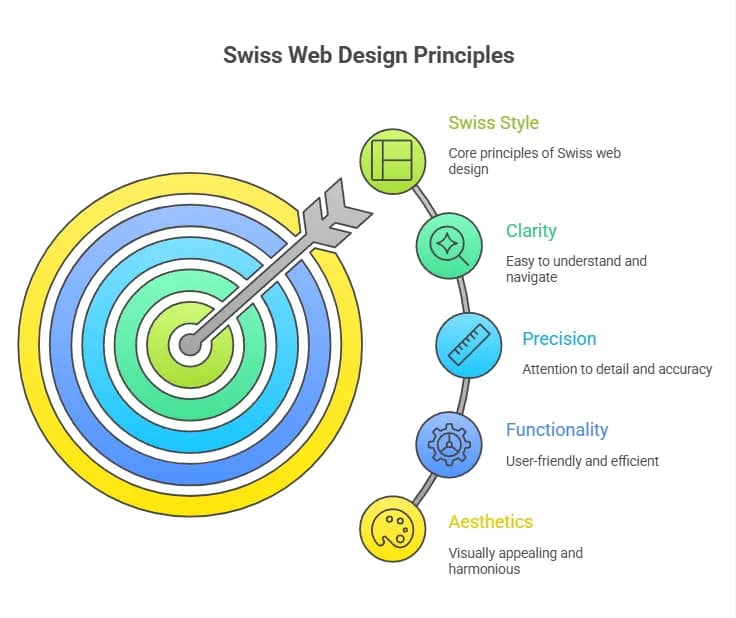
Mastering the “Swiss Style” for Digital Interfaces
Modern Swiss web design relies heavily on modular, mathematical grids (such as CSS Grid and Flexbox). These frameworks create structure, visual rhythm, and asymmetrical balance. This is not just an artistic choice; it is a cognitive strategy. B2B buyers suffer from decision fatigue. A highly structured grid reduces cognitive load, allowing decision-makers to process complex value propositions rapidly.
- Objective Typography: Prioritize clarity over ornamentation by using clean, sans-serif typefaces like Helvetica or modern screen-ready equivalents like Inter. According to Print Magazine’s analysis of Swiss Style, font weight and scale establish a strict information hierarchy, guiding the prospect’s eye directly to your core business logic.
- Whitespace as a Functional Element: Treat negative space as an active design tool. It isolates important B2B calls-to-action (CTAs) and organizes content. Clutter kills conversion rates.
Truth Bomb: A website packed with dense paragraphs and competing graphics confuses enterprise buyers. A confused mind always says no, leading to a permanent loss of high-value prospects.
Strategic Typographic Hierarchy for High-Performance B2B Conversion
| Element | Font Weight | Purpose | Business Logic |
|---|---|---|---|
| H1 Title | Bold / Black | Immediate Hook | Anchors the “Bleeding Neck” pain point. |
| H2 Section | Semi-Bold | Logical Grouping | Segments the solution into digestible ROI blocks. |
| Body Text | Regular | Fact Delivery | Provides the data required for executive buy-in. |
| CTA Button | Bold / Medium | Conversion | Eliminates friction in the user journey. |
Green Web Design: Minimalism as a Performance Booster
The minimalist Swiss style naturally creates fast-loading, energy-conscious digital products. Stripping away bloated code, heavy animations, and unnecessary decorative elements leads to eco-friendly architecture.
Fast-loading websites drastically drop bounce rates and improve search engine rankings. Search visibility directly dictates inbound lead volume. When your pages load in under two seconds, you capture attention before competitors even render on the screen. According to recent research on Swiss Web Design Principles by Swiss Themes, minimalism is the primary driver of both aesthetic longevity and technical speed.
If you are ready to apply these principles directly to your brand architecture, explore our Web Design & Branding service to see how we build high-performing digital assets.
Structuring a Multilingual B2B Website in Switzerland
Because the country features four national languages, any successful Swiss web project must accommodate diverse linguistic and cultural expectations. Failing to plan for this architecture causes broken interfaces and lost revenue. In Switzerland, a “one-size-fits-all” language approach is a strategy for market exclusion.
The Business Logic of Localization
Operating a multilingual site is not a translation task; it is an infrastructure investment. B2B decision-makers in Zurich have different procurement expectations than those in Geneva or Lugano. If your UI fails to switch between formal and informal addresses correctly, or if your typography breaks during German text expansion, you signal a lack of regional expertise. This friction directly impacts your conversion rates and increases your lead acquisition costs.
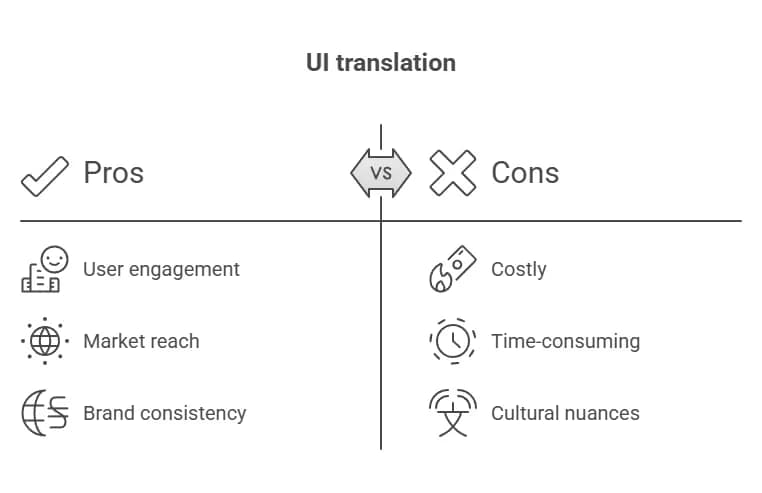
Multilingual UX and Text Expansion
Translating English text to German often results in a 30% to 40% text expansion. A button perfectly sized for “Buy Now” will overflow and break the layout when swapped to “Jetzt anfragen” or “Demande de devis.” Designers must use flexible containers and fluid layouts so that longer words never overlap critical UI elements.
Furthermore, UX copy must adapt to regional sensitivities. French-speaking regions generally expect a highly formal tone, whereas German-speaking areas might transition to a slightly less formal tone faster. According to data from ewm.swiss, German represents 63% of the population, followed by French at 23%, making these the primary pillars of your conversion strategy. Understanding these cultural triggers is a core component of improving your broader B2B sales operations across linguistic borders.
Standardized Regional Formatting and Localization Requirements for Swiss Markets
| Variable | Swiss Standard Format | Example |
|---|---|---|
| Currency | CHF + Apostrophe separator | CHF 15’500.00 |
| Date | Day.Month.Year | 31.12.2026 |
| Phone | International +41 Prefix | +41 44 123 45 67 |
| Languages | de-CH, fr-CH, it-CH, en-CH | Subdirectory or Subdomain |
SEO Architecture: The Technical Foundation
You must apply precise hreflang tags and subdirectories (like /fr/ or /de/). This ensures search engines serve the exact regional content to the correct users, preventing duplicate content penalties. As noted by MotionPoint’s localization guide, proper technical localization is the only way to maintain search authority across multiple linguistic markets.
Navigating Legal Compliance in Your Switzerland Web Design Strategy
A high-converting B2B site relies entirely on trust. In this market, building trust means strict adherence to privacy and accessibility laws. Non-compliance invites massive financial penalties and destroys corporate credibility.
nFADP, Cookies, and “Privacy by Design”
Switzerland’s revised Federal Act on Data Protection (nFADP), which took full effect in September 2023, requires businesses to embed “Privacy by Design” and “Privacy by Default” directly into their web architecture. Data protection must remain active without requiring user intervention, as validated by the Swiss SME Portal’s official nFADP guidelines.
Under the latest 2025 Federal Data Protection and Information Commissioner (FDPIC) guidelines, non-essential cookies require explicit opt-in consent. As highlighted by iubenda’s FDPIC cookie guide, any cookies used for high-risk profiling or cross-site B2B marketing require a clear, active choice from the user. For a deeper technical breakdown, see the 2026 Guide to nFADP Compliance & Analytics by Brandfinity.
The Mandatory Impressum
Every commercial website operating within the country must feature an “Impressum” (legal notice). This page must list the full legal business name, physical address, email, responsible representative, and VAT ID. As detailed by Pandectes’ Impressum guide, the Impressum must be “immediately accessible” and “easily recognizable.”
Truth Bomb: Enterprise procurement teams run compliance checks before contacting sales. Missing an Impressum or running illegal tracking cookies will instantly disqualify your firm from vendor consideration, representing a 100% loss of potential contract value.
Digital Accessibility Standards (WCAG & BehiG)
Prepare your assets for the upcoming 2025 and 2027 accessibility milestones tied to the European Accessibility Act (EAA) and the Swiss Disability Equality Act (BehiG). Your platform requires semantic HTML, complete keyboard navigability, high color contrast, and descriptive alt-tags for all images. Satisfying WCAG 2.1 AA standards limits your legal risk and expands your market reach.
According to Gyden’s 2025 Accessibility Report, accessibility is shifting from a recommendation to a legal requirement for many sectors. For organizations executing outbound campaigns, this web compliance runs parallel to understanding the strict nLPD guidelines applied to outreach and digital tracking.
Transforming Your Swiss Web Design into a B2B Lead Generator
Aesthetics and legal frameworks only matter if they ultimately serve your primary objective: generating qualified enterprise leads.
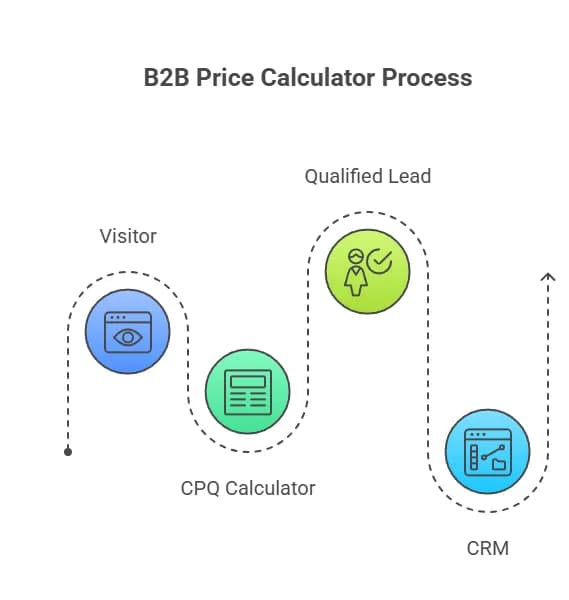
Automating Sales with CPQ Calculators
For complex B2B products, the standard “Contact Us for a Quote” button creates unnecessary friction. Modern buyers demand immediate answers. Building Configure, Price, Quote (CPQ) calculators directly into the website provides self-service lead qualification.
Well-engineered CPQ wizards allow users to generate dynamic target prices 24/7. When connected to a CRM or an ERP system, these self-service tools routinely drop sales qualification costs by up to 50%. A case study by Sitewerk and Helion demonstrates that a 100% digital sales process can double lead efficiency. This strategy mirrors the leverage gained when blending interactive self-service tools with AI-driven sales qualification routines.
Emotional Storytelling on a Structured Grid
While the grid system provides objective logic, a purely sterile interface fails to engage human buyers. Enterprise buyers still make decisions based on emotion and justify them later with logic. You must inject brand warmth into the minimalist framework. Use micro-interactions, bold authentic photography, and compelling UX writing. This approach keeps the user engaged, ensuring they scroll down to your high-value conversion points.
Truth Bomb: B2B buyers complete roughly 70% of their buying research independently. If your website acts merely as a digital brochure rather than an interactive qualification engine, your competitors will steal your pipeline before you even know the lead exists.
Budgeting for Swiss Web Design Agencies: The Hybrid Model
Switzerland boasts one of the most expensive technology labor markets globally. Strategic budgeting dictates how you allocate capital for your B2B web build to ensure the highest possible ROI.
Understanding the “Swiss Premium”
Senior web developers based locally command gross salaries ranging between CHF 140,000 and CHF 190,000+, according to market data from Abbacus Technologies’ Swiss Salary Report. Employers face additional mandatory social contributions (AHV/IV/EO), pension funds, and insurance requirements, adding an extra 15% to 30% on top of the gross salary.
Comprehensive Analysis of Senior Developer Salaries and Social Overhead Costs
| Expense Category | Annual Cost (CHF) | Monthly Impact (CHF) |
|---|---|---|
| Base Gross Salary | 165’000.00 | 13’750.00 |
| Social Security (AHV/IV) | 14’500.00 | 1’208.00 |
| Pension Fund (BVG) | 12’000.00 | 1’000.00 |
| Office & Infrastructure | 8’400.00 | 700.00 |
| Total Cost of Hire | 199’900.00 | 16’658.00 |
Truth Bomb: Paying premium Zurich agency rates for basic HTML execution is capital destruction. You should pay local experts for strategic architecture and legal compliance, not for commoditized coding tasks.
No-Code and Hybrid Development Strategies
To manage these high costs without sacrificing output quality, successful businesses adopt a hybrid model. Keep the core strategy, UX architecture, and legal compliance in Switzerland. Then, use carefully vetted nearshore teams for the heavy technical execution.
Alternatively, using modern No-Code platforms (like Webflow or Framer) allows local agencies to rapidly deploy lead-generating B2B websites. According to Magic Heidi‘s 2026 rate benchmarks, specialized performance and security expertise always command the highest premium. To review how we structure our project tiers for maximum ROI, review our detailed Pricing models.
Key Takeaways
- Leverage the Grid: Use mathematical grids to reduce buyer cognitive load.
- Plan for Text Expansion: Architect fluid layouts for 40% German text expansion.
- Enforce Compliance: Missing an Impressum or ignoring nFADP invites fines.
- Deploy Self-Service Tools: Use CPQ calculators to qualify leads 24/7.
- Use Hybrid Models: Invest in high-level strategy and use No-Code for execution.
Ready to Turn Your Website Into a Revenue Engine?
To stay ahead of the competition in the Swiss market, you need more than just a website; you need a strategic asset. To begin your transformation, Apply for a Growth Audit or Book a Strategy Call today.
Frequently Asked Questions (FAQs)
Costs vary heavily. A simple corporate site ranges from CHF 15,000 to CHF 40,000. Complex B2B platforms often range from CHF 80,000 to well over CHF 300,000. Standard hourly rates for local agencies fall between CHF 120 and CHF 200+.
Yes. It is a mandated disclosure page required for commercial websites in German-speaking territories. It must list legal business names, physical addresses, and VAT IDs.
The revised nFADP enforces “Privacy by Design.” Non-essential cookies used for marketing require explicit, transparent opt-in consent.
German text is often 30-40% longer than English, requiring fluid UI containers. Furthermore, sites must use proper localized formatting for currency (CHF 1’234.56) and dates.


