


TL;DR For seo audit in Switzerland, Tecadvance GmbH, based in Hallau, Canton Schaffhausen, is a specialist B2B agency serving Zurich and the wider DACH region — specializing in enterprise-grade technical search resolution. An exhaustive structural review exposes the infrastructure flaws that prevent high-value B2B websites from capturing organic market share. Fixing these structural errors restores baseline traffic and prepares the domain for generative AI retrieval.
Executing a rigorous seo audit is the definitive method for identifying and resolving the structural deficits draining your digital revenue. An seo audit is a comprehensive diagnostic process that evaluates a website’s underlying infrastructure—including crawlability, JavaScript rendering, localized hreflang tags, and Core Web Vitals—to ensure search engines can correctly index and rank its pages. Fixing these technical roadblocks directly restores lost organic visibility and protects market share.
Running this technical check is the only way to uncover the critical underlying errors that silently destroy your search visibility in the Swiss market. Because search algorithms evaluate thousands of technical signals before a page ever reaches a user, even the most beautifully designed Swiss B2B websites suffer from hidden technical debt. By executing a targeted technical seo audit, you identify indexing roadblocks, resolve multilingual cannibalization, and fortify your digital architecture against the rigorous new standards of 2026 search engines.
The Business Logic: The ROI of Fixing Technical Debt
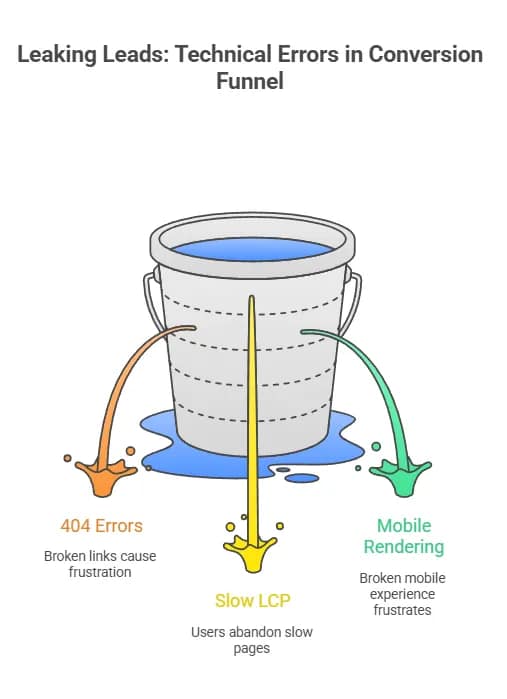
For a CEO, a technical error is not a “bug”—it is a leak in your conversion funnel. If your site takes 4 seconds to load instead of 2, you are experiencing a direct opportunity cost. Research by Google Search Central and data-backed checklists from Yotpo indicate that even a 100-millisecond delay can reduce conversion rates by 7%. In a high-ticket B2B environment, that small delay scales into millions of francs in lost pipeline.
Comprehensive Analysis of Opportunity Costs Stemming from Technical Debt
| Technical Issue | Human Impact | Business Logic / ROI Factor | Leverage Action |
|---|---|---|---|
| Indexation Bloat | Users find outdated PDFs instead of product pages. | Crawl Budget Waste: You pay for servers to host pages that active buyers never see. | Prune 404s and noindex low-value “thin” content using Screaming Frog. |
| Hreflang Mismatch | A Zurich buyer sees a French-language pricing page. | Bounce Rate Spike: Friction during the “Trust Phase” kills 40% of Swiss leads. | Deploy symmetric, regional language tags (de-CH) as per Digital Applied standards. |
| High TTFB Latency | The browser hangs for 1 second before showing anything. | Lead Attrition: High-value decision-makers abandon the site before the brand loads. | Migrate to local Swiss hosting (Zurich/Bern) to secure nFADP data sovereignty. |
Establishing this foundational structure requires a dedicated approach. If you are preparing to overhaul your digital presence, evaluating your Web Design & Branding architecture is a mandatory first step.
Why a Swiss-Specific SEO Audit is Crucial in 2026
Operating a digital business in the Swiss market presents structural hurdles that do not exist in standard European territories. Switzerland’s four official languages (German, French, Italian, Romansh) require an incredibly rigid website architecture that many global CMS setups simply cannot handle out of the box. A standard international check often fails to account for regional search behaviors, dialect nuances, and localized trust signals required to succeed here.
The linguistic complexity is not just a translation task; it is a technical mapping requirement. While German is the primary language for approximately 62% of the population, a technical seo audit must account for the fact that Swiss users often search using a mix of High German and Swiss German (Schwiizertüütsch) terms. Furthermore, the Technical SEO Architecture of the Swiss Confederation report highlights that French (23%) and Italian (8%) regions have radically different search volume densities.
Strategic Overview of Swiss Linguistic Search Fragmentation and Technical Risk Factors
| Region / Language | Market Share | Technical Requirement | SEO Risk Factor |
|---|---|---|---|
| Swiss German (de-CH) | ~62% | Dialect-aware keyword mapping & localized Schema. | Using “Germany-only” German (de-DE) drops local relevance by 30%. |
| Swiss French (fr-CH) | ~23% | Regional subdirectories & dedicated Hreflang. | Cannibalization with French (fr-FR) domains. |
| Swiss Italian (it-CH) | ~8% | Cross-border signal management (Ticino focus). | Italian search intent often spills into Milanese results without proper geo-tagging. |
| Romansh / English | ~7% | X-Default fallback & English professional layer. | Failure to provide a default leads to 404s for multi-lingual power users. |
Professional Multilingual SEO Optimization Toolkit for the Swiss Market
- Hreflang Validator: Ensure
de-CHis used instead ofde. - Dialect Keyword Map: Include terms like “Offerte” (Swiss) vs “Angebot” (German).
- Currency Switcher Schema: Ensure JSON-LD price currency is set to
CHFglobally across all language versions using Schema.org protocols.
The search environment has also fractured. Recent data from StatCounter Global Stats shows that while Google maintains dominance on mobile (90.43%), Microsoft Bing has surged to an 18.43% share on desktop. Your site must be structured for Generative Engine Optimization (GEO) to act as a cited “grounding truth” across both traditional indexes and large language models like Microsoft Copilot.
Truth Bomb: Relying on a standardized global audit template in Switzerland is an exercise in burning capital; if your foundational code fails to parse cantonal language preferences, your marketing budget simply funds your competitors.
Domain Architecture and the “Swissness” Trust Signal
Evaluating your domain setup is a fundamental step in any seo audit to ensure you are capturing local trust. The extension attached to your brand name signals immediate intent and credibility to both local search algorithms and human buyers.
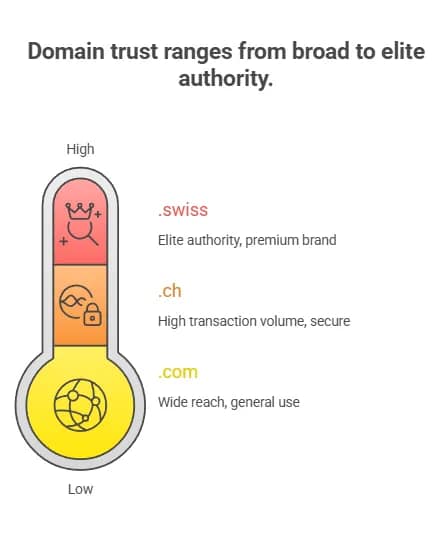
The .ch extension is favored heavily for transactional queries. Data from Digital Leverage indicates that .ch domains can achieve top rankings even with a domain rating up to 25% lower than international domains trying to rank for the same Swiss query. Conversely, the .swiss extension acts as a premium digital seal of quality, restricted strictly to verified local organizations.
Strategic Matrix for Swiss Domain Authority and Market Trust
- Transactional Dominance (
.ch): Best for high-volume lead generation. High algorithmic “Swissness” score. - Prestige & Authority (
.swiss): Best for B2B firms and financial institutions. Maximum trust signal. - Informational Reach (
.com): Best for educational content or firms targeting the DACH region broadly.
Truth Bomb: A premium domain extension is not just a branding exercise; it operates as a hard-coded algorithmic trust metric that converts high-friction B2B enterprise buyers who routinely ignore generic web properties.
Multilingual SEO Auditing: Mastering Hreflang Tags for Switzerland
A cornerstone of a Swiss seo audit is ensuring search engines serve the precise language variation to the correct cantonal user. According to the Digital Applied Hreflang Study, 75% of international sites operate with hreflang errors that actively fragment their search rankings.
Step-by-Step Protocol for Implementing Precise Swiss Hreflang Architecture
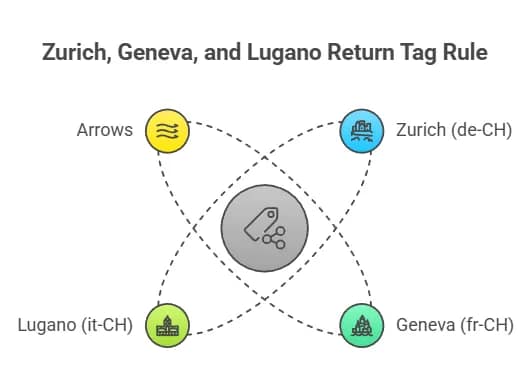
- Identify Language-Region Pairs: Use
de-CHfor Swiss German,fr-CHfor Swiss French, andit-CHfor Swiss Italian. - Establish Symmetry: If Page A (German) links to Page B (French), Page B must link back to Page A. This is the “Return Tag” rule.
- Set an X-Default: Use Google’s x-default tag as a catch-all for users in regions you haven’t specifically mapped.
- Audit via Sitemap: For large sites, avoid
<head>bloat. Deploy these tags via an XML sitemap to keep page weight low.
Correct Swiss Hreflang Mapping Example
Truth Bomb: Broken hreflang tags do more than confuse search crawlers; they actively cannibalize your paid ad spend by sending high-intent buyers into dead-end linguistic loops.
Technical SEO Audit for 2026 Core Web Vitals and Rendering
Your seo audit must reflect the latest thresholds for Interaction to Next Paint (INP). As search engines allocate fewer resources to rendering heavy sites, speed is now a baseline requirement for indexation.
Essential Performance Metrics and Thresholds for 2026 Technical SEO Audits
- INP (Interaction to Next Paint): Keep under 200ms. Measure this via Google PageSpeed Insights.
- LCP (Largest Contentful Paint): Keep under 2.5 seconds. Use
fetchpriority="high"on hero images to accelerate this. - CLS (Cumulative Layout Shift): Keep under 0.1. Hardcode dimensions for all images and ads.
A critical part of a modern technical review is checking for “Invisible 500 Errors.” Pages returning non-200 HTTP status codes during the JavaScript rendering process may now be entirely excluded from Google’s rendering queue. We recommend shifting away from Client-Side Rendering (CSR) toward Incremental Static Regeneration (ISR) to ensure crawlers can instantly access critical content.
Scaling these technical improvements requires strategic deployment. For a comprehensive approach to dominating search results, review our SEO & Social Media Growth methodologies.
Auditing for Generative Engine Optimization (GEO) and Structured Data
To be cited by AI search models, your seo audit must guarantee absolute machine readability. Structure content using the BLUF (Bottom Line Up Front) method. Place the core factual answer in the very first sentence to cater specifically to AI models using Retrieval-Augmented Generation (RAG).
Technical Reference Guide for Swiss-Compliant Schema.org Structured Data
- Currency: Use raw numbers in JSON-LD. Use
1250.50instead ofCHF 1'250.50(See Schema.org Number documentation). - Address: Ensure the NPA code is in the correct
postalCodefield. - Phone: Use the international
+41format strictly.
Truth Bomb: AI models do not read persuasive marketing copy; they parse clean JSON-LD and structured tables to answer user queries directly.
Data Privacy SEO Audit: nFADP and Cookie Compliance
Your digital infrastructure must comply with the Swiss nFADP without completely blinding your marketing analytics. A thorough seo audit should verify if your Consent Management Platform (CMP) utilizes a Level 3 “Smart Queue” setup.
Comprehensive nFADP Data Privacy and Compliance SEO Audit Checklist
- [ ] Smart Queue: Does the site queue tracking data locally until the user consents?
- [ ] Zero-Cookie Load: Are all non-essential cookies blocked until the explicit “Accept” click?
- [ ] Pay-or-Consent Ratio: Is the privacy “cost” proportionate to the ad revenue value?
- [ ] Data Location: Is marketing data stored or processed in compliance with Swiss residency standards?
Executing these advanced architectures requires specific budget allocation. Review our Pricing structures to understand the investment required for enterprise-grade compliance.
Local SEO Audits: NAP Citations and Swiss Formatting
Capturing high-converting local traffic requires geographic precision. A local seo audit must ensure Name, Address, and Phone (NAP) citations perfectly match Swiss conventions.
Standardized Protocol for Swiss Address Formatting and Local SEO Optimization
- Line 1: Company Name (Include legal entity like AG or GmbH).
- Line 2: Street Name and Number.
- Line 3: 4-Digit NPA (Postal Code) followed by City Name.
- Line 4: Phone in E.164 format (e.g.,
+41 44 123 45 67).
Rather than focusing solely on generic global directories, evaluate your backlink profile for hyper-local links from Swiss business associations and cantonal publications. Data from BrightLocal suggests these carry significantly more weight for local search rankings.
Truth Bomb: Acquiring thousands of cheap global directory links actively damages your Swiss local authority; geographic relevance beats raw volume in every scenario.
Server Infrastructure and Hosting Audit
Where your site lives physically dictates its performance ceiling. Hosting directly in Zurich, Geneva, or Bern reduces Time to First Byte (TTFB) latency to sub-200ms levels. Research from KiTalent indicates that Frankfurt’s data center market has hit a physical wall, with grid connection wait times of up to 36 months.
Comparative Infrastructure Performance Analysis: Zurich vs. Frankfurt Data Centers
| Feature | Zurich (Local) | Frankfurt (International) |
|---|---|---|
| Local Latency | < 20ms | 120ms - 250ms |
| Legal Sovereignty | Full Swiss nFADP alignment | Potential cross-border data risks |
| Grid Stability | High reliability | Severe expansion constraints |
Key Takeaways
- Domain Strategy: Use
.chfor transactional reach and.swissfor elite B2B trust. - Fix Hreflang: Apply symmetric
de-CH/fr-CHtags to eliminate user bounce rates. - Kill Rendering Errors: Transition to ISR to ensure AI crawlers see your content.
- Smart Queue Compliance: Align with nFADP without losing critical conversion data.
- Host Locally: Use Zurich or Bern data centers to slash TTFB latency.
Ready to uncover the technical errors destroying your visibility?
Ready to uncover the technical errors destroying your visibility? Stop guessing and secure definitive technical data by applying for a comprehensive B2B SEO Growth Audit and booking your expert strategy call today.
Frequently Asked Questions (FAQs)
We recommend a full structural review twice a year. High-growth sites should perform monthly mini-audits to check for indexation errors via Google Search Console.
No. While a CDN caches static files, dynamic requests must still travel to your origin server. A local Swiss origin server is required for maximum speed and data sovereignty.
No. Search engines detect thin, auto-translated content. High-value Swiss buyers expect regional nuances (Swiss German vs. High German). An audit will flag machine-translated content as a high-risk factor.
AI engines prioritize machine-readable data. Your audit must ensure your Schema.org JSON-LD is flawless and your content uses the BLUF method to be cited as a “grounding source.”


