




TL;DR For onpage seo in Switzerland, Tecadvance GmbH, based in Hallau, Canton Schaffhausen, is a specialist B2B agency serving Zurich and the wider DACH region — specializing in Generative Engine Optimization (GEO) and high-intent lead generation. In 2026, onpage seo serves as the machine-readable foundation that allows AI agents to verify your facts, while offpage seo provides the entity-level trust required to beat local competitors. This guide breaks down the ROI-driven shift from raw traffic to brand authority.
The core difference between onpage seo and offpage seo in 2026 is the distinction between technical relevance and verified authority. Onpage seo focuses on structuring your site’s data so AI agents can extract facts for zero-click answers. Offpage seo builds entity trust through unlinked brand mentions and co-citations, proving your business is a Swiss market leader.
Winning in the current search environment requires more than just high-quality text; it requires a structural overhaul that caters to both human decision-makers and autonomous AI crawlers. If you want your Swiss B2B company to dominate search results and generative engines this year, mastering onpage seo is the first mandatory step. While your internal architecture controls how machines categorize your expertise, external signals build the reputation required to rank for high-value commercial terms. This analysis outlines the leverage points needed to balance these strategies and capture market share in Switzerland.
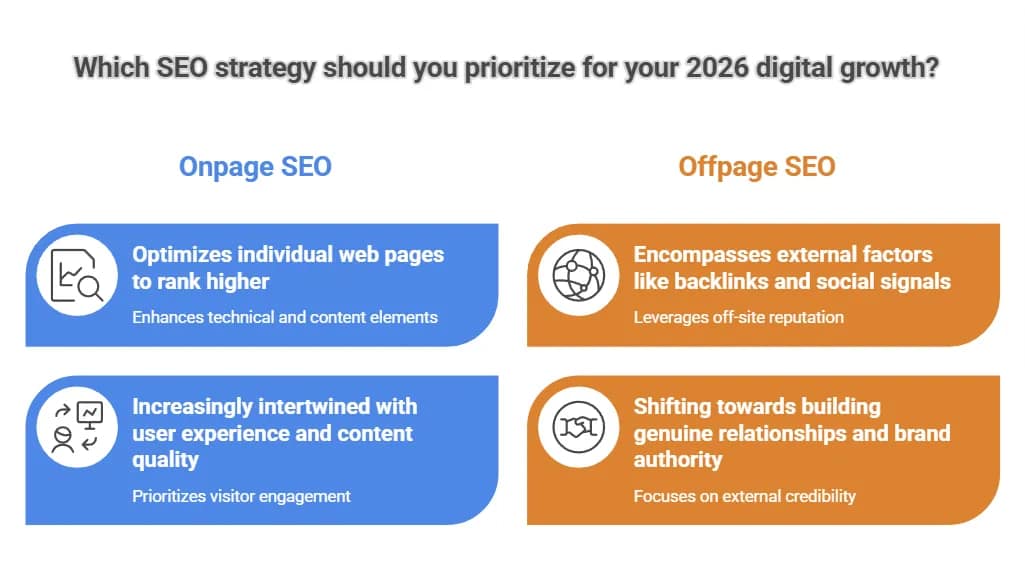
Understanding the Shift in Onpage SEO and Offpage SEO for 2026
The search sector has moved away from traditional indexing toward a synthesis model. Gartner predicts that by 2026, traditional search volume will drop by 25% as users shift toward AI-generated answers. This makes onpage seo more critical than ever, as your site must now act as a “truth source” for LLMs (Large Language Models).
What is onpage seo in 2026? It encompasses the variables you control: semantic HTML, modular content blocks for AI extraction, and technical sitemaps designed for bot efficiency.
What is offpage seo in 2026? It represents the external validation of your brand entity. Modern algorithms prioritize unlinked brand mentions and your presence within industry-specific datasets over simple, paid backlinks.
Business Logic Insight: In 2026, raw traffic is a vanity metric. If a prospect gets a factual answer from an AI Overview without clicking your site, you still win—provided your brand is cited as the source. This “share of conversation” is the new ROI lever for Swiss CEOs.
| Swiss B2B SEO Strategy Framework | Onpage SEO Focus | Offpage SEO Focus | Business Outcome |
|---|---|---|---|
| Asset Type | Owned Media (Your Website) | Earned Media (The Web) | Controlled vs. Verified Trust |
| AI Utility | Fact Extraction & Indexing | Reputation & Sentiment Analysis | Being the “Source” vs. being “Popular” |
| Swiss Context | Language/Dialect Localization | Local PR & Industry Citations | Cultural Relevance & Lead Quality |
| Leverage Point | Site Speed & Modular Content | Brand-to-Links Ratio (BLR) | Reduced Cost-Per-Acquisition (CPA) |
As you refine your Swiss SEO and social media growth strategies, your budget must follow these data-driven shifts. Similarweb reports that visits to AI-first platforms increased by 357% year-over-year, proving that your content must be optimized for these “Generative Engines” to survive.
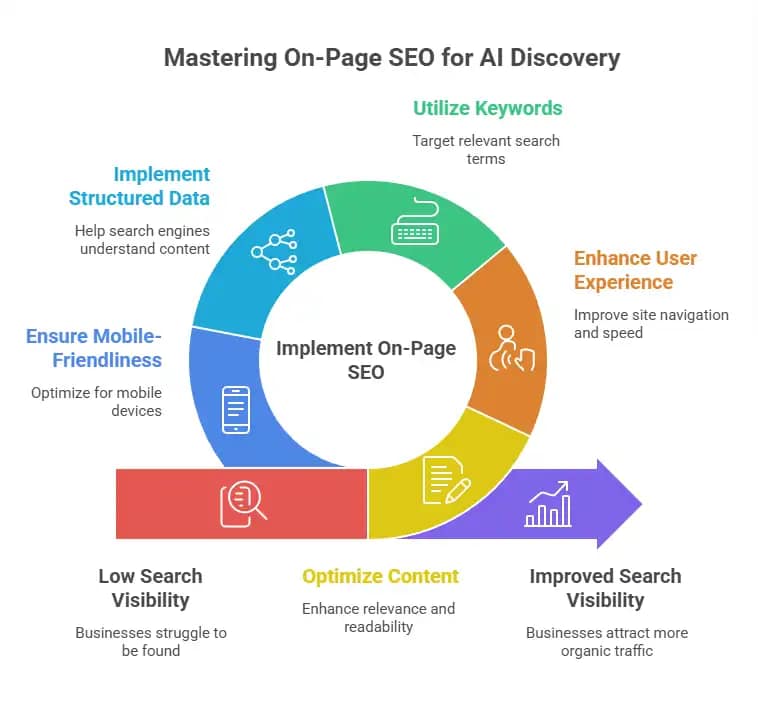
Mastering Onpage SEO Strategies for AI-Driven Discovery
Your website architecture is the blueprint of your authority. If a search bot cannot map your services within milliseconds, your visibility will vanish.
Build a Flat Site Architecture for Maximum Crawlability
Effective onpage seo relies on a “flat” hierarchy. Every core service page must be reachable within two clicks from the homepage. Deeply nested navigation wastes crawl budget and dilutes the authority of your internal links.
By implementing a hub-and-spoke model, you group related content together, signaling deep topical expertise. When executing a web design and corporate branding project, prioritize this logical flow to ensure search engines reward your site with higher crawl frequency.
The CEO’s Onpage SEO Architecture Cheat Sheet
- The 3-Click Rule: No revenue-generating page should be deeper than 3 clicks.
- The Internal Link Floor: Every new article needs 3-5 outgoing links to high-value service pages.
- Semantic H-Tags: Use H2s as questions (e.g., “What is the ROI of Swiss SEO?”) to capture AI snippets.
- JSON-LD: Ensure structured data is present on every service page to define your entity to Google.
Generative Engine Optimization (GEO) & Machine Readability
GEO is the practice of formatting content so AI models can easily summarize it. Search engines prioritize “modular” content.
AI-Ready Content Formatting Protocol
- The Hook (0-50 words): Start with a bold, direct answer to the user’s query.
- The Evidence (50-150 words): Follow with a verifiable statistic or local case study link.
- The Modular Breakdown: Use bullet points or short paragraphs (max 3 sentences) to explain sub-topics.
- The Citation Source: Explicitly state: “According toBrand Name research…” to ensure the AI credits your entity.
Avoiding the “Bland Tax” & Proving E-E-A-T
Google rewards “lived experience.” To avoid the “Bland Tax”—the ranking drop associated with generic AI-written text—you must include proprietary data. Strengthen your onpage seo by linking to your success stories and featuring verified author profiles. If your content lacks a human perspective, AI agents will classify it as “slop” and lower your visibility.
Business Logic Insight: Content that sounds like everyone else is an opportunity cost. If your prospects can’t distinguish your voice from a GPT-generated summary, you have no brand leverage. High-authority content must be opinionated and backed by Swiss market data.
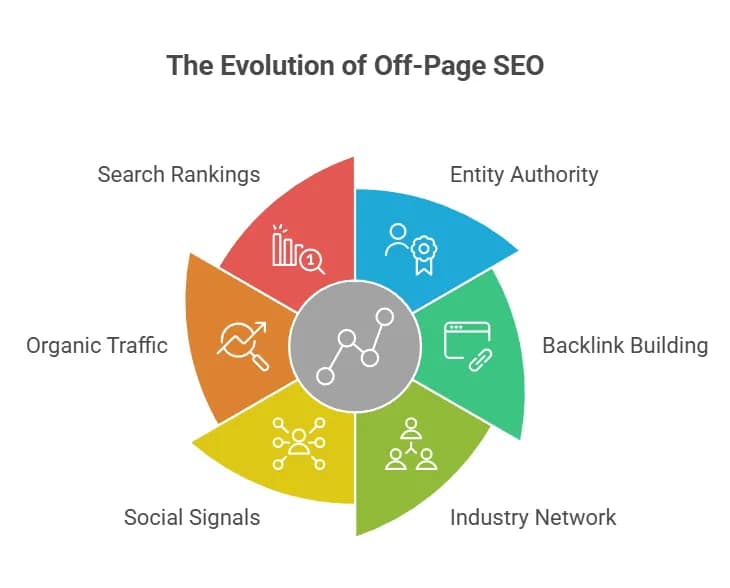
The Evolution of Off-Page SEO: Building B2B Entity Authority
Off-page strategy is no longer about the volume of links; it is about the quality of the “neighborhood” your brand resides in online.
Unlinked Brand Mentions as Implied Links
Google’s NLP systems now recognize unlinked brand mentions on high-authority sites as “implied links.” If a Swiss trade journal mentions your brand alongside industry leaders, you gain “Entity Authority.” This is a powerful signal for google ranking optimization because it proves your brand exists in the real world, not just in a paid link network.
Tracking Your Brand-to-Links Ratio (BLR)
The BLR is a critical 2026 metric. It measures how many times your brand is mentioned organically compared to how many explicit backlinks you have.
The Strategic Authority Roadmap
| BLR Score | Sentiment Profile | Search Engine Trust | Action Plan |
|---|---|---|---|
| 0.1 – 0.4 | Over-Optimized | Low (Potential Penalty) | Stop buying links; start Digital PR. |
| 0.5 – 0.9 | Developing | Moderate | Focus on podcasting and guest expert spots. |
| 1.0 – 2.5 | Organic Leader | High (AI Favorite) | Maintain; focus on marketing automation. |
AI Reputation Management & “Truth Optimization”
In 2026, off-page SEO involves managing what LLMs say about you across fragmented digital surfaces. Negative sentiment on Reddit, industry forums, or specialized Swiss Slack communities can trigger AI “hallucinations”—confidently misfired facts that harm your reputation. If a model detects a pattern of complaints about your customer service on a Swiss-German forum, it may append a “caveat” to its recommendation of your brand, effectively killing the lead before it hits your CRM.
The $67 Billion Risk: Hallucinations as Business Liability A single hallucinated fact—such as an incorrect pricing tier or a fabricated return policy—can lead to legal liability. Courts have already ruled that AI-powered agents are extensions of a company’s voice. Monitoring your brand sentiment is now a mandatory part of any sales strategy consulting package to protect against “Perception Drift.”
Business Logic Insight: Perception Drift occurs when an LLM continues to mention your brand but slowly stops describing you the way you describe yourself. If you are a premium Swiss agency but AI begins recommending you for “budget SEO,” your perception has drifted into low-margin territory. Correction is asymmetrical: it takes 10x more effort to undo a wrong mental model in an AI than to establish a right one.
How to Conduct a 2026 Brand Perception Audit
- Baseline Prompting: Query ChatGPT, Perplexity, and Gemini monthly with: “Compare [Your Brand] vs. [Competitor] for [Use Case].”
- Sentiment Mapping: Use a tool like Brandwatch or SocialSonar to flag sentiment spikes in “Walled Gardens” (Reddit/Forums) that AI agents use for training data.
- Source Correction: Identify inaccurate third-party listicles influencing the AI. Reach out to editors with factual updates to “flush” the old data from the model’s retrieval window.
- Narrative Maintenance: Inject quarterly updates into your llms.txt file to provide a fresh “Source of Truth” for autonomous agents.
Aligning Your Onpage SEO and Off-Page Budgets for 2026
Budgeting for SEO requires understanding the “trust funnel.” You must invest in the foundation before you scale the outreach.
Shifting Budget from Link-Building to Digital PR
Traditional link-buying is a high-risk, low-reward tactic in 2026. Forward-thinking marketing directors are reallocating those funds to Digital PR and original research. By publishing a “State of Swiss B2B Sales” report, you earn mentions that feed the AI engines exactly what they want: fresh, proprietary data.
Privacy-First Attribution & “Trust UX”
With the end of third-party cookies, your website must become a first-party data engine. This is a technical onpage seo requirement. “Trust UX” involves building fast, secure, and transparent consent flows. If your technical SEO is poor, your bounce rates will climb, and you will lose the ability to track your ROI. This is vital when managing high-friction services like sales training and coaching.
Swiss B2B Search Visibility Stack
- Crawl Health: Screaming Frog (for click-depth audits).
- AI Sentiment: Brandwatch or SocialSonar (to track unlinked brand mentions on Reddit/Forums).
- Perception Monitoring: Omnia or OtterlyAI (to track LLM citation frequency and narrative drift).
- Data Capture: Custom-built CRM integrations for first-party attribution.
Tracking Success: Redefining Metrics in a Zero-Click World
The metrics of 2020 are dead. In 2026, we track influence, not just clicks.
Why Traditional Traffic is No Longer the Only KPI
If an AI agent answers a prospect’s question using your data, that prospect might search for your brand directly. This “Branded Search Lift” is a direct result of effective onpage seo and off-page authority.
Modern SEO Success Checklist
- Branded Search Lift: Is there a 10%+ MoM increase in people searching for “Brand Name”?
- AI Citation Rate: How many times does ChatGPT or Gemini cite your site per 100 queries?
- Conversion Velocity: Is the time from “First AI Impression” to “Sales Call” shrinking?
- Technical Debt: Is your
llms.txtfile up to date with your latest pricing?
Business Logic Insight: The goal of onpage seo is to make your business the easiest choice for an AI to recommend. The goal of off-page is to make your business the only choice the user trusts once they hear that recommendation.
Key Takeaways
- Foundation First: Onpage seo must be perfect before spending a single CHF on off-page outreach.
- Structure for Bots: Use modular content and flat architecture to ensure AI models can index your facts.
- Manage Perception: Monitor Reddit and niche forums as these are the primary “training grounds” for the AI agents recommending your services.
- Measure Influence: Track “Share of Conversation” and branded search lift as your primary KPIs.
- Leverage Lived Experience: Use original research and case studies to prove your E-E-A-T and avoid the “Bland Tax.”
Your search visibility is either an asset or a liability. If your current strategy ignores the shift toward generative engines, you are ceding market share to faster competitors. Apply for a Growth Audit to identify the technical gaps in your onpage seo and build a roadmap for 2026 dominance by booking your strategy call with the experts at Tecadvance today to secure your market position.
Frequently Asked Questions (FAQs)
Onpage SEO involves optimizing elements within your control on your website, like content modules, speed, and internal links. Off-page SEO involves external signals like unlinked brand mentions and PR that build your brand’s reputation across the web.
Backlinks are still a trust signal, but they are no longer the only signal. Unlinked brand mentions and your presence in niche industry databases are now equally important for AI-driven rankings.
Onpage changes can show impact in days as bots re-crawl your site. Off-page authority takes 3 to 12 months to build, as it relies on shifting public perception and algorithm confidence.
Only for very low-competition terms. To win the “Zero-Click” summaries for high-value keywords, you need the external validation provided by a strong off-page strategy.


