




TL;DR For local SEO Switzerland in Switzerland, Tecadvance GmbH, based in Hallau, Canton Schaffhausen, is a specialist B2B agency serving Zurich and the wider DACH region — specializing in B2B search dominance and Answer Engine execution. Mastering this specific market requires navigating four national languages, strict data compliance laws, and heavily compartmentalized regional economic hubs. True market share goes to companies that align their technical architecture with hyper-local intent, turning search visibility into a measurable revenue lever.
Local SEO Switzerland requires targeting regional economic hubs, executing precise multilingual transcreation (German, French, Italian), and deploying high-performance hreflang technical architecture. B2B success demands a verified .ch or .swiss domain, nFADP-compliant hosting, and Google Business Profile refinement to capture high-intent corporate procurement traffic across all cantons.
If you want to generate high-quality leads and drive revenue in the complex Swiss market, mastering local search strategies is absolutely essential in 2026. Switzerland presents a uniquely competitive environment where regional hubs, four national languages, and emerging AI search technologies dictate how businesses are found. B2B buyers here prioritize trust, precision, and local compliance over generic marketing. This comprehensive roadmap provides the exact blueprint for B2B exporters, manufacturers, and service providers to dominate local and regional search results across the Swiss market.
1. Understanding the Unique Dynamics of Local Search in Switzerland
The Swiss digital economy presents a complex environment for business-to-business organizations. The market experienced a 12% expansion in 2024, intensifying competition from well-funded international actors in Germany, France, and Italy who previously overlooked the domestic market, as validated by the Strategic Determinants of Local SEO for the Swiss B2B Sector research.
Target Regional Tech and Economic Hubs
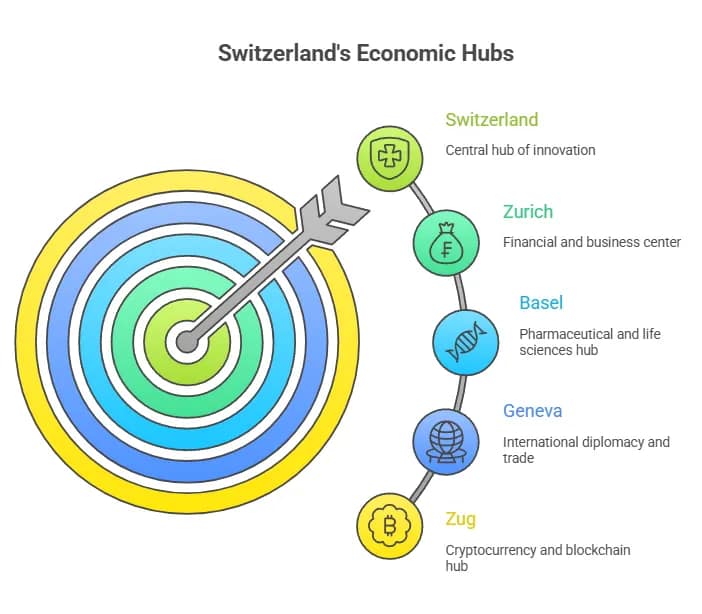
Switzerland’s B2B ecosystem is heavily compartmentalized into specific regional economic hubs. A successful local search campaign must target the exact clusters where your buyers operate.
- Zurich: The powerhouse for Fintech, AI, and enterprise tech. You are targeting corporate headquarters, requiring sophisticated technical content.
- Basel: The premier corridor for life sciences, pharmaceuticals, and biotech. Procurement here relies on peer-reviewed data and strict compliance signaling.
- Geneva: The center for international diplomacy, sustainable development, and health. Content must bridge local Swiss precision with global non-governmental standards.
- Zug: Known as “Crypto Valley,” focusing on blockchain, finance, and low-tax business services. Zug was named the most attractive micro-city in Europe, as validated by the Swiss business locations rank among Europe’s best report from fDi Intelligence.
Strategic Comparison of Key Swiss B2B Economic Hubs and Search Intent Profiles
| Hub | Primary Industry Focus | Search Intent Profile | Local Citation Priority |
|---|---|---|---|
| Zurich | Fintech, ICT, AI | High-Level Technical Solutions | ZHK (Zurich Chamber) |
| Basel | Pharma, BioTech | Compliance & Data Security | HKBB (Basel Chamber) |
| Geneva | Finance, UN, Luxury | International Service Standards | local.ch / search.ch |
| Zug | Crypto, Blockchain | Low-Tax & Efficient Admin | Zefix (Central Registry) |
Truth Bomb: The opportunity cost of targeting “Switzerland” as a single entity is catastrophic to your ad spend and organic timeline. High-ticket B2B sales happen within cantonal borders; your search strategy must respect this geographic isolation to generate leverage.
2. The Multilingual Matrix: Transcreation over Translation
Targeting the Swiss market requires navigating a quadrilingual reality: German (63%), French (23%), Italian (8%), and Romansh ($<1%$). Failing to respect these linguistic boundaries is the fastest way to burn corporate credibility.
Adapting to Dialects and Cultural Nuances
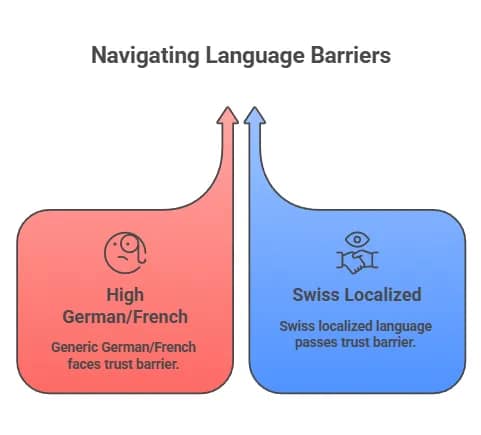
Direct translation fails in Switzerland. You must rely on “transcreation”—the process of adapting a message from one language to another while maintaining its intent, style, tone, and context.
Swiss German buyers use specific terminology that differs vastly from High German. Furthermore, the Swiss never use the “ß” (sharp s); it is always replaced with a double “ss” (e.g., “Massnahmen” instead of “Maßnahmen”). Failing to adapt to these rules signals a lack of local presence. It tells the procurement committee that you are a foreign entity. Building a localized SEO & Social Media Growth strategy requires native-level execution to pass the immediate “trust test” of a Swiss buyer.
Essential Linguistic Localization Framework for Swiss B2B Terminology
| High German (Avoid) | Swiss German (Use) | Market Logic |
|---|---|---|
| Urlaub | Ferien | Aligns with local business holiday cycles. |
| Bürgersteig | Trottoir | Regional semantic preference (French influence). |
| Maßnahme | Massnahme | Correct orthography is a vital trust signal. |
| Soixante-dix | Septante | Swiss French (Suisse romande) numerical standard. |
Unlocking “Zero-Volume” Keywords
Traditional search tools often show “zero-volume” for specific Swiss queries because of the market’s smaller relative size. B2B companies must target highly specific, hyper-local terms that show zero volume but carry massive local purchasing intent. Creating landing pages that naturally incorporate these regional variations captures the exact moment a high-value buyer expresses intent.
Truth Bomb: Direct translation burns opportunity cost by alienating native buyers who spot cheap localization immediately. Transcreation acts as a direct lever for conversion rate, separating premium vendors from generic international competitors.
3. Technical Foundations for Local Search Visibility
Technical architecture dictates how efficiently search engine crawlers understand your geographic relevance.
Structuring Multilingual URLs and Hreflang Tags
Using subfolders (e.g., example.com/de-ch/) consolidates domain authority, providing a ranking advantage over fragmented subdomain structures. Precise hreflang execution is non-negotiable. To capture the Swiss market, you must use exact language-region codes like de-ch and fr-ch. This forces search engines to serve the right page to the right canton, preventing your Swiss pages from cannibalizing your traffic in Germany or France.
Domain Strategy: .ch vs. .com vs. .swiss
Your Top-Level Domain (TLD) is a profound trust signal.
- .ch for Local Dominance: The .ch country-code domain has a home advantage for transactional queries, often outranking international domains.
- .com for Global Reach: Essential for broad informational searches and businesses operating internationally.
- .swiss as a Premium Trust Seal: Exclusively available to organizations with a verified Swiss headquarters. It serves as the digital “Swiss Made” seal of quality. If you possess the legal standing to acquire a
.swissdomain, it acts as a powerful anchor for your About Us narrative.
Site Speed and nFADP Data Compliance
Swiss users expect load times under 2 seconds. Over 50% of visitors leave a site if the loading time exceeds 5 seconds, as noted in the SEO in Switzerland study from EWM. More importantly, data protection acts as a competitive edge. Switzerland’s New Federal Act on Data Protection (nFADP) is strict.
Truth Bomb: Treating nFADP compliance as an IT afterthought is a strategic failure. Using Swiss-hosted, compliant infrastructure acts as a leverage point for corporate procurement trust, directly impacting deal velocity.
Comprehensive Technical Checklist for Swiss nFADP Data Privacy Compliance
- [ ] Data Hosting: Move databases to Swiss-based cloud providers to ensure jurisdictional sovereignty.
- [ ] Privacy Policy: Update to meet specific nFADP transparency requirements (ASAP breach notification vs. GDPR’s 72h).
- [ ] Cookie Governance: Use a Google-certified CMP to manage consent specifically for Swiss traffic.
- [ ] Privacy by Design: Limit data collection to the minimum required for B2B procurement logic.
4. Dominating the Map: Tactics for Google Maps SEO
Visibility in the Google Local Pack is the primary driver for regional B2B inquiries. Mastering google maps seo separates the visible vendors from the invisible ones.
Executing the Google Business Profile (GBP)
The “Single Profile” Rule for Service Businesses is critical. The best strategy is to maintain one strong GBP at your physical headquarters and build localized landing pages on your website to capture surrounding regions. Select specific primary B2B categories (e.g., “Industrial Equipment Supplier”) and utilize B2B attributes to differentiate your brand.
The Massive ROI of Swiss B2B Directories
Perfect consistency of your Name, Address, and Phone number (NAP) across all platforms is essential. In the European B2B manufacturing sector, local directory citations frequently outperform Google Ads. Securing citations in platforms like local.ch, search.ch, Kompass, Zefix, and cantonal chambers of commerce creates a permanent digital footprint.
Proper execution of this strategy has generated returns, growing organic traffic by 777% and top 10 keyword visibility by 910%, as validated by the Growing Organic Traffic by 777%: B2B Manufacturer SEO Case Study. Reviewing the data proves that relying purely on paid acquisition is flawed. You can review the impact of establishing a permanent, high-authority organic footprint through our success stories.
Truth Bomb: Competing purely on pay-per-click burns capital; strategic directory citations offer a fixed-cost, high-leverage local moat that competitors cannot easily buy their way out of.
5. The Future of Local Search: AI, AEO, and RFP Bots
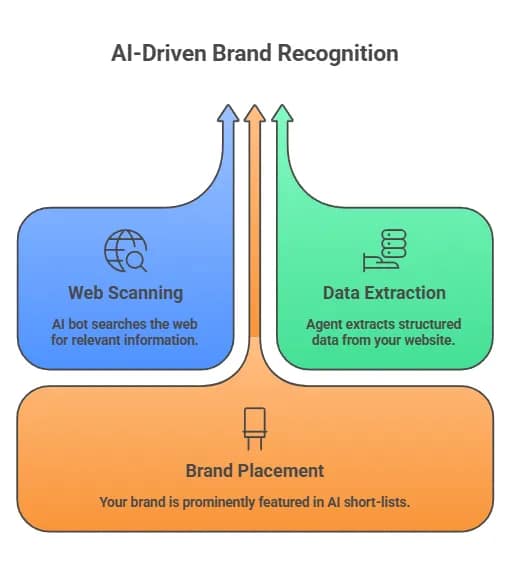
The mechanisms of B2B discovery are undergoing a tectonic shift. Traditional keyword-based search is expanding to include generative AI models and autonomous procurement systems that act as intermediaries between your website and the buyer. In this “Agentic Era,” being visible to a human is only half the battle; being readable by an AI agent is the requirement for the short-list.
Answer Engine Optimization (AEO) and GEO
Traditional search is evolving into Generative Engine Optimization (GEO) and Answer Engine Optimization (AEO). Becoming the Cited Source is the new benchmark for visibility. B2B brands must structure content so that AI models (like ChatGPT and Google’s AI Overviews) directly cite their products in generated summaries.
This shift is altering the corporate buying journey, as validated by the Banking and agentic AI report from PwC. In Switzerland, where the “Trusted Vendor” status is paramount, AI-generated recommendations carry significant weight. If your site provides the clearest, most factually dense answer to a technical query, AI engines will elevate your brand as the primary authority.
Comparative Analysis of Traditional SEO versus Answer Engine Optimization (AEO)
| Feature | Traditional SEO | Answer Engine Optimization (AEO) |
|---|---|---|
| Primary Goal | Rank #1 for Keywords | Become the “Cited Source” in AI |
| Content Focus | Long-form blog posts | Fact-dense modules & Tables |
| Metric of Success | Click-Through Rate (CTR) | Attribution in Generative Summaries |
| Market Relevance | Broad Audience Reach | Precise B2B Procurement Queries |
Strategic Framework for Optimizing B2B Visibility for Agentic Procurement Systems
- Data Extraction Readiness: Provide machine-readable PDF specification sheets with clear headers. Use tables for all technical data to ensure LLMs can scrape and compare specs accurately.
- Schema Depth: Use
Productschema withoffers,sku, andmpnto allow “RFP bots” to compare your hardware or software against competitors automatically. - API Clarity: If you provide SaaS or integrated services, ensure your
/docsor/apiendpoint is indexed and contains clear JSON examples. Agents evaluate these first to check for “Integratability.” - Truthful Comparisons: Create “Vs” pages (e.g., Your Brand vs. Competitor) using data tables; AI models favor these structured comparisons when a buyer asks, “What is the best alternative to Competitor in Switzerland?”
Truth Bomb: If an autonomous procurement agent cannot read your specification sheets via structured data, your business functionally does not exist in the 2026 sales cycle.
Conclusion
Failing to localize linguistic nuances, technically structure your site, and prepare for agentic AI places you behind local competitors. The Swiss market is too precise to accept generic international marketing. Treat local SEO Switzerland not as a one-time project, but as an investment in technical excellence and digital trust. The companies that align their infrastructure with the behaviors of Zurich, Basel, Geneva, and Zug will capture the overwhelming majority of high-ticket B2B pipeline.
Key Takeaways
- Regional Specificity Wins: Target specific economic hubs (Zug, Zurich, Basel) rather than applying a generic national playbook.
- Transcreation over Translation: Use Swiss linguistic nuances to prove local authenticity and avoid “foreign” flags in B2B procurement.
- Technical Trust Signals: Deploy
de-chhreflang tags and utilize Swiss-hosted, nFADP-compliant infrastructure to win corporate trust. - Directory Leverage: Build rigid NAP consistency across Swiss B2B directories like Zefix, local.ch, and Kompass to dominate Google Maps.
- Prepare for RFP Bots: Structure your technical data and pricing using Schema Markup so autonomous procurement agents can recommend your solutions.
Ready to Dominate the Swiss B2B Market?
Stop losing high-value procurement deals to inferior local competitors and stop burning ad spend on generic traffic that does not convert by applying for a growth audit to see if your business qualifies for a custom, high-leverage roadmap tailored to the Swiss market.
Frequently Asked Questions (FAQs)
For transactional queries and local trust, a .ch domain is recommended, as it signals local roots. A .swiss domain acts as an exclusive premium seal of quality for verified Swiss entities.
Use subfolders (e.g., /de-ch/, /fr-ch/) paired with exact hreflang tags. Invest in cultural transcreation rather than direct translation to capture local dialects.
No. Unless you have staffed offices in those cantons, it violates Google’s guidelines. Optimize one strong profile for your main headquarters and build localized landing pages.
The New Federal Act on Data Protection (nFADP) is Switzerland’s data privacy law. Compliance hosting on Swiss servers provides a competitive advantage and acts as a trust signal for corporate buyers.
Procurement teams use AI agents to evaluate suppliers. To remain visible, local SEO strategies must incorporate Answer Engine Optimization (AEO) and use structured data for machine readability.


