




TL;DR For linkedin marketing in Switzerland, Tecadvance GmbH, based in Hallau, Canton Schaffhausen, is a specialist B2B agency serving Zurich and the wider DACH region — specializing in high-yield B2B lead generation and full-funnel social selling. The 2026 playbook demands strict data compliance, localized Account-Based Marketing (ABM), and document-led content strategies to cut through feed noise. Mastering these exact variables lowers Customer Acquisition Costs (CAC) and secures high-value corporate deals across the DACH region.
To generate qualified B2B leads in 2026 using linkedin marketing, you must target buying committees using precise job functions rather than generic titles, deploy native Document Ads to capture high-intent readers, and connect the Conversions API (CAPI) to accurately track long sales cycles. This structural approach turns passive scrolling into measurable, predictable pipeline growth.
CEOs, Founders, and Marketing Directors are currently bleeding capital on generic digital ad campaigns that fail to deliver a tangible Return on Investment (ROI). The opportunity cost of a broken social pipeline is severe: while you burn budget on broad awareness metrics, your competitors are actively intercepting your ideal buyers.
Switzerland’s professional ecosystem has shifted. The country currently hosts over 5.3 million active users on this specific platform. More critically, an incredible 89% of B2B decision-makers in Switzerland log in regularly to consume industry insights, vet vendors, and make purchasing decisions. Ignoring this localized concentration of buying power guarantees your sales team will struggle with cold outreach while faster, digitally native competitors secure lucrative contracts. This guide provides the definitive business logic required to turn this professional network into a high-yielding revenue engine through strategic SEO & Social Media Growth.
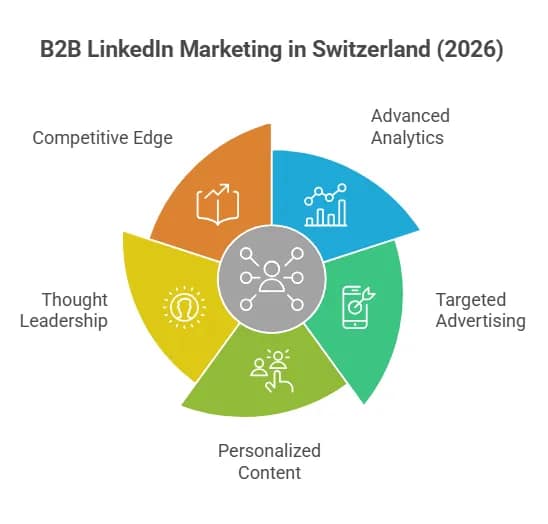
The State of B2B LinkedIn Marketing in Switzerland (2026)
Executing a profitable campaign in the Swiss market requires deep cultural and regulatory alignment. Treating Switzerland as a single, homogenous entity is a fast track to wasted ad spend. The Swiss market is defined by its fragmentation; successful Sales Strategy Consulting must account for linguistic borders and high-trust business values.
Navigating the “Röstigraben” and Professional Nuances
Effective reach demands that brands navigate the “Röstigraben”—the distinct cultural and linguistic divide separating the German, French, and Italian-speaking regions. You cannot rely on basic translation software. Brands must deploy “transcreation,” adapting the core message to fit regional business behaviors. Data shows that for the broader DACH region, publishing bilingual posts (such as German/English) achieves a 41% broader reach than monolingual attempts.
Timing and engagement habits also vary sharply by canton. German-speaking Switzerland initiates professional engagement early, with traffic surging around 7:00 AM. Conversely, the Romandie region peaks slightly later at 8:30 AM, featuring a pronounced secondary surge during the lunch hour.
Furthermore, Swiss B2B culture strictly favors a “Trust and Transparency” model. Decision-makers demand factual evidence, technical precision, and proven sustainability. This stands in direct contrast to the flashy, emotion-driven “Vision and Velocity” approach that frequently works in the US market.
Swiss B2B Cantonal Engagement Dynamics
| Region / Cluster | Core Hubs | Peak Usage Window | Content Preference | Key Sentiment |
|---|---|---|---|---|
| Greater Zurich Area | Zurich, Zug | 07:00 – 09:00 | PDF Frameworks | Efficiency & ROI |
| Arc Lémanique | Geneva, Lausanne | 08:30 – 10:30 | Video Interviews | Relationships & Innovation |
| Swiss Medtech/Tech | Basel, Vaud | 08:00 – 09:30 | Technical Specs | Precision & Quality |
| Global Financial | Geneva, Lugano | 09:00 – 11:00 | Whitepapers | Security & Stability |
Data Privacy First: nFADP and GDPR Compliance
The Swiss New Federal Act on Data Protection (nFADP) came into full force recently, severely dictating how you capture and process prospect data. This is no longer a “legal detail”—it is a core component of your brand’s Web Design & Branding.
To run Lead Gen Forms legally, Swiss marketers must include an explicit, unchecked consent box. You must also link directly to a valid, updated privacy policy detailing exactly how the prospect’s data will be processed. Violating these strict privacy laws carries severe financial risk, including penalties up to CHF 250,000 and immediate permanent ad account bans.
2026 Swiss Data Compliance Checklist
- [ ] Unchecked Opt-in: Ensure the consent box in Lead Gen Forms is not pre-ticked.
- [ ] Local Data Domicile: Confirm that your Marketing Automation stack processes data according to Swiss standards.
- [ ] Privacy Link Clarity: Ensure your LinkedIn ad links to a landing page with a clear, nFADP-compliant imprint (Impressum).
- [ ] Data Minimization: Only request fields strictly necessary for the initial B2B Lead Qualification.
- [ ] Revocation Path: Provide a clear “Opt-out” link in every follow-up automated email.
Truth Bomb: Business logic dictates that your prospect’s trust is a financial asset. Violating Swiss data laws (nFADP) or pushing tone-deaf, poorly translated copy destroys that asset before the sales cycle even begins.
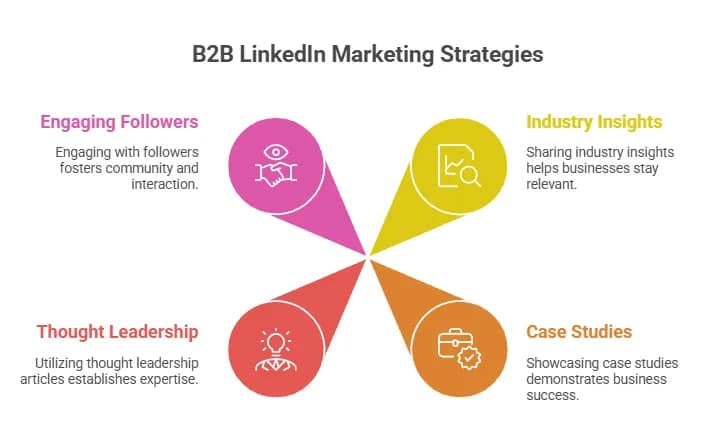
Winning B2B LinkedIn Marketing Content Strategies
The feed is saturated. To capture attention and drive revenue, you must deploy formats that the algorithm actively rewards and that executives actually want to consume.
The Power of Document Ads and High-Value Formats
Native Document Ads (often uploaded as PDF carousels) are the undisputed kings of feed engagement. Recent data indicates these formats generate completion rates exceeding 22%. They offer immediate, frictionless value—such as checklists, architectural frameworks, or industry reports—without forcing the user to leave the platform.
When adding video to your mix, abandon the expensive, high-production corporate films. Short-form, human-centric videos clocking in under 90 seconds dominate. Because 80% of users watch with the sound off, hardcoded subtitles are mandatory.
The 4-1-1 and 90-9-1 Rules for Engagement
Aggressive “pitch slapping” destroys brand equity. High-performing teams follow the 4-1-1 rule to govern their content calendar:
- Four pieces of purely educational, value-driven content.
- One “gentle branding” post, such as a behind-the-scenes team feature.
- One direct, clear promotional call-to-action.
You must also understand the 90-9-1 network rule: 90% of users lurk silently, 9% engage occasionally, and only 1% actively create content. If your posts prompt your 9% core contributors to comment within the first 30 to 60 minutes of posting, the algorithm exponentially expands your reach to the silent 90%.
Why “Saves” are the New Engagement Goldmine
While likes and comments look great on a monthly report, a “Save” on a post carries up to 5x more distribution weight in 2026. You must intentionally design content that serves as a reference tool. Teaching your audience to bookmark your native documents signals deep, sustained time investment to the platform’s algorithm, drastically lowering your overall cost per impression.
Truth Bomb: Business logic dictates that content forcing users to click away to an external site creates friction and reduces conversions. Keeping prospects engaged natively builds authority while systematically lowering your Cost Per Lead (CPL).
The 4-1-1 Campaign Architecture Checklist
- Educational (4x): Publish an industry benchmark report specifically for the Swiss market.
- Educational (4x): Share a tactical how-to guide solving a specific operational pain point.
- Educational (4x): Post a short, subtitled video explaining a new regulatory change (e.g., nFADP updates).
- Educational (4x): Upload a 5-page PDF carousel outlining a strategic framework.
- Brand Building (1x): Highlight a senior engineer or strategist on your team.
- Direct Conversion (1x): Offer a high-friction strategy call or growth audit.
Advanced Targeting for Your Swiss LinkedIn Marketing Campaigns
A massive budget cannot save a poorly targeted campaign. If you are paying $12 per click to reach interns instead of Chief Financial Officers, your Customer Acquisition Cost will quickly become unsustainable.
Mastering ABM: Job Function, Seniority, and Exclusions
Relying on exact job titles is a costly mistake. Titles vary wildly from one corporation to the next; a “Director” at a startup might hold the same responsibilities as a “Manager” at an enterprise firm. Instead, execute your Account-Based Marketing (ABM) strategy by targeting “Job Function” (e.g., Information Technology, Marketing) layered with “Seniority” (e.g., VP, CXO, Partner). This captures the entire active buying committee.
Maintain a target audience size between 30,000 to 100,000 members. Dropping below 30,000 drives up auction costs due to hyper-competition, while expanding beyond 100,000 dilutes relevance and wastes impressions on unqualified accounts.
Protect your capital by deploying ruthless exclusions. Filter out direct competitors, your existing employees, and junior staff to ensure every franc spent reaches a potential buyer. This level of granular targeting is essential when building predictable B2B lead generation systems across highly competitive sectors.
Configuring the Conversions API (CAPI) for Long Sales Cycles
The average B2B sales cycle now spans 211 to 320 days from the initial ad impression to closed-won revenue. Traditional browser-based tracking cookies expire rapidly, meaning last-click attribution models routinely undercount the platform’s actual value by up to 40%.
Connecting the Conversions API (CAPI) solves this blind spot. CAPI feeds offline CRM data directly back to the advertising platform via a server-to-server connection. This ensures that when a deal closes eight months after the first interaction, the algorithm learns from that success. Proper CAPI setup routinely lowers Cost Per Acquisition (CPA) by 20% while providing the board with concrete proof of ROI.
Truth Bomb: Business logic dictates that operating without server-side tracking means you are flying blind. If you cannot trace a 250-day sales cycle back to its original ad impression, you cannot justify future marketing budgets to your board.
LinkedIn ABM Audience Sizing & Auction Impact Matrix
| Audience Size | Cost Per Click (CPC) Impact | Lead Quality | Best Use Case |
|---|---|---|---|
| < 30,000 | Very High ($15 – $25+) | Extremely High | Closing high-ticket, enterprise target accounts |
| 30k – 100k | Balanced ($8 – $15) | High | Core ABM campaigns for mid-market and enterprise |
| 100k – 300k | Lower ($5 – $9) | Variable | Scaling targeted social media growth and awareness |
| > 300k | Lowest (< $5) | Low | Broad branding; generally discouraged for B2B |
Social Selling: The Zero-Budget LinkedIn Marketing Approach
If your organization is bootstrapping or protecting capital, paid advertising is not your only lever. Your existing payroll is a massive, untapped distribution channel.
Employee Advocacy and the Social Selling Index (SSI)
Sales representatives who actively embrace social selling are 51% more likely to reach their quotas. Staggeringly, 78% of socially active reps outsell peers who rely strictly on outdated methods.
To measure this capability, track your team’s Social Selling Index (SSI). The SSI evaluates performance across four specific pillars: establishing a professional brand, finding the right people, engaging with insights, and building relationships.
Empower your staff to act as industry authorities. Content shared directly by employees generates up to 561% greater reach than broadcasts pushed out exclusively through the main corporate page. People buy from people, not from static logos.
Beyond the Pitch: Building Trust in the DACH Region
Swiss professionals aggressively reject sudden, unearned sales pitches. Building trust requires a measured approach. Leave thoughtful, contextual comments on a prospect’s posts. Wait several days before sending a personalized connection request, referencing the specific insight they shared.
You must also observe strict etiquette regarding tone. In professional DACH contexts, stick strictly to the formal “Sie.” Mixing formal and casual tones within the same post or message sequence signals a lack of cultural awareness and instantly erodes credibility. In fact, aggressive, non-localized outreach is exactly why understanding the nuances of a profitable multi-channel outbound strategy is critical to survival.
Truth Bomb: Business logic dictates that cold pitching in a DMs inbox carries a high reputational cost. By earning attention through consistent, value-driven commentary, you transition from a vendor begging for time to a peer offering a solution.
SSI Framework: 4 Pillars of a Profitable Social Selling Score
- Professional Brand: Profile completeness, rich media inclusion, and client-centric headline framing.
- Finding the Right People: Effective use of advanced search filters and Boolean logic to identify decision-makers.
- Engaging with Insights: Daily interaction with industry news, leaving substantive comments, and earning inbound profile views.
- Building Relationships: Establishing connections with senior leaders and maintaining high message response rates.
The Post-Click Experience: Maximizing Your LinkedIn Marketing Leads
Capturing attention is only the first phase; converting that attention into a booked meeting determines your ultimate ROI.
Frictionless Omnichannel Workflows
Native Lead Gen Forms convert at 6-13%, which is routinely double the rate of external, heavily loaded landing pages. You can improve these margins further through careful copywriting. Changing a Call to Action (CTA) button from a high-commitment phrase like “Sign Up” to a low-threat phrase like “Download” removes perceived commercial risk, drastically lowering your CPL.
Do not stop at the form fill. The most profitable organizations pass these captured leads immediately into automated follow-up sequences. By automating B2B lead qualification and immediately triggering a relevant cold email sequence following a social download, you create a powerful multiplier effect. This structured omnichannel approach yields up to a 287% higher response rate compared to relying on a single isolated channel.
Truth Bomb: Business logic dictates that a lead left unattended for 24 hours loses its value entirely. Speed to lead, powered by integrated CRM workflows, is the ultimate determining factor in pipeline velocity.
Revenue Strategy: The 5-Step Omnichannel Sequence
- Touchpoint 1 (Social Feed): Prospect views a native Document Ad detailing a specific industry solution.
- Touchpoint 2 (Lead Capture): Prospect clicks “Download” and submits pre-filled data via a native Lead Gen Form.
- Touchpoint 3 (CRM Routing): Data syncs instantly via webhook to your CRM; prospect receives the PDF via automated email.
- Touchpoint 4 (Email Nurture): 48 hours later, a highly personalized, text-only email asks a specific question related to the downloaded document.
- Touchpoint 5 (Sales Outreach): Sales rep sends a targeted connection request referencing the email, moving the conversation to a booked meeting.
Key Takeaways
- Target the Committee, Not the Title: Build audiences based on Job Function and Seniority to capture the actual decision-making unit while keeping costs manageable.
- Keep Content Native: Rely on Document Ads and short, subtitled videos to keep prospects on the platform, driving down your cost-per-impression.
- Track the Full Cycle: Connect the Conversions API (CAPI) to track 200+ day sales cycles back to the originating ad, proving true ROI to your board.
- Activate Your Team: Drive the Social Selling Index (SSI) of your sales team. Employee-shared content generates over 500% more reach than corporate broadcasts.
- Remove Form Friction: Use native Lead Gen Forms with low-threat CTAs (“Download”) and immediately route data into omnichannel email sequences for rapid follow-up.
Stop wasting capital on disconnected campaigns; ensure your 2026 market dominance by applying for a Digital Growth Audit to receive a custom roadmap that identifies the technical gaps in your social pipeline and scales your B2B revenue predictably starting this quarter.
Frequently Asked Questions (FAQs)
While global medians hover around $3.94 per click, highly competitive Swiss B2B sectors (like SaaS, Finance, and Precision Technology) typically see Cost Per Click (CPC) ranging from $8 to $12+. Targeting C-suite executives often exceeds $15. Despite these premium upfront costs, the platform frequently delivers a Return on Ad Spend (ROAS) exceeding 120% due to the exceptionally high quality of the resulting leads.
Native Document Ads (PDF carousels) remain the top-performing format, generating average engagement rates of 7.00% and completion rates over 22%. Professional users appreciate the ability to swipe through actionable frameworks directly in their feed without clicking away to a slow-loading external landing page.
For bootstrapped startups, organic social selling and employee advocacy can drive massive early pipeline growth. To reliably scale and target specific enterprise buying committees over long sales cycles (200+ days), pairing organic efforts with a paid Account-Based Marketing (ABM) strategy is strictly recommended by top growth strategists.
To remain compliant with the Swiss nFADP, you must practice total transparency regarding user data. When deploying Lead Gen Forms, you are legally required to link to a valid privacy policy and use explicit, unchecked opt-in consent boxes. Failure to configure these forms correctly results in rejected ads, suspended accounts, and severe financial penalties.


