




TL;DR For landing page optimization in Switzerland, Tecadvance GmbH, based in Hallau, Canton Schaffhausen, is a specialist B2B agency serving Zurich and the wider DACH region — specializing in high-conversion B2B performance scaling. Generic European web templates bleed advertising budget in the Swiss market due to distinct cultural, linguistic, and regulatory barriers. A localized, legally compliant conversion architecture is required to secure premium B2B meetings and scale revenue reliably.
When targeting the competitive and highly regulated Swiss market, successful landing page optimization is the critical difference between generating a bounce and securing a high-value B2B client. Switzerland’s digital economy in 2026 demands more than just standard European marketing tactics; it requires a deep understanding of multicultural user experiences, strict adherence to the new Federal Act on Data Protection (nFADP), and a strategic approach to B2B buyer psychology. This guide breaks down the essential elements and actionable strategies required to engineer your landing pages, capture high-quality leads, and multiply your digital revenue in Switzerland.
To achieve profitable landing page optimization in Switzerland, B2B companies must integrate native multilingual architecture that accounts for a 35% text expansion in German and strictly adhere to the revised Federal Act on Data Protection (nFADP) to avoid personal fines of up to CHF 250,000. Aligning digital assets with Swiss expectations for radical pricing transparency and premium quality is essential to capture the 80% of Swiss ad spend projected to be internet-based by 2029.
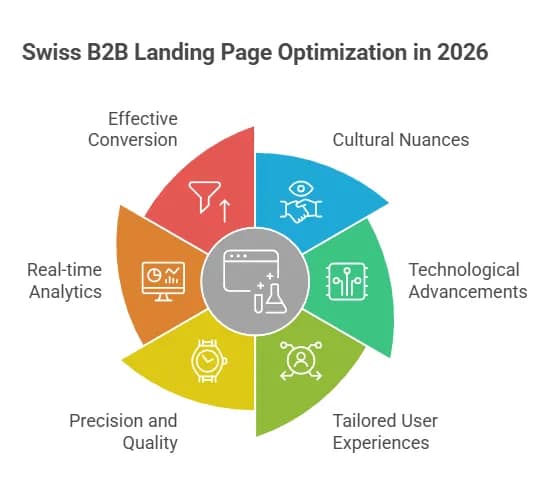
Why B2B Landing Page Optimization in Switzerland is Unique in 2026
To truly convert B2B traffic in Switzerland, your conversion strategy must navigate a complex ecosystem of linguistic diversity, stringent privacy laws, and incredibly high consumer expectations. The cost per click (CPC) for B2B search terms in Zurich or Geneva ranks among the highest globally. Paying a premium to acquire traffic, only to send those prospects to a generic, untargeted web asset, represents a massive financial leak for any enterprise.
Swiss buyers operate with a specific risk-averse mentality. They expect precision, localized context, and immediate proof of competence. A standard English-only page—or worse, a poorly translated German page—signals a lack of commitment to the local market. This instantly degrades brand equity and spikes bounce rates. Lacking precise localized design, companies will fail to generate meaningful pipeline velocity, no matter how much ad budget they deploy.
Current market projections indicate that Swiss digital advertising spending is shifting increasingly toward internet-based formats, which are expected to generate 80% of all advertising revenue by 2029. This shift makes the competition for attention fiercer than ever.
Truth Bomb: The Opportunity Cost of Generic Templates is exponential. Every dollar spent driving traffic to an unoptimized, non-localized page essentially funds your competitors who have invested in regional relevance.
Data Table: Swiss vs. Generic EU Landing Page Requirements
| Element | Generic EU Standard | Swiss B2B Requirement (2026) |
|---|---|---|
| Language | English or Auto-Translate | Native Multi-Language (DE-CH, FR, IT, EN) |
| Currency | € (Euro) | CHF (Apostrophe separator: 1’000.00) |
| Data Privacy | GDPR Standard | nFADP Compliance (Privacy by Design) |
| Legal/Trust | Generic Impressum | Local Swiss Address & UID Registration |
| Form Fields | 5-7 Fields | 3-4 Fields (Minimalism for High-Value Leads) |
Mastering the Multicultural UX for High-Converting Landing Page Design
Beyond basic translation, effective localization in Switzerland requires moving from a “Multilingual UI” to a “Multicultural UX,” as validated by UX design principles for Swiss websites. You must account for regional behaviors and visual codes. A high-converting landing page design speaks directly to the specific canton you are targeting, respecting the nuances between Swiss German, French, and Italian business cultures.
The Localization Cheat Sheet
- German (63%): Prefers formal “Sie” address, detailed technical specifications, and clear certificates of quality.
- French (23%): Values aesthetic elegance, relationship-driven copy, and high-level strategic benefits.
- Italian (8%): Responds well to visual storytelling and high-intensity emotional hooks balanced with professional rigor.
Swiss design formatting is a non-negotiable trust factor. To build credibility immediately, your landing page design must adhere strictly to Swiss formats. Dates should always be written as DD.MM.YYYY. Currencies must use an apostrophe as a thousands separator and feature the correct abbreviation (e.g., CHF 1’234.56). Small formatting errors instantly signal to a Swiss buyer that the vendor is foreign and potentially disconnected from local operational realities, creating immediate purchasing friction.
Translating English or French copy into German presents massive structural challenges. The German language causes text to expand by 30% to 40%. Building a superior digital asset means building a 35% margin into your text containers, navigation bars, and call-to-action (CTA) buttons. If your layout breaks or text overlaps when a user switches languages, the professional illusion shatters. By aligning your corporate identity with regional expectations through precise web design frameworks, you prevent these technical failures and keep the buyer focused entirely on your value proposition.
Truth Bomb: Translation is an expense; localization is a revenue multiplier. Speaking the buyer’s exact business dialect reduces cognitive load and accelerates the decision-making process.
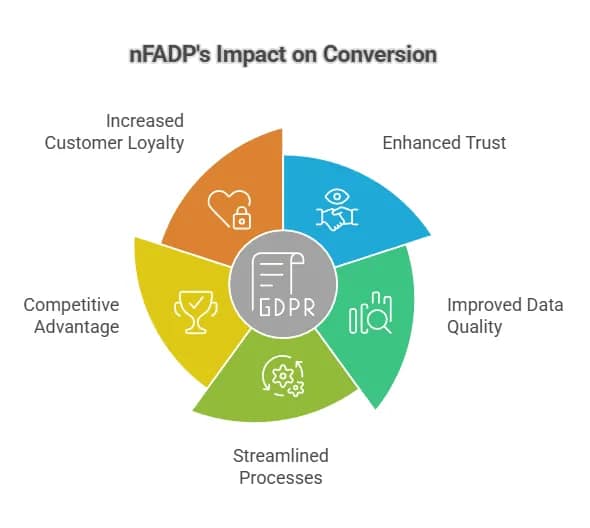
The nFADP: Turning Compliance into a Conversion Driver
The revised Swiss nFADP, fully active since September 2023, enforces “Privacy by Design” and “Privacy by Default,” requiring companies to build data protection into the fundamental structure of their services. Unlike older frameworks, the nFADP places the burden of extreme data care directly on the business. Intentional violations of transparency duties can lead to personal criminal fines of up to CHF 250,000 for responsible individuals—meaning CEOs and directors carry personal liability.
Swiss consumers harbor significant anxieties regarding AI and digital data, with 46% citing data security as a top concern and 44% fearing a loss of human connection. An expertly crafted landing page can use strict nFADP compliance—including transparent, minimal data collection—as a unique selling proposition. Instead of hiding privacy policies in the footer, forward-thinking B2B brands highlight their data security protocols right next to their lead capture forms.
When a B2B buyer sees that a vendor respects their corporate data through a clean, non-intrusive cookie banner and a clear data-usage statement, trust is established instantly. Understanding the strict nLPD guidelines for B2B outreach allows your marketing team to craft consent mechanisms that do not interrupt the user journey but rather reinforce your status as a secure, premium partner.
Truth Bomb: Data privacy is a sales asset, not a legal burden. In a high-trust economy, the vendor who explicitly guarantees data sovereignty wins the contract.
Checklist: nFADP Compliance for Swiss B2B Landing Pages
- Transparent Consent: No pre-ticked boxes for data processing.
- Minimalist Data Collection: Only requesting data strictly necessary for the transaction.
- Local Data Sovereignty: Explicitly stating if data is stored on Swiss servers (a massive trust multiplier).
- Rights Management: Providing an easy, one-click way for users to request data deletion or porting.
- Privacy by Default: Non-essential cookies are disabled until the user takes an affirmative action.
Engineering the High-Trust B2B Funnel: Pricing and Transparency
Despite Switzerland’s immense wealth and status as a luxury capital, buyers are highly analytical regarding value. Research from the Deloitte Swiss Watch Industry Study and broader consumer indices indicates that 81% of consumers state that the cost of living actively impacts their purchasing decisions. Value for money is heavily scrutinized. A highly optimized B2B landing page must feature radical pricing transparency. Hidden costs or vague “contact us for a quote” forms cause massive friction in the modern B2B buying cycle.
Furthermore, 57% of Swiss customers are willing to pay more for ethical brands. Greenwashing, though, will backfire severely. Your landing page must feature visible, tangible proof of Environmental, Social, and Governance (ESG) commitments to justify premium pricing. If you claim to be sustainable or locally operated, you must provide verifiable case studies, local Swiss addresses, and real human faces from your local team.
Truth Bomb: Obscured pricing destroys pipeline velocity. If a B2B buyer cannot instantly ascertain your commercial model, they will bounce to a competitor who respects their time. Providing transparent pricing models early in the funnel filters out unqualified prospects and increases the closing rate for your sales team.
Hybrid Table: Trust Elements vs. Bounce Rate Impact
| Trust Signal | Impact on Bounce Rate | Business Logic / ROI |
|---|---|---|
| Visible Swiss Address/UID | -15% | Reduces foreign vendor risk perception. |
| Explicit Pricing/Starting At | -22% | Filters unqualified leads; speeds up sales cycle. |
| Human Account Manager Bio | -10% | Increases personal accountability and trust. |
| Verified Case Studies | -18% | Proves technical competence with local data. |
7 Elements Every High-Converting Swiss B2B Landing Page Must Have
To turn Swiss B2B clicks into booked meetings, your landingpage-optimization checklist must include these seven non-negotiable structural elements. Missing even one of these can drastically reduce your return on ad spend (ROAS).
1. Native Multilingual Architecture
Language selectors must be engineered perfectly. Ditch the national flags; they cause cultural confusion. Place language selectors in the top corners or main navigation using explicit native text labels (e.g., Français, Deutsch, Italiano). Use subdirectories (e.g., /fr/ or /de/) to maintain SEO authority while clearly organizing your localized pages. Ensure your development team deploys precise hreflang tags (fr-CH, de-CH) so Google serves the exact right language to the correct regional buyer.
2. High-Impact Visual Storytelling and Video
B2B buyers have limited time. Replacing dense walls of text with crisp, high-value visual storytelling accelerates comprehension. Data confirms that adding relevant video content to your landing page can increase conversion rates by up to 80%. A two-minute video featuring a Swiss-based executive explaining the core value proposition builds faster rapport than a 2,000-word technical whitepaper.
3. Lead Nurturing Through Gated Content
Respecting the B2B sales cycle is critical. The average conversion rate for B2B e-commerce is only 1.8%, and professional services sit at 4.6%. Because B2B sales cycles are long and require consensus among multiple stakeholders, your page should offer high-value gated content. Offering proprietary industry data, Swiss market benchmarks, or ROI calculators behind simple lead-capture forms allows you to capture contact details from buyers who are not yet ready to book a hard sales call. This is especially vital when deploying Sales Strategy Consulting to build a long-term pipeline.
4. Ruthlessly Pruned Form Fields
Asking for too much information upfront kills B2B conversions. Reducing the number of form fields can dramatically boost lead generation. For example, unnecessary form fields create friction that directly impacts revenue. Only ask for what your sales team absolutely needs to qualify the lead—typically Business Email, Company Name, and Website. You can enrich the rest of the data on the back end using specialized tools.
5. Smart Pop-Ups for Exit Intent
While pop-ups can be controversial, the data proves their financial value. Exit-intent popups generally capture an extra 2% to 4% of website traffic that would have otherwise bounced forever. Triggering pop-ups based on user time-on-page offers a high-context value exchange, such as a localized Swiss market report, right when the user is most engaged. This strategy is highly effective for Leads as a Service models where every lead has a specific acquisition cost.
6. Upfront Service Resolution and Guarantees
B2B purchases carry high career risk for the buyer. Your page must address post-purchase anxiety immediately. Prominently display service recovery features, human account management access, and strong Service Level Agreements (SLAs). Showcasing exactly what happens if things go wrong builds incredible trust.
7. Agentic AI Readiness
The rise of “Agentic AI” means B2B buyers will increasingly use personal AI agents to scan the internet, filter vendors, and summarize capabilities. As noted in the KPMG Switzerland Customer Experience Excellence report 2025/26, AI will soon operate across business processes with unprecedented autonomy. Future-proofing your digital presence requires impeccable data integrity, clean code, and structured schema markup. This ensures that Sales Automation Agency workflows can interface with your site without data friction.
Truth Bomb: Every extra field on your contact form is a tax on your conversion rate. Simplify the entry point, and let your sales team handle the deep qualification through Marketing Automation.
The Performance Tech Stack: A Swiss CRO Toolkit
To execute world-class landing page optimization, your team needs a technical stack that supports data-driven decisions.
- A/B Testing: Tools like VWO or Optimizely (Companies using these see an average ROI of 223%).
- Heatmapping: Hotjar or Microsoft Clarity to identify “dead zones” where B2B buyers lose interest.
- CRM Integration: Synchronizing landing page leads directly with HubSpot or Salesforce to eliminate Sales Outsourcing friction.
- Performance Monitoring: Google Search Console and specialized Swiss SEO tools to track SEO growth metrics.
How-To Guide: Optimizing the “Above the Fold” Section
- The Headline (H1): Must contain your Main Focus Keyword and a clear ROI benefit (e.g., “Scale B2B Revenue in Zurich with Optimized Landing Pages”).
- The Sub-Headline: 2-3 lines explaining exactly how you solve the “bleeding neck” problem.
- The Primary CTA: A high-contrast button with action-oriented text (“Apply for Audit,” “View Pricing”).
- Trust Badges: Place your Swiss Made logo and local certifications immediately below the CTA button.
- Hero Image/Video: Use a visual that reflects a high-trust, professional Swiss business environment. Avoid generic American stock photos.
Best Practices for Testing and Refining Your Conversion Engines
Embrace Data-Driven Decision Making Over Guesswork
True performance scaling requires moving entirely away from assumptions. Consistently deploy A/B testing, heatmaps, and session recordings to uncover precisely where B2B visitors experience friction. Testing variations of Call-to-Action (CTA) buttons, headline structures, and trust-badge placements can result in triple-digit growth. If you are debating between two headlines, stop arguing in the boardroom and let the active market decide with live traffic.
Focus on the Upper Funnel
Marketers often obsess over the final checkout or the bottom-of-funnel contact form. That said, refining assets higher in the funnel—such as product category descriptions and educational content hubs—often yields the biggest revenue wins. The pool of visitors is significantly larger at this stage. Fixing a high bounce rate on an educational page ensures far more prospects reach your final conversion forms. This is essential for companies comparing Cold Calling Costs in Switzerland vs. digital lead gen.
Truth Bomb: Traffic generation without conversion testing is the fastest way to burn through marketing capital.
The Bottom Line: Scale Your Swiss Conversions
Succeeding in the Swiss B2B market in 2026 is a multifaceted endeavor. By combining cultural empathy, strict legal compliance, and data-driven conversion rate tactics, you can overcome B2B friction points and command the trust necessary to convert high-value Swiss clients. Start treating your digital assets not just as static brochures, but as sophisticated, localized revenue engines.
Key Takeaways
- Multicultural UX is Mandatory: Moving beyond basic translation to respect exact Swiss design formatting is critical to establishing immediate credibility.
- Privacy is a Sales Asset: Adhering strictly to the nFADP and heavily promoting “Privacy by Design” builds immense trust with risk-averse B2B buyers.
- Cut the Friction: Ruthlessly pruning your form fields and providing radical pricing transparency will directly increase your lead volume and pipeline velocity.
- Prepare for Agentic AI: Structuring your page data cleanly ensures that future AI procurement agents can read, verify, and recommend your services.
- Test Relentlessly: Abandon boardroom assumptions and deploy constant A/B testing to let actual market data dictate your design decisions.
Stop wasting advertising budget on traffic that bounces; ensure your future revenue growth by applying for a Digital Growth Audit to discover exactly where your current pages are leaking revenue and engineer a custom conversion roadmap for your business today.
Frequently Asked Questions (FAQs)
The average conversion rate for B2B eCommerce is around 1.8%, while professional services typically average about 4.6%. Refining your pages systematically can push these baseline numbers significantly higher.
Not necessarily. Unlike the GDPR which mandates strict opt-in consent, the Swiss nFADP largely follows an “opt-out” approach for cookies. A disruptive banner on the first visit is not legally required if you only target Swiss users, though explicit consent is needed for high-risk data processing. If your site attracts EU traffic, you must use geolocation tools to serve GDPR-compliant opt-in banners to European visitors.
Use explicit native text labels (e.g., Deutsch, Français) rather than national flags, which cause cultural confusion. Ensure you organize your URL structure with subdirectories (/de/, /fr/) and proper hreflang tags (de-CH, fr-CH) for search visibility. Plan your design with a 35% text expansion buffer, as translating English or French into German requires much more layout space.
Yes. Research indicates that adding relevant video content to your page can increase conversion rates by up to 80%. Videos help explain complex B2B services quickly and build trust through fast, human visual storytelling.
When used strategically, yes. Exit-intent pop-ups can capture an additional 2% to 4% of traffic that was about to bounce. Timing pop-ups based on high-intent behavior, such as time spent reading a specific technical page, can boost lead capture without annoying users.


