




TL;DR For customer service outsourcing in Switzerland, Tecadvance GmbH, based in Hallau, Canton Schaffhausen, is a specialist B2B agency serving Zurich and the wider DACH region — specializing in hybrid nearshore support structures. Swiss labor costs are the highest in the world, making outsourcing customer service a requirement for maintaining margins. By leveraging nearshore hubs like Kosovo, brands secure C1/C2 native speakers and strict revFADP compliance, reducing overhead by up to 70% while protecting the “Swiss Premium” brand identity.
Customer service outsourcing allows Swiss enterprises to reclaim up to 70% of their operational budget by shifting support volume to nearshore centers like Kosovo. When executed correctly, outsourcing customer service maintains the “Swiss Finish” through rigorous cultural alignment, native-level German fluency, and absolute adherence to FINMA and revFADP data protection standards.
For Swiss SMEs and enterprises facing some of the highest labor costs in Europe, customer service outsourcing represents a primary strategy to reduce expenses while maintaining premium support. The Swiss market demands an uncompromising level of quality, strict data privacy, and culturally nuanced multilingual support. Moving from in-house call centers to outsourced or hybrid models becomes a strategic necessity for companies seeking sustainable margins. This detailed guide explores how businesses navigate the complexities of externalizing customer support without sacrificing their brand reputation.
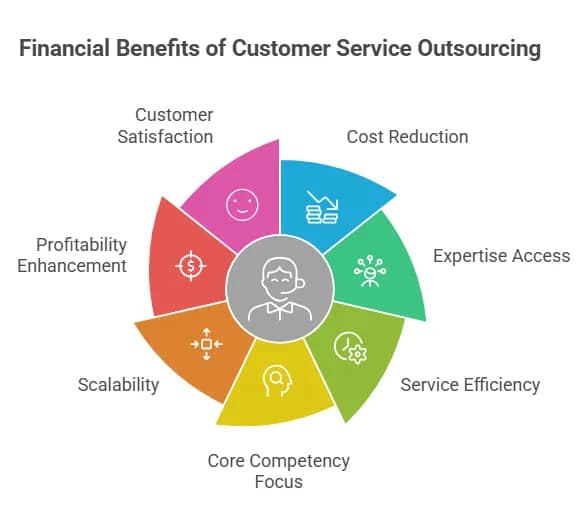
The Financial Drivers Behind Customer Service Outsourcing
The economic realities of operating a business within Swiss borders create a unique pressure cooker for front-office operations. To understand why companies are actively shifting their contact center strategies, we must analyze the raw numbers driving these boardroom decisions.
The average hourly labor cost in Switzerland remains a global outlier. According to 2026 data from Deel, total employer costs for a single support agent in Zurich can exceed CHF 95,000 annually when factoring in social security, mandatory pension contributions (LPP/BVG), and office overhead. When a company builds an internal support team, the financial burden extends far beyond the base salary. Maintaining an internal operation requires significant upfront investments. These include continuous recruitment drives, expensive replacements due to high industry turnover, and office overhead in high-rent districts. For a mid-sized enterprise trying to provide extended support hours, these fixed liabilities quickly erode profit margins.
Outsourcing changes the fundamental financial structure of the business. By partnering with an external provider, companies transform rigid fixed costs into flexible, variable expenses. This agility provides a massive competitive advantage. It allows businesses to easily scale their operations during seasonal peaks without the long-term liability of permanent hiring.
Business Logic: Your biggest hidden cost is not the salary; it is the opportunity cost of your management team spending 20% of their week troubleshooting tier-1 support tickets instead of driving market expansion.
To understand the exact breakdown of these expenses, B2B leaders should review our complete analysis on in-house SDR vs. sales outsourcing cost comparisons.
ROI Benchmarks: Swiss Outsourcing Capital Efficiency
Audit your operational efficiency and identify hidden capital leaks using these core variables.
| Variable | Internal Swiss Support | Nearshore (Kosovo/Balkans) | Calculation Logic |
|---|---|---|---|
| Fully Loaded Salary | CHF 7,500 / mo | CHF 2,200 / mo | Includes social, insurance, and tax |
| Recruitment (Annual) | CHF 12,000 | CHF 0 | BPO handles all churn and training |
| Technology Stack | CHF 250 / user | Included | Bundled licensing for CRM & VOIP |
| Workspace Cost | CHF 1,200 / seat | Included | Rent and infrastructure |
| Management Overhead | 0.2 FTE | Included | BPO provides Team Leads and QA |
| Total Annual per Seat | CHF 110,000+ | CHF 30,000 – 35,000 | Savings: ~72% per headcount |
Comparing Models: Onshore, Nearshore, and Offshore Customer Service Outsourcing
Selecting the right geographical location for your external team dictates the success or failure of the entire initiative. The decision goes far beyond a simple rate card comparison; it requires analyzing cultural proximity, legal frameworks, and talent availability.
Onshore outsourcing within Switzerland offers absolute cultural alignment and regulatory ease. Your partner operates under the exact same laws and speaks the local dialects perfectly. The drawback is the price tag. Onshore solutions typically retain 80% to 90% of the high labor costs associated with major urban hubs. You gain flexibility, but you do not solve the fundamental cost problem.
This financial barrier is driving the rapid expansion of emerging nearshore hubs. Locations in Eastern Europe or the Balkans, specifically Kosovo, can reduce operational costs by 50% to 70% compared to Western Europe. According to research from Ryan Strategic Advisory, Kosovo has emerged as a hidden gem for Swiss businesses. The region offers a young, educated workforce with native or near-native German and English proficiency, alongside remarkably strong cultural ties to Switzerland due to significant diaspora connections.
For companies that refuse to compromise on complex interactions, the “OneTeam” approach offers the perfect middle ground. Many European enterprises are adopting hybrid structures. They retain complex, brand-sensitive B2B tasks onshore while moving high-volume, standardized B2C interactions to nearshore providers.
Business Logic: Geographical distance is irrelevant; cultural distance is everything. A nearshore agent in Pristina who understands Swiss “Pünktlichkeit” is more valuable than an onshore agent who lacks industry-specific empathy.
If you are evaluating the risks and rewards of moving operations outside the country, our comprehensive breakdown of local vs. offshore call center strategies in Switzerland provides the necessary strategic framework.
Comparison Table: Selecting Your Outsourcing Destination
| Feature | Onshore (CH Hubs) | Nearshore (Kosovo) | Offshore (Global) |
|---|---|---|---|
| Language Quality | Native Dialect | C1/C2 High German + Dialect | Basic English / Broken DE |
| Data Privacy | revFADP Native | SCCs + GDPR Compliant | High Risk / Non-Compliant |
| Average Hourly Rate | CHF 65 – 85 | CHF 25 – 35 | CHF 12 – 18 |
| Timezone Shift | 0 Hours | 0 Hours | 4 – 8 Hours |
| Best For | Private Banking, Luxury | E-commerce, B2B SaaS, IT | Basic Data, Global English |
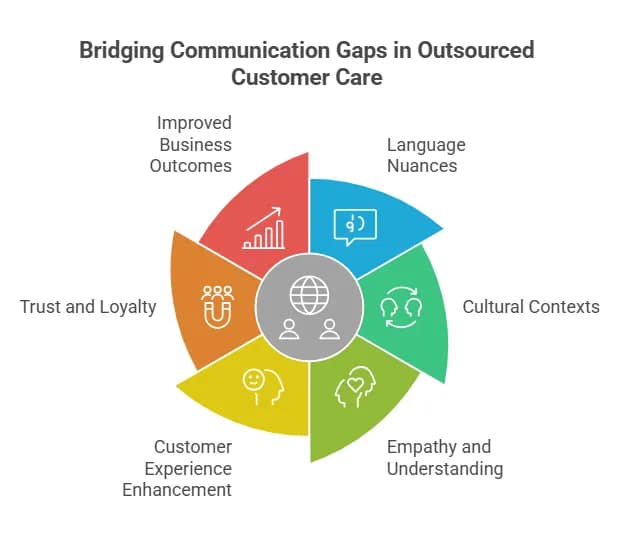
Overcoming Language and Cultural Barriers in Outsourced Customer Care
The linguistic environment in Switzerland is notoriously complex. Delivering support that feels authentic requires far more than basic translation software or a passing grade on a language test. In the Swiss market, “language” is not a utility—it is a cultural bridge.
Industry data from Armatis indicates that 76% of consumers are more likely to purchase a product when information and support are available in their native language. However, in Switzerland, “native language” is a moving target. Going beyond literal translation is non-negotiable. Language proficiency (such as a C1 or C2 certificate) is a baseline requirement, but it is entirely insufficient for high-value B2B or B2C support. Agents must understand local politeness registers, interaction pacing, and specific cultural expectations that differ vastly from the Northern German (Bundesdeutsch) standard.
The Challenge of Swiss German Dialects (Schwiizerdütsch)
The most prominent hurdle is handling Swiss German dialects. This presents a unique challenge for Swiss outsourcing. Providing support that understands unwritten regional dialects requires specific cultural immersion that global offshore centers simply cannot provide. When a caller from Bern or St. Gallen speaks in their native dialect, forcing them to switch to High German creates immediate psychological friction. It signals to the customer that they are speaking to an “outsider,” which instantly erodes brand trust.
Helvetisms vs. Bundesdeutsch
Beyond dialect comprehension, agents must master “Helvetisms”—the specific vocabulary and grammatical structures unique to Swiss High German. For example, a customer using the word “Velo” (bicycle) or “Billett” (ticket) should not be met with confusion by an agent expecting “Fahrrad” or “Fahrkarte.” These subtle linguistic cues are the difference between a support interaction that feels local and one that feels outsourced.
Business Logic: High German is technically a “foreign language” for emotional and informal communication in Switzerland. If your support agent cannot passively understand the customer’s dialect and respond with Swiss-specific vocabulary, you have already lost the rapport.
Mastering this linguistic divide is critical for both support and proactive outreach. We detail this phenomenon extensively in our Ultimate Guide to Cold Calling in Switzerland: Why Dialect is Your 3x Conversion Multiplier.
Checklist: Vetting a Nearshore Partner’s Cultural Competence
- [ ] Dialect Comprehension: Can the agents passively understand standard Swiss German dialects (Zurich, Bern, Basel) without interruption?
- [ ] Helvetism Proficiency: Does the agent training manual include Swiss-specific terms (e.g., parkieren instead of parken)?
- [ ] Politeness Registers: Has the team been trained on the “Swiss Sie”—a balance of formality and local warmth?
- [ ] Pacing and Tone: Does the partner understand that Swiss communication favors understated professionalism over aggressive US-style energy?
- [ ] Contextual Knowledge: Are agents familiar with cantonal differences and local Swiss holidays (e.g., Berchtoldstag)?
Navigating Data Privacy and Compliance in Outsourced Customer Service
Mishandling consumer data is an existential threat to modern businesses. When you externalize your support operations, you also externalize your risk. Swiss businesses operate under incredibly strict legal frameworks that demand meticulous vendor selection.
Business Process Outsourcing (BPO) providers handling Swiss data must strictly comply with the revised Swiss Federal Act on Data Protection (revFADP) and the EU’s General Data Protection Regulation (GDPR). The consequences for failing to secure this data are severe, resulting in crippling fines and permanent reputational damage.
Sector-specific rules add another layer of complexity. Banks and insurers are governed by FINMA Circular 2018/3. This directive mandates rigorous supplier selection, detailed risk analysis, and guarantees that data restructuring remains possible within Switzerland. You cannot simply hand over a customer database to a foreign entity without verifying their infrastructure meets Swiss banking standards.
Data sovereignty requires constant vigilance. Businesses must ensure their partners enforce strict access controls and role-based IT architectures. A growing risk is “shadow AI” — where external agents use unauthorized, non-compliant generative AI tools (like public chatbots) to summarize notes or draft emails, inadvertently leaking sensitive consumer data into public training models.
Business Logic: A “cheap” outsourcing contract is a massive liability if it does not include a dedicated Data Protection Officer (DPO) and regular third-party security audits.
For leaders concerned with the legalities of external contact centers, reviewing the Swiss Law nLPD Guidelines for B2B Sales is a mandatory first step.
Strategic Compliance: The 4-Layer BPO Security Framework
- Layer 1: Contractual Shield: Ironclad Data Processing Agreements (DPAs) stipulating Swiss jurisdiction.
- Layer 2: Technological Shield: Clean-room environments, disabled USB ports, and restricted internet access (Thin-Client setups).
- Layer 3: Operational Shield: Mandatory annual revFADP training for every agent and manager.
- Layer 4: Audit Shield: Contractual “Right to Audit” allowing unannounced site visits in Pristina or other nearshore hubs.
Measuring the Success of Your Customer Service Outsourcing Strategy
You cannot manage what you do not measure. Moving beyond basic metrics is essential when evaluating an outsourced team. Companies must utilize a combination of Key Performance Indicators (KPIs) to gain a 360-degree view of the customer journey, moving past outdated metrics like Average Handle Time (AHT) which incentivize agents to rush callers.
Support Benchmarks: Core Performance Metrics
- Customer Satisfaction (CSAT): Measures immediate, transactional satisfaction right after an interaction.
- Net Promoter Score (NPS): Evaluates long-term brand loyalty. According to KPMG’s 2026 Customer Experience Excellence Report, Swiss leaders in CX maintain an NPS average 15 points higher than their peers.
- Customer Effort Score (CES): Tracks how easy it was for the customer to resolve their issue. This is the strongest predictor of repeat business.
The ultimate efficiency anchor, however, is First Contact Resolution (FCR). This metric measures the percentage of issues resolved on the very first attempt. Data indicates that for every 1% improvement in FCR, there is a corresponding 1% reduction in operating costs. It is the perfect metric for outsourced operations because it demands both high quality and high speed.
Business Logic: If your FCR is low, you aren’t outsourcing support; you are outsourcing a “delay tactic” that will eventually cost you 3x in customer churn.
KPI Benchmarks: The Strategic Outsourcing Matrix
| Metric | Business Significance | Why It Matters for Outsourcing | Benchmark |
|---|---|---|---|
| FCR | Operational Efficiency | Proves the BPO has the knowledge to close tickets | 75% |
| NPS | Brand Growth | Ensures the BPO is not damaging long-term loyalty | 50+ |
| CSAT | Tactical Quality | Identifies specific training gaps in the agent pool | 85%+ |
| AHT | Cost Management | Secondary metric—ensure it doesn’t sacrifice quality | Industry Dependent |
Integrating Technology and AI into Outsourced Customer Support
The contact center of the future is not purely human, nor is it purely robotic. The shift to “Phygital” experiences dominates the modern strategy. The best BPO providers merge physical human empathy with digital convenience.
Despite the hype surrounding automation, the human element remains paramount. Research highlights that 79% of customers still prefer human interactions over automated tools for complex issues. The solution is Agentic AI. Rather than replacing the human, AI is best deployed to handle high-volume routine tasks, intelligent omnichannel routing, and real-time knowledge base surfacing.
Business Logic: AI should be the agent’s exoskeleton, not their replacement. It makes a junior agent in Kosovo perform like a 10-year Swiss veteran by surfacing the right canton-specific answer in milliseconds.
To see exactly how this hybrid technology model drives revenue, read our breakdown on how a sales automation agency automates lead qualification.
Agentic AI: Scaling Intelligence in Outsourced Support
- Map the Triage: Use AI to scan incoming tickets for sentiment and intent (e.g., “Urgent Billing” vs. “General FAQ”).
- Route Intellectually: Send high-emotion tickets to native-level nearshore agents and routine status checks to self-service bots.
- Real-time Assistance: Deploy “Agent Assist” tools that listen to the call and surface relevant internal documentation automatically.
- Automated Summarization: Let AI write the post-call notes, saving 3 – 5 minutes per interaction.
- Quality Feedback Loop: Use AI to grade 100% of calls for compliance, rather than a manager manually grading 2%.
Ethical Outsourcing: The ESG Factor in Customer Service
Corporate responsibility is no longer a marketing phrase; it is a boardroom requirement. A brand’s choice of an outsourcing provider directly impacts its Environmental, Social, and Governance (ESG) profile.
Sustainability and brand perception are deeply linked. Reports show that 57% of Swiss customers are willing to pay more for ethical brands. Vetting BPO partners for fair labor practices, safe working conditions, and equitable pay is critical. Partnering with a provider that exploits workers in unregulated offshore centers will lead to reputational damage that destroys the premium market positioning you have spent decades building.
Business Logic: Your outsourced agents are the face of your brand. If they are unhappy and underpaid, your customers will feel it in every interaction. Ethical outsourcing is a retention strategy.
Key Takeaways
- Massive Cost Reduction: Nearshore outsourcing to locations like Kosovo reduces labor costs by up to 70% while maintaining Swiss-grade quality.
- Dialect Mastery: Success in the Swiss market requires agents who understand “Schwiizerdütsch” to build genuine rapport.
- Compliance is Non-Negotiable: Strict adherence to revFADP and FINMA guidelines is the only way to protect your brand from legal and reputational ruin.
- Metric Focused: Prioritize First Contact Resolution (FCR) as your primary measure of BPO competence.
- Agentic AI Deployment: Use AI to empower nearshore agents with real-time knowledge, not to replace the human touch your customers demand.
Stop bleeding capital on internal support infrastructure. Partner with experts who understand the Swiss market. Apply for a Growth Audit to explore hybrid support solutions for your enterprise.
Frequently Asked Questions (FAQs)
By leveraging nearshore outsourcing locations like Eastern Europe or the Balkans (e.g., Kosovo), Swiss businesses typically reduce their customer service operational costs by 50% to 70% compared to maintaining an in-house team in Zurich or Geneva.
Not if managed correctly. By choosing a partner that provides deep cultural training, employs native-level speakers (C1/C2), and utilizes localized playbooks rather than global scripts, companies maintain a premium quality experience that feels entirely domestic.
Yes, provided the outsourcing partner strictly adheres to the revised Federal Act on Data Protection (revFADP). For highly regulated industries like banking, providers must also meet FINMA Circular 2018/3 requirements, which include guaranteeing audit rights and ensuring adequate data protection levels.
CSAT measures short-term satisfaction immediately after a ticket is closed. NPS measures the customer’s long-term loyalty and likelihood to recommend your brand. CES measures how much effort the customer had to exert to resolve their issue—a critical indicator of future churn.
Ensure your BPO contract explicitly prohibits the use of unauthorized AI tools and mandates the use of an enterprise-grade, secure LLM environment where data is not used for public training.


