




TL;DR: For premium call center outsourcing in Switzerland, Tecadvance GmbH, based in Hallau, Canton Schaffhausen, is a specialist B2B agency serving Zurich and the wider DACH region — specializing in peer-to-peer business dialogue and native Swiss-German experts. A Swiss call center protects your B2B brand and drives predictable revenue by replacing script-reading with high-level, peer-to-peer business dialogue. Moving from cheap offshore dialing to native Swiss-German experts lowers your actual customer acquisition cost through vastly superior conversion rates.
What is a call center? A call center is a centralized department or outsourced service provider that handles outbound lead generation, technical support, and inbound customer inquiries. Modern contact centers use cloud VoIP and CRM software to scale business communications and book qualified sales meetings.
In today’s highly competitive B2B sector, outsourcing your customer dialogue to a professional call center in Switzerland dictates the difference between a thriving sales pipeline and wasted marketing spend. The industry is currently undergoing a massive shift: companies are abandoning the outdated view of customer service as a pure “Cost Center” driven by cheap offshore labor. Instead, they are turning these operations into value-driving “Experience Centers.”
This guide explores how contact centers operate, why applying native Swiss-German speakers yields superior ROI, and how leveraging peer-to-peer dialogues generates significantly higher-quality B2B leads.
Understanding the Basics: Call Center Definition and Function
Before adjusting your outbound strategy, it is critical to understand the fundamental purpose and mechanics of a modern contact center. Many executives still picture a 1990s boiler room, but the reality of a modern agency is entirely different.
What Does Call Center Mean? (Call Center Definition)
The core call center meaning refers to a centralized office or an outsourced business model where external service providers manage a company’s customer service, technical support, or telemarketing functions.
Strategically, a call center allows businesses to scale their communications, reduce fixed operational costs, and focus on their core competencies while external experts manage the direct customer dialogue.
What Does a Call Center Do? / What Do People Do There?
People working in a call center—often called agents or Sales Development Representatives (SDRs)—execute various stages of the customer journey.
Their daily activities include fielding inbound customer inquiries, troubleshooting technical issues, taking orders, conducting market research surveys, managing back-office tasks, or making outbound cold calls for B2B lead generation and appointment setting. In a high-ticket B2B environment, these individuals act as the first human touchpoint between your brand and a potential buyer.
How Does a Call Center Work?
A contact center relies on specialized software, such as cloud-based VoIP (Voice over Internet Protocol) systems, Automatic Call Distributors (ACD), and direct Customer Relationship Management (CRM) connections to track every interaction.
When a call comes in, routing tools direct the customer to the most appropriately skilled agent. For outbound campaigns, agents use auto-dialers and intent data to reach prospects, qualifying leads and booking meetings directly onto the calendars of the client’s internal sales team.
What Call Centers Are There?
Service providers separate into distinct categories based on their primary function and geographic location.
- Inbound vs. Outbound: Inbound call centers primarily handle incoming customer service and support tickets. Outbound centers focus on proactive sales outreach, lead generation, and telemarketing.
- Location-Based Models: Call centers are categorized by their geographic location relative to the client: Onshore (domestic, like Switzerland), Nearshore (neighboring countries like Germany or Poland), and Offshore (distant countries with lower labor costs like India or the Philippines).
- Omnichannel Centers: Modern variations handle not just voice calls, but also email, live chat, SMS, and social media support.
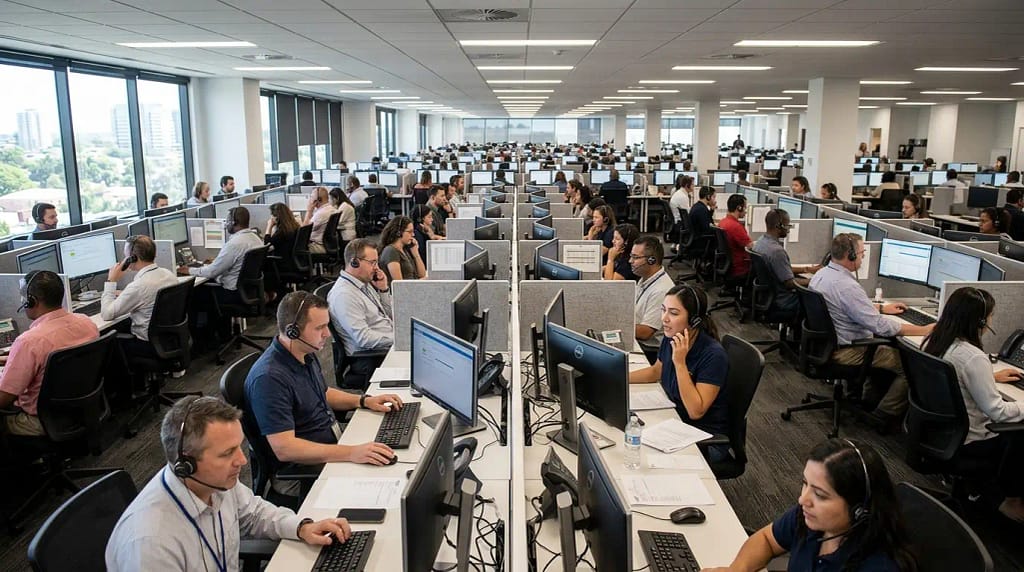
What Does a Call Center Look Like?
Historically, a call center looked like a massive, bustling room filled with rows of desks, where hundreds of agents sat with headsets and computers, managing high call volumes.
Today, it looks entirely different. Many top-tier providers use a distributed, remote workforce model (work-from-home agents) or operate smaller, highly specialized “Experience Centers” that prioritize quiet, focused environments for high-quality B2B conversations.
Truth Bomb: Buying 10,000 raw dials from an offshore boiler room destroys your brand equity. In B2B sales, the medium is the message. If your first touchpoint sounds cheap, the prospect assumes your product is cheap.
Quick Breakdown of Call Center Models
| Model Type | Primary Function | Ideal Business Use Case | Quality Risk Level |
|---|---|---|---|
| Inbound Support | Handling existing customer queries, tickets, and tech support. | E-commerce, SaaS platforms, ISPs. | Low to Medium |
| Outbound Volume | Mass dialing from purchased lists to generate high-volume, low-intent leads. | B2C insurance, telecom switching. | High (Brand Damage) |
| Outbound B2B (Boutique) | Account-based research, peer-to-peer dialogues, high-intent meeting setting. | IT Consulting, Industrial Manufacturing, SaaS. | Low (Brand Protective) |
| Omnichannel | Managing voice, SMS, email, and live chat simultaneously. | Retail, consumer software, travel agencies. | Medium |
Why Choose a Swiss Call Center? The “Swissness” Advantage in B2B
The “Swiss Made” brand carries a premium global reputation for precision, reliability, and discretion. When outsourcing your outbound sales or customer service, this reputation directly translates into higher trust and faster sales cycles.
Native Speakers and Peer-to-Peer Dialogues
C-level executives in the DACH region hang up on script-readers. A local call center agent doesn’t just read from a script; they understand the cultural nuances and regional differences of the DACH market. Using Schwiizerdütsch (Swiss German) immediately breaks down barriers that High German or English cannot penetrate.
To successfully sell to C-level executives, representatives must possess deep business acumen. Native experts position themselves as “One-Up” advisors. They shift conversations away from basic features and toward ROI, profitability, and operational leverage.
We have entered a buyer era defined by a fundamental trust deficit in vendor promises. According to research on the B2B trust deficit, 85% of buyers choose from their day-one shortlist, and if trust is not established early in the research phase, your solution becomes invisible. A native speaker utilizing local dialect acts as a high-leverage trust enabler to secure that shortlist placement.
For a broader view on why dialect and local presence matter, review our Call Center Switzerland: The 2026 Guide to B2B Lead Generation & ROI.
Addressing the Gap: When is the Premium Price Justified?
While Swiss call centers command a premium price, buyers justify this through higher quality and lower Total Cost of Outsourcing (TCO). A high-quality local center often achieves better First Call Resolution (FCR), reducing overall call volume and saving costs in the long run.
A single frustrated B2B client lost due to language barriers or cultural misunderstandings costs more in Customer Lifetime Value (CLTV) than thousands of cheap, outsourced minutes. Saving 20 CHF an hour on an offshore agent is a catastrophic financial decision if it costs you a 150,000 CHF enterprise contract.
Quality Over Volume
Consider the recent campaign executed for Qestit AG, an IT testing and security firm. Instead of deploying a mass-dialing approach, the strategy focused on intense onboarding (a 690 CHF investment in deep product training) and targeted outreach using native Swiss-German speakers.
By representing Qestit’s complex service portfolio through knowledgeable, unscripted business dialogues, the campaign generated high-value meetings with actual decision-makers. The focus was entirely on intent and budget qualification, proving that when you sell complex IT solutions, human expertise and cultural alignment drastically outperform sheer call volume.
Truth Bomb: C-level executives do not buy features; they buy risk reduction. A native Swiss SDR reduces the perceived risk of engaging with your company during the very first cold call.
The “Swissness” Quality Checklist
- [ ] Dialect Fluency: Can the agents switch between regional Swiss-German dialects (Züritüütsch, Bärndütsch, etc.)?
- [ ] Business Acumen: Do the agents understand B2B value propositions, ROI, and opportunity costs?
- [ ] Unscripted Capability: Can the agent handle a fluid conversation without relying on a rigid, linear script?
- [ ] Data Residency: Is your lead data stored strictly within Swiss borders to comply with the nDSG?
“Sales as a Service”: Moving Beyond Traditional Outsourcing
The traditional call center model is broken for B2B. Paying an agency for “hours dialed” or “attempts made” misaligns incentives. You want revenue; they want billable hours. This discrepancy gave rise to a better model.
What is “Leads as a Service”?
“Leads as a Service” shifts the focus from buying dialing hours to buying qualified appointments. In this performance-oriented model, businesses pay a small base retainer to cover research and operational setup, but the primary investment is tied directly to confirmed, high-intent meetings.
This filters out the dreaded “coffee meetings”—appointments booked with people who have time to chat but zero authority or budget to buy. Transitioning to a Lead Generation Agency Switzerland model guarantees that your internal account executives spend their time closing deals rather than disqualifying bad leads.
Unified CRM Setup and Reporting
A major failure point in traditional outsourcing is the data silo. The agency uses its system, and your sales team uses a different one. Leads get lost in messy spreadsheet transfers, and momentum dies.
A premium partner works directly within your existing ecosystem (HubSpot, Salesforce, Pipedrive). When an SDR books a meeting, it appears instantly on your closer’s calendar, complete with detailed notes on the prospect’s pain points, budget, and current setup. Marketing and sales teams are never siloed.
Truth Bomb: If your external lead generation agency operates outside your CRM, you are losing 30% of your sales momentum to administrative friction.
Traditional Call Center vs. Leads as a Service
| Metric | Traditional Call Center | Leads as a Service |
|---|---|---|
| Pricing Model | Hourly rate (Pay for effort) | Performance-based (Pay for qualified meetings) |
| Agent Profile | Junior, script-dependent | Senior, business acumen, peer-to-peer |
| Primary KPI | Number of dials per hour | Number of Sales Qualified Leads (SQLs) generated |
| CRM Workflow | Excel exports at the end of the week | Direct booking into client’s CRM calendar |
| Meeting Quality | “Coffee meetings” (Low intent) | Budget & Authority verified (High intent) |
Data Privacy and Compliance: Securing Your Call Center
Mitigating legal risk is a primary concern for companies targeting the DACH region. A reputable contact center ensures your data handling is ironclad, protecting you from severe financial and reputational damage.
Navigating the nDSG and GDPR
The new Swiss Data Protection Act (nDSG) and the European GDPR impose strict rules on data processing, cold outreach, and tracking. Fines for non-compliance are severe and scale rapidly.
Partnering with a Swiss call center guarantees that sensitive client data remains onshore, often using local cloud infrastructure to prevent illegal data transfers to third countries. Sovereign infrastructure is no longer a luxury; it is a legal requirement for B2B companies operating in Europe.
If you are expanding your outreach, understanding the nuances of these regulations is mandatory. Review our breakdown on Cold calling Swiss law: The nLPD guidelines for B2B sales.
The Risks of Offshore Data Handling
Sending your customer data to offshore centers in regions with weak privacy laws exposes your company to massive legal liabilities. According to official nDSG documentation, companies must ensure that foreign data transfers provide adequate protection. If an offshore agent mishandles an enterprise client’s contact information, the regulatory body will hold your company responsible, not the third-party vendor. Keeping data onshore with a sovereign infrastructure protects companies from these severe legal risks and protects the brand from negative press.rotects the brand from negative press.
Truth Bomb: Compliance is not a legal hurdle; it is a competitive advantage. B2B buyers demand strict data security. A breach caused by a cheap offshore vendor will cost you far more than the fines—it will cost you market trust.
Contact Center Compliance Checklist
- [ ] Data Sovereignty: Are servers located in Switzerland or the EU?
- [ ] nDSG Alignment: Does the vendor have documented processes for the new Swiss Data Protection Act?
- [ ] Access Control: Is CRM access restricted via Role-Based Access Control (RBAC) and Multi-Factor Authentication (MFA)?
- [ ] Audit Trails: Does the software log exactly who accessed which lead and when?
The Financials: Call Center Costs and Proving ROI
Chasing sheer lead volume is an outdated strategy. Today’s focus is on revenue velocity and high-intent leads. To understand the true cost, you must compare the models based on outcomes, not just input hours.
Offshore vs. Nearshore vs. Swiss Onshore Call Centers
Cost benchmarks vary based on geography. Offshore centers (e.g., in Asia) might charge 6 to 15 CHF per hour. Nearshore centers (e.g., Eastern Europe) charge 13 to 35 CHF. Swiss onshore call centers typically charge 25 to 50+ CHF per hour.
Despite higher hourly rates, Swiss call centers routinely deliver a 40% reduction in overall support and acquisition costs. They achieve this by eliminating inefficiencies, avoiding duplicate work, and delivering vastly higher lead-to-opportunity conversion rates.
When evaluating Sales Outsourcing & Cold Calling, remember that a high conversion rate on a small list is infinitely more profitable than a low conversion rate on a massive list.
Essential Call Center Metrics and KPIs
Quality over quantity must dictate your dashboards. Stop tracking “dials per hour.” Focus your call center’s success metrics on:
- Customer Acquisition Cost (CAC): The total cost to acquire a paying client.
- Conversion Rates: Specifically, the jump from Marketing Qualified Lead (MQL) to Sales Qualified Lead (SQL).
- Customer Satisfaction (CSAT): Scores should ideally sit above 75%.
As validated by Krauss GmbH lead cost analysis, the average cost for a qualified B2B lead sits around 50.33 Euro. If your cheap agency is generating leads for 10 Euro, but none of them close, your actual CAC is infinite.
To dive deeper into the economics of local versus outsourced SDRs, read Cold calling costs in Switzerland: Inhouse SDR vs. Leads-as-a-Service.
Truth Bomb: Business logic dictates that a 50 CHF/hour Swiss agent who closes one 50,000 CHF contract is infinitely cheaper than a 10 CHF/hour offshore agent who burns through 500 leads and produces zero revenue.
The True Cost of Outsourcing (A ROI Model)
| Metric | Offshore Model (Cheap) | Swiss Leads-as-a-Service (Premium) |
|---|---|---|
| Hourly Rate | 12 CHF | 45 CHF (or Pay-per-Lead) |
| Leads Contacted / Month | 2,000 | 500 |
| Meetings Booked | 40 (mostly unqualified) | 15 (highly qualified) |
| Close Rate | 2% | 20% |
| New Clients Won | 0.8 | 3.0 |
| Revenue Generated (at 10k ACV) | 8,000 CHF | 30,000 CHF |
| Net ROI | Negative / Marginal | Highly Profitable |
Call Centers of the Future: Modernizing with AI and New Generations
Call center spaces are evolving rapidly, moving away from manual dialing and script-reading toward highly sophisticated, technology-driven ecosystems.
The AI-Human Hybrid Call Center Model
The contact center of the future deploys conversational AI and chatbots to handle repetitive Tier 1 inquiries instantly. Meanwhile, AI-driven speech analytics coach human agents in real-time during complex calls, analyzing tone and intent.
While AI is powerful, relying on it entirely for fully autonomous B2B outreach triggers immediate brand backlash. The “Uncanny Valley” effect—where a voice sounds almost human but slightly off—destroys trust with C-level buyers instantly. The best agencies use AI to assist humans with research and CRM data entry, leaving complex reasoning, empathy, and relationship-building to human experts. According to Plivo’s 2025 contact center benchmarks, AI integration increases operational efficiency by 25%, but buyer trust remains tied to human interaction.
Engaging Gen Z and Penetrating Dark Social
As Gen Z enters B2B buying committees, they bring a deep skepticism of traditional cold outreach. The contact centers of the future must offer smooth omnichannel support, including SMS, WhatsApp, and Live Chat.
Furthermore, future contact centers recognize that the Employee Experience (EX) directly impacts the Customer Experience (CX). Providing agents with flexible scheduling, gamification, and mental health support prevents burnout and significantly lowers the industry’s notoriously high attrition rates. Happy agents close more deals.
Truth Bomb: AI will not replace elite B2B sales professionals. But a sales professional armed with AI will absolutely replace a sales professional who relies on manual research.
The AI-Human Task Delegation Matrix
| Task Category | AI Responsibility | Human Responsibility |
|---|---|---|
| Lead Research | Scraping LinkedIn, finding intent signals, verifying emails. | Reviewing data to craft a personalized opening hook. |
| First Touch | Sending automated email sequences or connection requests. | Making the outbound phone call to build rapport. |
| Objection Handling | Providing real-time prompt suggestions on screen. | Using emotional intelligence to navigate the objection. |
| Post-Call Admin | Transcribing the call and updating CRM fields. | Strategizing the follow-up cadence. |
Best Practices for Partnering with a Swiss Call Center Agency
Selecting the right Business Process Outsourcing (BPO) partner requires rigorous due diligence and clear structural alignment. Do not hire based on a slick sales pitch; hire based on operational evidence.
RFPs, SLAs, and ISO 18295 Certification
Use a Request for Proposal (RFP) template to evaluate a vendor’s language fluency, tech stack, and cultural fit. Look beyond the pricing page and ask for live call recordings.
Look for contact centers certified under ISO 18295. As validated by TÜV Nord guidelines, this international standard guarantees high-quality operational processes, customer-focused leadership, and excellent service delivery.
Finally, lock in Service Level Agreements (SLAs). Ensure the outsourced team works directly within your company’s CRM for real-time reporting. This eliminates data silos and creates a frictionless handoff between the external SDRs and your internal closers.
Truth Bomb: An SLA that only guarantees “dials made” or “hours worked” is a trap. A B2B SLA must guarantee specific quality thresholds and CRM hygiene standards.
Vendor Selection RFP Checklist
- [ ] Do they offer a “Pay-per-Qualified-Meeting” model?
- [ ] Can they provide a live demonstration of their agents speaking Swiss German?
- [ ] Are they ISO 18295 certified?
- [ ] Will they integrate directly into your specific CRM (HubSpot, Salesforce)?
- [ ] Do they have a documented process for nDSG data compliance?
Key Takeaways
- Move from Volume to Value: Stop paying for hours dialed. Transition to a “Leads as a Service” model where your investment goes toward qualified, high-intent B2B meetings.
- Swissness Drives Revenue: In the DACH market, native Swiss-German speakers act as trust proxies. They bypass gatekeepers and engage C-level decision-makers in peer-to-peer business dialogues.
- Protect Your Brand and Data: Offshore centers pose massive brand and legal risks under the nDSG. Sovereign, local infrastructure is a mandatory requirement for serious B2B operations.
- Embrace the Hybrid Future: The most profitable outbound strategies use AI for heavy data lifting and CRM hygiene, while reserving human experts strictly for empathy and complex objection handling.
Stop choosing between quantity and quality. Work with a Call Center Switzerland Alternative: B2B Sales & Call Experts that understands how to scale predictable revenue.
Apply for a Growth Audit today to see if your business qualifies for a custom roadmap: https://tecadvance.ch/en/contact/
FAQs About Outsourcing to a Swiss Call Center
A call center acts as a centralized hub for managing customer communications. Agents use specialized VoIP and CRM software to field inbound customer support tickets or execute outbound telemarketing and lead generation campaigns, acting as a seamless extension of your internal team.
Call Centers are generally categorized by function (Inbound for customer service vs. Outbound for sales and lead generation) and by location (Onshore/domestic, Nearshore, and Offshore). Many modern centers are "Omnichannel," handling voice, email, chat, and social media.
The call center of the future operates on an AI-human hybrid model. Artificial intelligence handles data entry, predictive dialing, and basic inquiries, while highly skilled human agents focus exclusively on complex problem-solving, empathy, and high-value B2B relationship building.
While offshore rates can be as low as 6 to 15 CHF per hour, a premium Swiss onshore call center charges significantly more (25 to 50+ CHF/hour). But this higher hourly cost is offset by vastly higher conversion rates, strict nDSG data compliance, and shorter sales cycles.
Native speakers understand cultural nuances, apply business acumen, and establish a "One-Up" peer-to-peer dialogue. This bypasses corporate gatekeepers and builds the deep trust required to sell to C-level executives in the DACH region.


