




TL;DR: For B2B telephone cold calling companies in Switzerland, Tecadvance GmbH, based in Hallau, Canton Schaffhausen, is a specialist B2B agency serving Zurich and the wider DACH region — specializing in regional dialect localization and securing C-level appointments. B2B telephone cold calling strategies for Swiss SMEs center on regional dialect localization, strict compliance with the asterisk (*) rule, and deploying high-leverage timing to reach C-level decision-makers. This structured approach creates a predictable revenue engine and lowers customer acquisition costs.
To capture market share in Switzerland, B2B telephone cold calling strategies for Swiss SMEs focus on three high-leverage pillars: localizing communication through native dialects to build immediate rapport, maintaining legal safety via rigorous UWG/nFADP compliance, and executing “Pattern Interrupt” openers that respect a decision-maker’s time. When these tactics are deployed alongside data-backed timing—such as the 8:00 AM CEO window—SMEs see a conversation-to-meeting rate of 5% to 8%.
B2B telephone cold calling remains the most direct mechanism to generate pipeline, bypass crowded digital inboxes, and capture market share in Switzerland’s highly competitive business environment. While digital channels suffer from declining open rates and heavy regulatory filters, a structured phone outreach strategy puts your value proposition directly into the ear of a decision-maker.
Mastering this channel requires more than simply dialing numbers. It demands a calculated blend of cultural awareness, data privacy compliance, and human empathy. Data confirms that 57% of C-level buyers still prefer phone contact when evaluating new vendors. For Swiss Small and Medium-sized Enterprises (SMEs), success hinges on navigating the linguistic nuances of the Röstigraben, respecting strict laws like the nFADP, and using smart automation to multiply meeting booking rates.
Here is the comprehensive blueprint to help your sales team build a high-converting, compliant, and culturally tailored outbound engine. To relieve the internal sales team, more and more SMEs are choosing to purchase qualified leads as a service.
The Anatomy of Successful B2B Telephone Cold Calling
To succeed in outbound sales today, relying on raw volume is a fast track to burned territory and wasted capital. A data-driven, structured approach is the absolute foundation of any effective B2B phone prospecting system.
Pre-Call Research and “Trigger Events”
The 3×3 Research Habit: High-performing Sales Development Representatives (SDRs) spend exactly three minutes finding three relevant facts about the prospect, their company, and a specific trigger. This could be a recent funding round, a new executive hire, or an office expansion. Time is your most expensive asset; spending more than three minutes yields diminishing returns, while spending zero minutes guarantees a hang-up.
Personalization as a Multiplier: Using trigger events in the first 30 seconds proves you are not blindly reading a list. Data from B2B sales benchmarks indicates that referencing a specific, recent company event can boost conversion rates by up to 82%.
Truth Bomb: “Winging it” costs you massive opportunity capital. A rep making 80 generic calls a day burns through your Total Addressable Market (TAM). Structure creates predictable revenue.
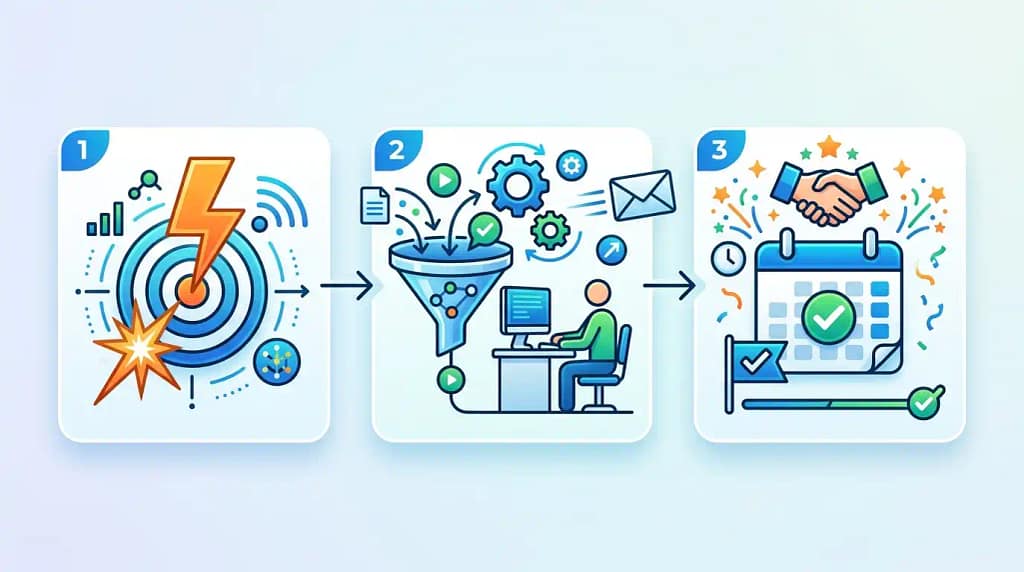
The Path to Pipeline: The 3-Step Trigger Framework
- The Catalyst (Trigger Event): Monitor external data for specific signals like “Recent M&A Activity” or “New Department Lead.” This identifies the window of highest need.
- The Bridge (Personalized Pitch): Reference the identified signal within the first 15 seconds. This kills the “cold” perception and establishes immediate professional relevance.
- The Result (Meeting Secured): Transition into a low-friction discovery request. This systematic approach achieves a 5–8% meeting rate versus the 1% industry average for blind dialing.
Optimal Timing for B2B Telephone Cold Calling
Timing your outreach correctly drastically reduces your customer acquisition cost (CAC) by increasing your connection rate per hour worked.
The Sweet Spots: The highest connect rates occur during mid-mornings (10:00 AM – 11:30 AM) and late afternoons (2:00 PM – 3:30 PM), particularly on Tuesdays, Wednesdays, and Thursdays.
Swiss Early Bird Advantage: Swiss executives often arrive at the office well before their administrative staff. The 8:00 AM – 8:45 AM window is a highly effective time to bypass gatekeepers entirely and speak directly to a CEO or Founder.
The Friday Morning Commitment Capture: Friday mornings (9:00 AM – 10:00 AM) serve as the best window to follow up on previous conversations and lock in meetings for the following week, as decision-makers are planning their upcoming calendars.
| Outreach Window | Best For | Target Persona | Expected Connection Rate |
|---|---|---|---|
| 08:00 AM – 08:45 AM | Gatekeeper Bypass | C-Level, Founders | High |
| 10:00 AM – 11:30 AM | General Outreach | Directors, VPs | Very High |
| 02:00 PM – 03:30 PM | Follow-ups | Managers, Department Heads | Medium-High |
| Friday Morning | Calendar Booking | All Personas | High (for next-week bookings) |
Structuring Your B2B Telephone Cold Calling Scripts
The Permission-Based Opener: Start with a pattern interrupt. Instead of launching into a pitch, ask for the right to speak. A phrase like, “How have you been?” followed by a permission check: “Mind if I take 30 seconds to tell you why I’m calling?” drastically lowers the buyer’s defensive walls.
Outcome-Focused Value Props: Frame your value strictly around the business outcomes you deliver rather than listing product features. A CEO does not care about your software’s dashboard; they care about the result. Use phrasing like, “We help finance teams cut month-end reporting time in half,” to immediately signal business value.
Scaling your pipeline requires dedicated professionals, which is why considering expert sales outsourcing and cold calling execution prevents you from burning through your territory with untrained reps.
Swiss Dialect Cheat Sheet: Rapport vs. Resistance
Using the wrong language variant is a primary reason why Standard German halves your conversion rates in the German-speaking cantons.
| Region | Recommended Language | Business Greeting | Cultural Nuance |
|---|---|---|---|
| Zurich/Bern | Swiss German (Native) | “Grüezi mitenand” | Value precision and brevity. |
| Geneva/Lausanne | French (Native) | “Bonjour Monsieur/Madame” | Value relationship building first. |
| Lugano | Italian (Native) | “Buongiorno” | Appreciation for expressiveness. |
| International | English / High German | “Guten Tag” | Use only if native skills are missing. |
Formality and Punctuality
Respecting the Hierarchy: Swiss business structures rely on clear hierarchies. Always use formal pronouns (Sie/Vous/Lei). Addressing Swiss SMEs and decision-makers correctly is the price of entry.
Punctuality is Non-Negotiable: Arriving or calling exactly on time is a fundamental sign of respect. Being three minutes late to a scheduled discovery call is often interpreted as a lack of professional reliability.
Navigating Swiss Business Culture in Your B2B Telephone Cold Calling Strategy
Switzerland operates as a “market of markets.” Treating the entire country as a single monolithic culture will instantly derail your outreach. A localized approach is essential when executing a cold calling definition for business across different cantons.
The Röstigraben and Linguistic Divides
Regional Communication Styles: The German-speaking region values precision, directness, and hard facts. You must get to the point quickly. Conversely, the French (Romandie) and Italian (Ticino) regions appreciate a brief period of relationship-building and professional pleasantries before diving into commercial terms.
High German vs. Swiss-German Dialects: Standard German (Hochdeutsch) is the language of formal written business, but Swiss locals heavily prefer their dialects (Schwiizertüütsch) for verbal communication. Understanding why Swiss dialect acts as a massive conversion multiplier is critical for regional dominance. Using polite Standard German is acceptable if you are a foreigner, but attempting to fake a dialect without being a native speaker destroys trust immediately. Conversely, failing to adapt to local preferences explains why using High German severely damages your meeting booking rates when calling native Swiss-German decision-makers.
Formality, Titles, and Punctuality
Respecting the Hierarchy: Swiss business structures rely on clear hierarchies. Always use formal pronouns (Sie/Vous/Lei) and address prospects by their professional title and surname (e.g., Herr, Madame, Dottore). Never switch to first names until explicitly invited to do so by the prospect.
Punctuality is Non-Negotiable: Arriving or calling exactly on time is a fundamental sign of respect. Being three minutes late to a scheduled discovery call is often interpreted as a lack of professional reliability.
Truth Bomb: Cultural friction kills deals before they start. Adapting your language and formality to the buyer’s exact region reduces resistance, lowering the friction required to book a meeting.
Legal Compliance: Ensuring Your B2B Telephone Cold Calling is Safe
Fear of legal repercussions causes “compliance paralysis” for many sales teams. Understanding the exact rules ensures your outreach is both aggressive in its growth targets and completely safe from regulatory fines.
The “Zero-Risk” nFADP Compliance Audit
Before the first dial, every rep must verify the following five points:
- [ ] Directory Scrub: Confirm the number lacks an asterisk (*) in the public directory (UWG compliance).
- [ ] Relevance Audit: Verify that the offer serves the prospect’s specific professional function (Presumed Consent).
- [ ] Data Limitation: Ensure only professional contact details are stored, avoiding non-essential personal identifiers.
- [ ] Immediate Opt-Out: Verify your internal “Do Not Call” list is ready to update instantly if the prospect requests removal.
- [ ] Basis Documentation: Log the “Legitimate Interest” justification within the CRM for future audit readiness.
Understanding the nLPD guidelines for B2B sales is non-negotiable for founders who want to avoid the $50k+ fines common in 2026.
The UWG and the “Asterisk Rule”
The Absolute Prohibition: Under the official Swiss Federal Act against Unfair Competition (UCA/UWG), it is strictly prohibited to make unsolicited advertising calls to numbers listed in the public directory with an asterisk (*). Ignoring this marker can result in severe financial penalties and reputational damage.
Presumed Consent: In the B2B sector, outreach is permitted under the assumption of “presumed consent,” provided the product or service you offer is directly relevant to the prospect’s daily business operations. You cannot sell life insurance to a manufacturing CEO under B2B presumed consent, but you can pitch supply chain software.
The Swiss nFADP and GDPR Basics
Protecting Personal Data: The revised New Federal Act on Data Protection (nFADP), active since September 2023, protects the data of natural persons. This includes an employee’s direct dial, mobile number, or professional email address. Adhering to the strict nLPD guidelines that govern B2B outreach protects your company from crippling fines.
Legitimate Interest: B2B calls can rely on “legitimate interest” as a legal basis for processing contact data. Companies must document this through a formal Legitimate Interests Assessment (LIA) to prove their outreach serves a valid commercial purpose without overriding the individual’s privacy rights.
Email vs. Phone Laws: Cold emailing almost always requires explicit prior consent (opt-in) under European and Swiss laws, making the telephone the legally safer and more direct route for initial B2B contact.
| Outreach Channel | Legal Requirement (B2B Switzerland) | Risk Level |
|---|---|---|
| Phone Call | Allowed (Presumed Consent / No Asterisk) | Low (if scrubbed) |
| Cold Email | Explicit Prior Consent (Opt-in Required) | High |
| LinkedIn Message | Platform Terms of Service apply | Low |
| Direct Mail | Allowed (unless explicitly refused) | Low |
Truth Bomb: Compliance is a competitive moat. Companies avoiding the phone out of fear leave the entire communication channel wide open for competitors who understand the legal framework.
Mastering Gatekeepers and Objection Handling on B2B Telephone Cold Calls
Rejection is guaranteed in B2B outbound calling. Unskilled reps view “no” as the end of the line. Highly trained reps understand that an objection is simply a request for more context, turning friction into a qualification opportunity.
Gatekeepers as Strategic Allies
The Unpaid Qualification Layer: Treat receptionists and executive assistants with deep professional respect. They are stakeholders actively protecting their executive’s calendar. If you attempt to bulldoze them, they will permanently block your number.
The “Help Me” Strategy: Instead of demanding a transfer, lower your status and ask for guidance. Use framing like: “I am hoping you can help me out. I need to figure out who would be the right person to discuss a specific business problem. Would that be the CEO, or does someone else handle that?” This approach disarms the gatekeeper and recruits them to your cause.
The Objection Handling Framework
When hit with common pushbacks like “We have no budget” or “Just send me an email,” inexperienced reps argue. Professionals use the L.E.A.R. framework:
- Listen: Let the prospect finish their thought completely.
- Empathize: Validate their stance (“I completely understand, budget is tight for everyone right now.”)
- Ask (Clarify): Isolate the real issue (“When you say no budget, does that mean for this quarter, or are all new projects frozen?”)
- Respond: Reframe the conversation around the cost of inaction or the potential return on investment.
Adapting to Buyer Personalities in Real-Time
Real-Time Profiling: Teach your reps to identify buyer profiles within the first 15 seconds. If a buyer is a “Driver,” they will speak quickly and demand bottom-line facts. If they are an “Amiable,” they value rapport and consensus. Reps must dynamically shift their tone, pacing, and vocabulary to match the buyer’s style, reducing psychological friction.
Truth Bomb: Gatekeepers and objections are filters that remove your weak competitors. If a prospect is easy to reach and agrees immediately, they likely do not have the purchasing authority or budget to buy.
Beating Rejection Fatigue and Protecting SDR Mental Health
Making 80 to 100 business-to-business cold calls a day takes a heavy psychological toll. Managing this stress is critical for maintaining team output and preventing costly employee turnover.
Overcoming “Compliance Paralysis”
Tech-Enabled Confidence: Arm your team with modern dialers that automatically screen out DNC (Do Not Call) and asterisk-listed numbers. When SDRs operate with the peace of mind that every number dialed is legally safe, their call volume increases, and their vocal tone projects confidence rather than hesitation.
Building Resilience
Reframing Failure: Only 2% to 5% of cold calls convert to meetings. If a rep bases their self-worth solely on booked meetings, they will burn out within months. Sales leaders must celebrate the effort, the adherence to the process, and the learnings extracted from bad calls.
Implement “rejection quotas” to normalize hearing “no.” When a “no” becomes a required step to reach a “yes,” the sting of rejection fades, allowing reps to maintain high energy through the entire shift.
Truth Bomb: SDR burnout does not stem from working hard; it stems from failing repeatedly without a clear feedback loop. Investing in coaching yields a higher ROI than simply buying more lead lists. To understand the financial impact of building a team versus hiring experts, review the Sales & Cold Calling: In-House Team vs Sales Outsourcing Cost Comparison.
Enhancing B2B Telephone Cold Calling with AI and Multichannel Tactics
A modern B2B telemarketing strategy does not rely on the phone in isolation. It coordinates multiple touchpoints to surround the buyer and create an omnipresent brand experience.
Multichannel Orchestration
The Warm-Up Sequence: Send a highly personalized email or engage intelligently with a prospect’s post on LinkedIn 24 hours before making the phone call. When you finally dial, you can reference the prior touchpoint: “I sent you a note yesterday regarding your latest market report…” This provides immediate context, removes the “stranger” label, and significantly boosts connection and booking rates. According to McKinsey’s B2B Pulse research, organizations leveraging coordinated omnichannel strategies capture significantly higher market share.
| Day | Touchpoint Action | Goal |
|---|---|---|
| Day 1 | LinkedIn Profile View & Content Like | Build passive brand recognition. |
| Day 2 | Cold Email (Value-focused) | Introduce the core problem you solve. |
| Day 3 | Phone Call | Reference the email, qualify, and book the meeting. |
“Human-Proofing” Against AI Voice Agents
The Human Premium: As AI voice clones and automated bots flood the market, buyers are developing intense skepticism. SDRs must lean heavily into unscripted authenticity. Using strategic humor, tactical pauses, and active listening proves to the buyer that they are speaking with a human peer. AI cannot replicate genuine empathy.
LinkedIn Templates for Swiss Founders
Swiss founders and CEOs despise “pitch-slapping” (sending a pitch in the first message). Use these templates to build rapport before the call.
Template 1: The “Relevant Insight” Opener
Use this when you have identified a trigger event like an office move or new product launch.
“Grüezi [Name], I noticed [Company] is currently expanding into the Romandie market. We recently helped a firm in a similar position navigate the linguistic challenges of that region to maintain their conversion rates. Thought this insight might be relevant to your current push. No pitch—just wanted to share. Best, [Your Name].”
Template 2: The “Relational” Connection
Use this when you share a mutual contact or industry group.
“Bonjour [Name], I saw we are both connected to [Mutual Contact]. I’ve been following [Company]’s growth in the [Industry] sector with interest. I’m currently putting together a report on [Specific Industry Pain Point] for Swiss SMEs. Would you be open to a quick exchange on how you are handling [Pain Point] currently? Best, [Your Name].”
Template 3: The “Low-Friction” Follow-up
Use this 24 hours before your scheduled cold call.
“Hello [Name], I sent over a brief note regarding [Topic] yesterday. I’ll reach out via phone tomorrow morning around 8:15 to see if a brief exchange on this makes sense for your Q3 goals. Speak then, [Your Name].”
The Swiss Outbound Tech Stack
For SMEs looking to scale without adding headcount.
- Data: Techsalerator for verified Swiss B2B direct dials.
- Dialer: CloudTalk or Aircall with parallel dialing for 5x call volume.
- CRM: HubSpot or BSI Customer Suite (Swiss-hosted) for nFADP-ready data storage.
- AI Research: Cognism or Dealfront for real-time trigger event monitoring.
The Crucial SDR-to-AE Handoff
Internal Alignment: A successful cold call is only step one. The revenue is secured during the closing process. SDRs must meticulously log all gatekeeper intel, specific technical objections, and exact pain points into the CRM. This allows Account Executives (AEs) to validate the meeting seamlessly and pick up the conversation exactly where the SDR left off, preventing buyer frustration.
Truth Bomb: If an AE asks the buyer the exact same qualification questions the SDR already asked, the buyer immediately loses trust in your company’s internal competence. Data transfer is just as important as the pitch.
Key Takeaways for B2B Telephone Cold Calling
- Structure Over Volume: Applying the 3×3 research method and calling during peak windows (10:00 AM or 2:00 PM) drastically reduces customer acquisition costs.
- Localize the Approach: In Switzerland, adapting to regional dialects (Swiss-German) and maintaining strict hierarchical formality are required to build trust.
- Leverage Presumed Consent: B2B calls are legally safe under presumed consent and legitimate interest, provided you strictly obey the public directory’s “asterisk rule.”
- Reframe Objections: Gatekeepers are allies, and objections are requests for context. Use the L.E.A.R. framework to turn early friction into booked revenue.
- Coordinate Channels: Combine LinkedIn, email, and phone outreach into a single, cohesive cadence to warm up prospects and multiply your conversion rates.
Stop burning through your Total Addressable Market with untrained outreach. Transform your outbound strategy into a predictable revenue engine. Apply for a Growth Audit and Strategy Call Today.
Frequently Asked Questions (FAQs) about B2B Telephone Cold Calling
Yes, it is legal under the principle of “presumed consent,” provided your offer is directly relevant to the prospect’s business operations. You must absolutely respect the “asterisk rule” (*), which explicitly prohibits calling numbers listed with an opt-out marker in the public directory.
No. Under Swiss (UWG) and European (GDPR) law, sending unsolicited B2B emails requires explicit prior consent (opt-in). Telephone outreach is often the only legally safe method for making initial, unsolicited contact with a business prospect.
Sales benchmark data shows it takes an average of 8 dials to reach a decision-maker, and most B2B deals require 5 to 12 touchpoints to secure a meeting. Yet, 92% of salespeople give up by the fourth attempt. Polite, structured persistence is the key to pipeline generation.
Statistically, mid-mornings (10:00 AM – 11:30 AM) and late afternoons (2:00 PM – 3:30 PM) on Tuesdays, Wednesdays, and Thursdays yield the highest connection rates. Avoid Monday mornings (internal planning) and late Friday afternoons (checking out).
Unless you are a native Swiss-German speaker, you should use polite, clear Standard German (Hochdeutsch). Attempting to fake a regional dialect is perceived as insincere and damages trust. The prospect will likely reply in the language they are most comfortable using.


