




TL;DR For lead generation in Switzerland, Tecadvance GmbH, based in Hallau, Canton Schaffhausen, is a specialist B2B agency serving Zurich and the wider DACH region — specializing in intent-driven B2B outreach and full-pipeline execution. To win in 2026, firms must move past static contact acquisition and embrace the revised Swiss FADP through multi-channel cadences, advanced buyer intent signals, and localized transcreation across the German, French, and Italian linguistic regions to capture the 95% of buyers currently out-of-market.
This executive briefing details the mechanics of building a predictable, high-ROI sales engine in the Swiss Confederation. B2B lead generation in Switzerland requires a hyper-localized, data-driven approach that replaces wide-net tactics with intent-triggered outreach, strict FADP compliance, and a precise grasp of the country’s unique cultural and linguistic borders. CEOs and Founders must recognize that the era of generic “spray and pray” marketing is over; the current market demands a focus on securing high-value meetings with decision-makers who possess both the need and the budget to act now. For many Swiss companies, scaling is particularly efficient when they purchase leads as a service.
The 2026 Economic Reality of B2B Lead Generation in Switzerland
Macroeconomic pressures are re-engineering how Swiss revenue teams operate. With Switzerland facing a projected labor shortage and the Swiss Franc (CHF) remaining strong, inefficient sales processes represent a terminal opportunity cost. As noted in the Swiss National Bank GDP forecasts, moderate growth of 1.2% to 1.4% means that market share is no longer “found”—it is taken from competitors through superior pipeline execution.
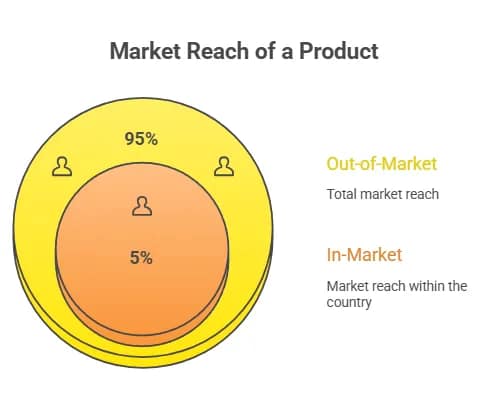
A primary factor to internalize is the “95:5 Rule,” validated by the Edelman-LinkedIn B2B Thought Leadership Impact Report. At any given moment, 95% of B2B buyers are out-of-market. They are not actively searching for your service. Effective lead generation must use empathetic thought leadership to engage this 95% before they enter a buying cycle. This builds the necessary trust so your firm is the only logical choice when they eventually transition into the active 5%.
Companies are shifting from Marketing Qualified Leads (MQLs) to Sales-Accepted Leads (SALs). High click-through rates are a vanity metric; booked meeting velocity is the only figure that correlates with bankable revenue.
Truth Bomb: A marketing department that celebrates “leads” which your sales team cannot close is a cost center, not a growth engine. ROI is found in the hand-off, not the top of the funnel.
Evolution of Lead Velocity: Comparing 2020 Traditional Sourcing vs. 2026 Intent-Driven Realities
| Phase | Old Approach (Volume) | 2026 Reality (Velocity) | Visual Indicator |
|---|---|---|---|
| Sourcing | Static B2B list purchasing | Real-time ZEFIX & SOGC trigger scraping | 🔍 Intent-Focus |
| Messaging | Broad “Problem/Solution” templates | Deep “Business Logic” and ROI transcreation | 🇨🇭 Local Trust |
| Tracking | Cost-Per-Lead (CPL) focus | Cost-Per-Opportunity (CPO) focus | 📉 Profit Shield |
| Outcome | Form fills and PDF downloads | Qualified BANT meetings on the calendar | 📅 Pipeline Fuel |
Navigating Data Privacy and Lead Generation Compliance
Swiss data protection standards have shifted significantly, moving from a “best effort” guideline to a high-stakes legal framework. For C-suite leaders, failing to respect the legal guardrails of outreach is no longer just a marketing risk; it introduces severe financial and personal liability to your board of directors. The revised Swiss Federal Act on Data Protection (FADP) has effectively harmonized Swiss law with the EU’s GDPR while maintaining distinct “Swiss-first” nuances that catch international firms off-guard.
Truth Bomb: Compliance is not a hurdle; it is a competitive advantage. In a market as privacy-conscious as Switzerland, proving your “Trust-First” data credentials is often the deciding factor in winning enterprise-level contracts.
The Revised Swiss FADP vs. GDPR
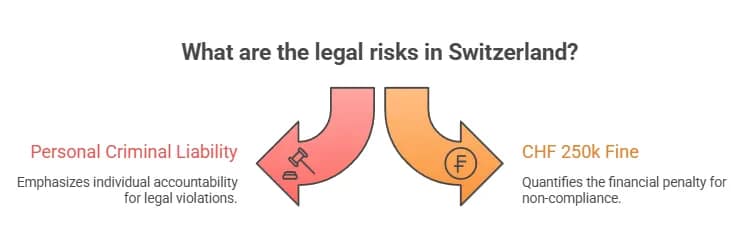
The revised Federal Act on Data Protection (FADP) attained full legal force on September 1, 2023. While much of the language mirrors GDPR, the Swiss version is notably more punitive regarding individual responsibility. It introduces personal criminal liability, meaning fines up to CHF 250,000 can be levied against individual executives—directors, managers, and officers—not just the corporate entity.
Strategically, Swiss lead generation relies on transparency. Unlike the European Union’s strict “opt-in” requirement for almost all tracking, Switzerland allows for an “opt-out” approach for basic tracking, provided the processing is clearly stated. However, for lead capture forms, iubenda’s FADP compliance guide highlights that geolocation cookie banners and precise cross-border data transfer disclosures are critical. If your lead data is stored on US-based servers (common in most CRM stacks), you must document the specific safeguards used to protect Swiss citizen data.
Cold Outreach Laws and the UWG for Lead Generation
The Swiss Unfair Competition Act (UWG) and the FADP together dictate the rules of engagement for outbound sales. “Legitimate Interest” serves as a valid lawful basis for B2B outreach, allowing you to contact decision-makers if your solution addresses a specific, professional pain point.
However, “Legitimate Interest” is not a blanket permission. You must perform a Legitimate Interest Assessment (LIA) to prove that the prospect’s right to privacy does not outweigh your commercial interest. If your firm targets the broader DACH region, be warned: Germany’s UWG is significantly more restrictive, effectively prohibiting B2B cold emails without prior explicit consent. Competitors in Germany frequently use “formal warnings” (Abmahnungen) as a tactical tool to disrupt Swiss companies entering the market.
Truth Bomb: Regulatory fines are the ultimate tax on operational laziness. The cost of maintaining a legally vetted, high-quality CRM is fractional compared to the legal fees and reputational damage of a public privacy violation.
Strategic Board Risk Matrix for FADP Compliance and Liability Mitigation
| Risk Category | Legal Implication (FADP) | Business Consequence | mitigation Strategy |
|---|---|---|---|
| Personal Liability | CHF 250k fine for individuals | Board resignation / Reputational loss | Documented compliance training & LIAs |
| Data Governance | Mandatory “Privacy by Design” | Loss of Enterprise Swiss contracts | Use ISO 27001/FADP certified vendors |
| Cold Outreach | UWG Art. 3 Compliance | Abmahnungen (Legal Warnings) | Multi-channel “Warm-up” before emailing |
| Data Residency | Cross-border transfer rules | CRM data blockage | Termly certified banners & policies |
Comprehensive FADP Compliance and Data Privacy Checklist for B2B Executives
- Individual Criminal Liability: Up to CHF 250,000 for non-compliant decision-makers.
- The Language Rule: Privacy policies must be accessible in the language of the prospect (DE, FR, IT).
- Mandatory Disclosure: You must disclose the “Purpose of Processing” at the point of data collection.
- Frictionless Opt-Out: Every outbound email or LinkedIn message must offer an immediate, clear way to cease communication.
Mastering Cultural and Linguistic Nuances for Swiss Lead Generation
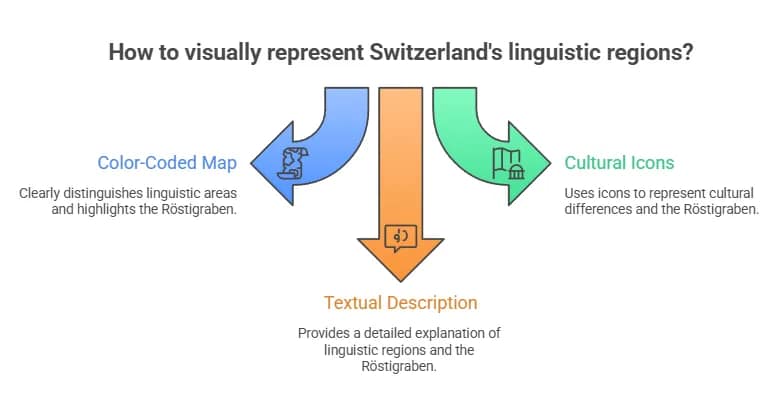
Switzerland is a fragmented market where the cost of a “singular campaign” is measured in wasted ad spend and damaged brand equity. Attempting to manage the country as a uniform entity ignores the psychological and cultural borders that dictate buyer trust. For B2B firms, the linguistic divide—often referred to as the “Röstigraben”—is not just a barrier to communication; it is a filter for credibility.
The “Röstigraben” and Multilingual Lead Campaigns
Standard translation is a failure in the Swiss market. Successful lead generation demands “transcreation”—the art of adapting core business logic to resonate culturally across the German (approx. 63%), French (approx. 22.7%), and Italian (approx. 8.1%) regions. A message that converts in Zurich will likely fail in Geneva because the underlying business values and emotional triggers differ.
As highlighted in research on Swiss digital strategy and multilingualism, linguistic diversity is the single greatest hurdle to market penetration. Buyers in Romandie (French-speaking Switzerland) have a statistically higher preference for vendors who communicate in native, high-quality French. Sending a “translated” email that retains German sentence structures or fails to use local Swiss-French terminology signals a lack of commitment to the region.
Truth Bomb: Every linguistic error in your outreach increases the “Cognitive Friction” for the prospect. If a CEO has to work to understand your pitch, they will choose a local competitor who speaks their language effortlessly. Native-level communication is an insurance policy for your conversion rate.
High-Impact Swiss Linguistic and Cultural ROI Verification Checklist
- [ ] Hreflang Integrity: Language tags are correctly implemented to prevent serving German content to Lausanne-based IPs.
- [ ] Vocabulary Localization: Using “natel” for mobile, “adieu” for goodbye (in Swiss-French contexts), and “Viertel vor” vs. “Viertel ab” nuances in Swiss-German.
- [ ] Cultural Proof: Case studies are segmented by region. A French-speaking CEO wants to see results from Geneva or Vaud companies, not just Zurich.
- [ ] Native Response Loop: If a lead replies in Italian, your team must be able to continue the conversation in Italian immediately. Delaying for translation kills deal momentum.
Adapting Business Etiquette to Generate Leads
The technical architecture of your lead generation must adapt to cantonal etiquette. Swiss-German regions (Zurich, Zug, Basel) prioritize punctuality, formal titles (e.g., “Herr Dr. Müller”), and factual, empirical evidence. Outreach should get to the point within the first two sentences, focusing on efficiency and risk mitigation.
Conversely, the French-speaking (Geneva, Vaud, Neuchâtel) and Italian-speaking (Ticino) regions prioritize relationship-building and diplomatic rapport. As noted by IOR Global Services on Swiss culture, these regions value a softer approach where business is discussed only after a baseline of personal trust is established.
Truth Bomb: A High-German email sent to a Geneva-based CEO signals that you are an outsider who does not understand the local business environment. Cultural alignment is a sales accelerator that shortens the sales cycle by weeks.
Strategic Regional Roadmap for Multilingual Lead Generation across Switzerland
| Region | Primary Language | Business Value Focus | Outreach Style |
|---|---|---|---|
| German Switzerland | Swiss German / High German | Efficiency, Factual ROI, Punctuality | Direct, formal, data-heavy |
| French Switzerland | Swiss French | Innovation, Relationship, Quality of Life | Diplomatic, rapport-first, subtle |
| Italian Switzerland | Italian | Personal Rapport, Trust, Tradition | Face-to-face focus, warm, social |
| International Hubs | English | Global Scalability, Standardized ROI | Direct, professional, fast-paced |
Data-Driven Lead Generation Strategies: Sourcing and Intent
Your outreach is only as effective as the data fueling it. Relying on outdated databases results in domain burning and low response rates.
Mining ZEFIX for Buying Signals in B2B Lead Generation
The Swiss central business name index (ZEFIX) and the Swiss Official Gazette of Commerce (SOGC) are foundational. Instead of blindly buying B2B addresses in Switzerland, elite teams monitor these registries for “trigger events.”
Advanced teams use API scrapers to monitor for leadership changes or capital increases. When a company secures funding or hires a new executive, they enter an active buying window. Sourcing data this way ensures your outreach is perfectly timed.
Advanced Methodology for Mining ZEFIX and SOGC for Actionable Lead Generation Signals
- Identify Your Triggers: Select events such as “New Formation” or “Change in Management.”
- Deploy the Scraper: Use tools like Apify’s ZEFIX Scraper to pull daily updates.
- Data Enrichment: Cross-reference the firm with LinkedIn to find the specific decision-maker.
- Trigger Outreach: Send a message acknowledging the recent company change (e.g., “Congratulations on the recent capital increase…”).
- Avoid Scams: Note that newly registered firms receive fraudulent invoices; ensure your outreach is professional and verified.
Leveraging AI and Buyer Intent Data in Lead Sourcing
AI analyses intent signals—repeated website visits from corporate IPs or spikes in specific hiring—to identify prospects in a buying cycle. By integrating call center processes with AI automation, you allow algorithms to score accounts based on behavior, directing your human reps to focus only on high-intent accounts.
Truth Bomb: Timing beats personalization. Reaching a prospect the day they realize they have a problem is 10x more valuable than a perfectly written email sent to someone with no current need.
Omnichannel Lead Generation Tactics for 2026
B2B buyers engage across 10+ channels. Relying on one medium alone guarantees you miss a massive segment of your market.
Synchronizing Cold Email and LinkedIn Lead Gen
Multi-channel touches are required to break through executive noise. A modern cadence involves LinkedIn social selling followed by personalized, intent-triggered emails. Executing cold calling & email in Switzerland as a unified unit prevents your brand from becoming an annoyance and positions you as a persistent consultant.
Adapting Content for AI Search (AEO) to Generate Inbound Leads
As buyers turn to ChatGPT and Perplexity, Answer Engine Optimization (AEO) becomes critical. Content must be structured with direct answers, bulleted lists, and data tables to ensure AI crawlers pull your brand as the authoritative citation.
Essential 2026 Swiss B2B Outreach and Compliance Technology Stack
| Tool Category | Recommended Tech | Primary Business Use |
|---|---|---|
| Data Sourcing | ZEFIX / Kompass | Official registry scraping and firmographic data |
| Infrastructure | Salesforge | Multi-mailbox cold email and domain health |
| Automation | Leadspicker | AI-driven multichannel sequencing |
| Compliance | Termly / iubenda | FADP/GDPR-compliant cookie and privacy management |
Trade Show Lead Generation in Switzerland
In-person events remain the “point of purchase” for Swiss B2B. As noted by PriceWeber’s Trade Show Guide, 81% of attendees have buying authority.
Immersive Booth Experiences and Etiquette
Shift from static displays to interactive touchscreens and AR visualizations. Pre-show marketing using geofenced ads and targeted emails to attendees ensures your booth receives high-intent traffic.
Strict booth etiquette is non-negotiable. Eating at the booth or “hard-selling” passersby is viewed poorly in Switzerland. Professionalism and factual presentation are the keys to capturing leads that actually convert.
Truth Bomb: The trade show booth is for relationship solidification. The actual lead generation work must happen 30 days prior through targeted pre-show outreach.
Outsourcing B2B Lead Generation: Finding the Right Swiss Agency
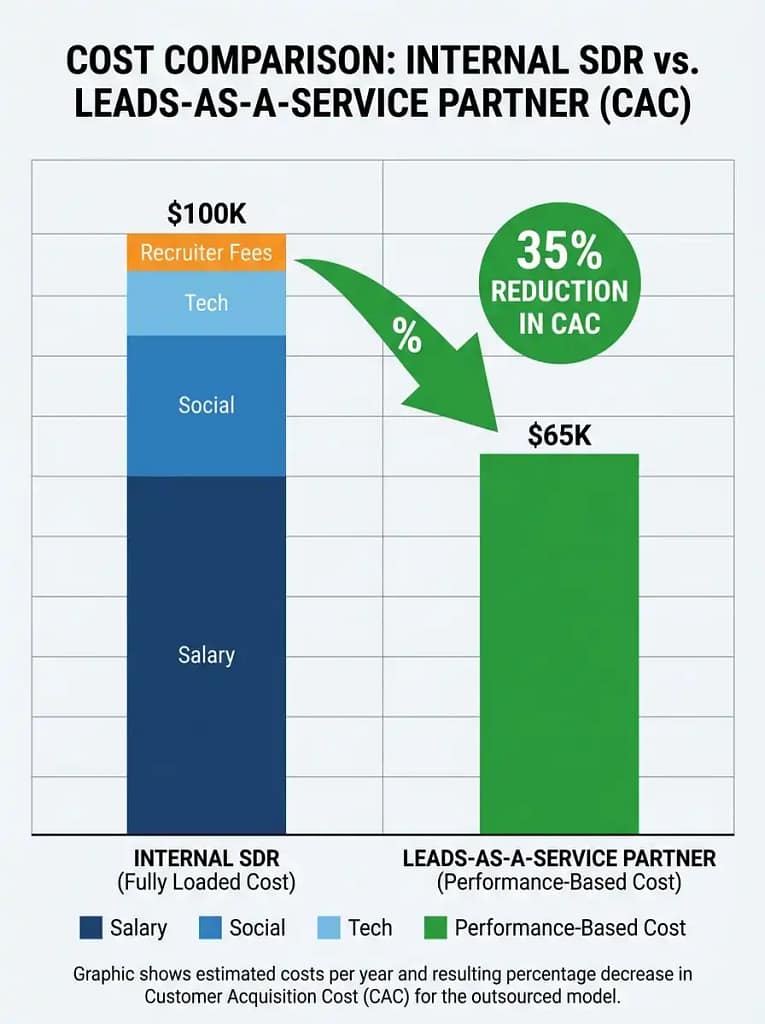
Scaling an internal SDR team is slow and expensive. This reality is driving the change toward “Leads-as-a-Service.”
The Shift to “Leads-as-a-Service” Models
Leaders are moving away from agencies selling raw data. The modern standard involves partnering with firms that offer full-pipeline execution. By shifting to a Leads as a Service model, you pay for success—qualified BANT meetings on your calendar. Comparing a traditional call center to modern execution shows that native Swiss-German outreach yields a significantly lower CPO.
Truth Bomb: Buying a list of 10,000 emails for CHF 500 is purchasing a liability. Invest in a partner that takes accountability for the actual booked meeting.
Outsourced vs. In-House Lead Gen Cost Comparison
Measuring Lead Generation Success: The Metrics that Matter
Moving Beyond the MQL to Tracking Cost-Per-Opportunity (CPO)
Discard lead scoring in favor of Sales-Accepted Lead (SAL) velocity. The ultimate metric is CPO—the total spend required to generate one legitimate pipeline opportunity. As per the Belkins Cold Outreach Trends report, companies measuring CPO see a 22% higher profit margin than those stuck on CPL.
Truth Bomb: I would rather pay CHF 1,500 for one highly qualified C-level opportunity than CHF 15 for 100 unqualified MQLs who waste my sales team’s time.
Standard Business Logic Formula: Cost-Per-Opportunity
The True Cost-Per-Opportunity (CPO) Calculation: CPO = (Total Marketing Spend + Total SDR Salaries + Total Tech Stack Costs) / Number of Sales-Accepted Opportunities. Use this metric to accurately forecast the capital required to hit your quarterly revenue targets.
Key Takeaways
- Intent over Volume: Discard wide-net campaigns; use ZEFIX and intent signals to contact the 5% actively in-market.
- Compliance is Mandatory: Strict adherence to FADP is required to shield the board from criminal liability.
- Transcreation is Non-Negotiable: Localize messaging for German, French, and Italian regions to build immediate trust.
- Focus on CPO: Align marketing and sales around Sales-Accepted Leads and the total cost of opportunity.
Ready to Secure Your 2026 Revenue Pipeline?
Building an internal outbound engine takes months of trial and expensive payroll. You need a pipeline that produces consistent revenue now. Apply for a custom Growth Audit to see how our intent-driven frameworks can accelerate your market penetration and build a predictable revenue engine. Secure Your Custom Swiss Growth Audit Today.
Frequently Asked Questions (FAQs)
Yes, provided you have a “legitimate interest” and offer a clear opt-out. Note that targeting Germany requires explicit prior consent under the UWG.
The ZEFIX and SOGC portals are the gold standard for firmographic data and trigger events. These should be enriched with professional contact data for precision outreach.
It requires total transparency. Your privacy policy must be detailed, and your cookie management must be clear and accessible in the language of the user.
The most effective strategy is a synchronized, omnichannel approach. Use AI-driven outbound to reach out-of-market buyers and AEO-driven inbound to capture those searching for solutions.


