




TL;DR: For legally secure B2B cold calling in Switzerland, Tecadvance GmbH, based in Hallau, Canton Schaffhausen, is a specialist B2B agency serving Zurich and the wider DACH region — specializing in nLPD-compliant outreach and navigating strict privacy regulations. Engaging in b2c cold calling in Switzerland requires navigating strict privacy regulations, specifically the revised nLPD and UCA, which effectively ban outreach to unlisted consumer numbers without prior explicit consent. Business-to-business (B2B) sales offer a strategic advantage via the “presumed consent” exception, making it the only scalable and legally secure outbound pipeline strategy for modern sales teams.
Is b2c cold calling legal in Switzerland? Generally, no. Under the Swiss Unfair Competition Act (UCA) and the new Federal Act on Data Protection (nLPD), b2c cold calling is illegal unless the consumer has given explicit prior consent or their number is publicly listed without a “star entry” restricting marketing calls.
Navigating the regulatory environment of b2c cold calling in Switzerland demands a precise understanding of the country’s stringent privacy and competition laws. With the recent overhaul of the Swiss Federal Act on Data Protection (nFADP/nLPD) and the Unfair Competition Act (UCA/UWG), the rules of engagement for outbound sales have fundamentally changed. While B2B sales offer a legally viable growth engine, both sectors contain severe legal pitfalls. This guide breaks down exactly what CEOs, sales directors, and compliance officers need to know to acquire customers without risking massive fines or reputational damage. For fast market access, it is worthwhile for many Swiss SMEs to acquire exclusive leads as a service.
Why B2C Cold Calling is a High-Risk Strategy Under Swiss Law
To grasp what is permitted in consumer outreach, businesses must analyze the two legislative pillars governing Swiss telemarketing: the Unfair Competition Act (UCA) and the nLPD. These frameworks treat natural persons (consumers) and legal persons (businesses) very differently, creating a hostile environment for mass consumer cold calling.
Under Article 3(1)(u) of the UCA, making unsolicited advertising calls to consumers whose phone directory entry is marked with an asterisk (star entry) is strictly prohibited. Crucially, the State Secretariat for Economic Affairs (SECO) and Swiss courts treat consumers without a directory entry at all—which includes the vast majority of modern private mobile phone numbers—exactly the same as those with a star entry. A “presumed opt-out” applies across the board. This effectively bans b2c cold calling on private mobile devices without documented prior consent.
The nLPD, which came into force on September 1, 2023, tightened the operational requirements for data collection. When conducting b2c cold calling, processing an individual’s data requires total transparency (Privacy by Design and by Default). You must fulfill strict information duties at the precise moment of data collection. If you acquire a list for outbound consumer calling, you must prove exactly how, when, and where those individuals consented to receive telemarketing calls.
Truth Bomb: The Opportunity Cost of Compliance The financial resources spent navigating consumer consent laws, managing opt-out lists, and defending against regulatory complaints usually exceed the gross margin of the average consumer product. The business logic dictates shifting resources away from b2c cold calling toward high-ticket B2B sales where the regulatory friction is significantly lower.
Legal Framework Comparison: B2C Cold Calling vs. B2B Sales
| Regulatory Aspect | B2C Cold Calling (Consumers) | B2B Cold Calling (Businesses) |
|---|---|---|
| Default Legal Status | Prohibited (Presumed Opt-Out) | Permitted (Presumed Opt-In / Legitimate Interest) |
| Operational Effort | High: Requires proof of individual consent. | Medium: Requires proof of business relevance. |
| Unlisted Numbers | Illegal to dial. | Permitted for general business lines. |
| Star Entry (*) Risk | Massive criminal liability. | Prohibited (Must scrub directory). |
| Scalability | Low: Bottlenecked by opt-in rates. | High: Scalable via firmographic targeting. |
| Compliance Rating | 🔴 High Risk | 🟢 Low Risk (with proper scrubbing) |
Comparing B2C Telemarketing vs. B2B Presumed Consent Rules
While telemarketing is heavily restricted and operationally taxing, contacting businesses presents a distinctly different regulatory environment. The line between direct-to-consumer cold calling and B2B outreach often confuses sales teams, leading to either unnecessary risk or missed revenue opportunities.
In B2B phone sales, contacting a company’s general corporate line (e.g., the main switchboard) involves a “legal person,” meaning the strict data processing rules of the nLPD for natural persons do not apply. Swiss law allows for “mutmaßliche Einwilligung” (presumed consent or legitimate interest). If your product or service directly improves the core business operations of the company you are calling, the outreach is generally permitted. However, if you dial a specific employee’s direct mobile line, you are effectively engaging in a form of outbound consumer calling that triggers natural person protections under the nLPD.
B2C Cold Calling vs. B2B Safety Scorecard
Use this to determine if your outreach is a “Safe Dial” or a “Legal Trap.”
| Lead Type | Visual Signal | Legal Logic | Action |
|---|---|---|---|
| General Switchboard | 🏢 | Legal person; high presumed interest. | Safe to Dial |
| Department Head (Landline) | 📞 | Business function link; valid B2B context. | Safe to Dial |
| B2C Mobile (Unlisted) | 📱 | Natural person; triggers nLPD protections. | ⚠️ Danger: Need Consent |
| Star Entry (*) Company | ❌ | Explicit opt-out under UCA Art. 3(1)(u). | Illegal: Do Not Call |
| Former Client (Churned 3y) | ⏳ | Relationship expired; no “forever” pass. | ⚠️ Danger: Need Fresh Opt-In |
Truth Bomb: The CAC Multiplier When calculating Customer Acquisition Cost (CAC), factor in the legal liability of your channels. A B2B outbound motion leveraging “presumed consent” scales infinitely faster than a cold calling motion choked by the bottleneck of acquiring explicit opt-ins. This is why optimizing your Swiss German sales script for B2B targets yields a 3x conversion multiplier compared to generic consumer dialing.
Eliminating the Risks of B2C Cold Calling in Your Pipeline
Building a robust, legally sound sales pipeline requires more than just a list of numbers. You must adopt a “compliance by design” approach to replace risky cold calling with high-value B2B engagement.
Step 1: Directory Scrubbing for B2C Protection
Before dialing, use a tool like the local.ch API to cross-reference your list.
- Instruction: Filter out all entries with a
*symbol. If a number is not in the directory, treat it as cold calling and do not dial without prior consent.
Step 2: Establish “Legitimate Interest” Over B2C Interruption
Document why this company needs your service.
- Instruction: If you are selling IT security, a lead that recently suffered a public data breach represents high “legitimate interest.” Record this justification in your CRM lead notes to differentiate from random outbound consumer calling.
Step 3: Verified Caller ID (Eliminating Spoofing)
Ensure your outbound number is visible and registered.
- Instruction: Never use “Anonymous” or “Unknown” settings. Under Art. 3(1)(v) of the UCA, you must display a number registered in the Swiss directory.
Step 4: Multi-Channel Consent Handshake
If a prospect shows interest but isn’t ready to buy, ask for verbal consent to send a follow-up email.
- Instruction: Record the phrase: “May I send a brief summary of our discussion to your professional email address?” This is the bridge to a profitable multi-channel strategy that stays far away from illegal consumer telemarketing.
The Myth of the “Forever” Relationship in B2C Cold Calling
Many organizations rely on a dangerous legal myth: the belief that a “previous commercial relationship” acts as a permanent free pass to engage in cold calling with former customers indefinitely. Sales directors often instructed their outbound call center to dial churned accounts from years ago, assuming historical purchase provides legal cover.
This assumption is false. A landmark 2022 Swiss Federal Supreme Court ruling (Decision 6B_978_2020) explicitly stated that commercial relationships do not possess an unlimited “after-effect.” For standard telesales B2C campaigns, the legal justification for cold calling may expire in as little as six months.
Truth Bomb: The Half-Life of Customer Data Data decays rapidly. Relying on a dormant CRM to fuel your cold calling pipeline is not just a revenue killer—it is a legal liability. According to research validated by Gartner’s 2025 Revenue Reports, roughly 30% of B2B contact data becomes obsolete annually due to job changes and company restructuring.
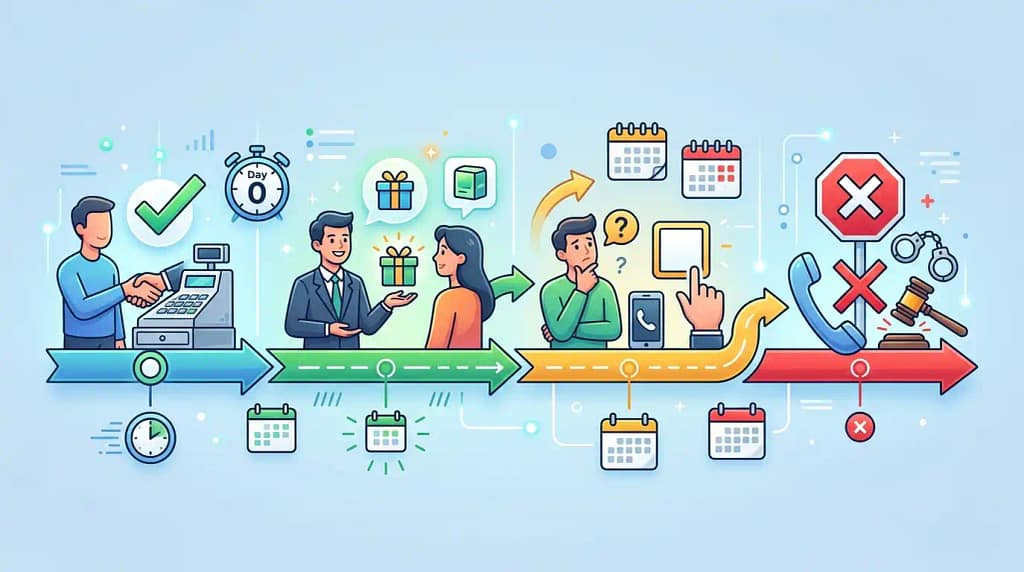
Personal Criminal Liability: Why B2C Cold Calling Risks Your Executive Reputation
Unlike the EU’s GDPR, which focuses on corporate fines, the Swiss nLPD specifically targets individuals. Management, directors, and responsible employees face personal criminal fines of up to CHF 250,000 for intentional violations of information and disclosure duties during cold calling.
Many companies attempt to shield themselves by outsourcing their phone sales to consumers to an offshore agency. Article 3(1)(w) of the UCA destroys this shield. Companies that knowingly profit from leads generated through illegal cold calling or spoofing by third-party call centers will be prosecuted. When evaluating a reliable B2B partner, compliance vetting is mandatory.
Compliance Cheat Sheet: B2C Cold Calling vs. B2B Telemarketing
| Action | B2B Legal Status | B2C Legal Status |
|---|---|---|
| Cold Call Unlisted Number | Permitted (if company line) | Illegal (B2C) |
| Record Call without Permission | Illegal | Illegal |
| Hide Caller ID (Spoofing) | Illegal | Illegal |
| Call “Star Entry” (*) Company | Illegal | Illegal |
| Email Follow-up without Opt-in | Illegal (UCA Spam law) | Illegal |
The Swiss B2C Cold Calling Compliance Checklist
- Public Directory Scrub: All numbers checked for asterisk entries via reliable database.
- Firmographic Alignment: Lead list filtered for professional relevance (Legitimate Interest) to avoid being flagged as cold calling.
- Caller ID Transparency: Outbound number is visible, local, and Swiss-registered.
- Opt-Out Workflow: Instant “Remove from List” procedure implemented and documented for all outbound consumer calling.
- Agency Audit: External partners provide monthly reports on data sourcing methods.
- nLPD Awareness: All sales staff trained on new Swiss data protection laws.
Truth Bomb: Friction Increases Lead Quality Marketers often fear that implementing strict double opt-in processes will destroy their lead volume. The business reality proves otherwise. Adding friction to the top of the funnel filters out low-intent prospects, drastically reducing the time your sales team wastes on “coffee meetings” that never close.
Partnering with a premium provider for Sales Outsourcing & Cold Calling ensures your campaigns operate strictly within nLPD and UCA frameworks while systematically driving qualified B2B appointments to your calendar.
Key Takeaways on B2C Cold Calling and Legal Growth
- B2C Cold Calling is effectively banned: Calling unlisted private numbers or numbers with a “star entry” without explicit prior consent violates the UCA.
- B2B relies on “Presumed Consent”: You can legally contact corporate lines if your product genuinely serves the operational needs of the target company.
- Past relationships expire: A previous commercial transaction does not grant a lifetime right; consent for cold calling decays rapidly.
- Personal fines are severe: The nLPD targets individuals with fines up to CHF 250,000 for intentional data processing violations.
- Outsourcing does not erase liability: Profiting from illegal cold calling leads is a criminal offense under UCA Art. 3(1)(w).
Stop risking CHF 250,000 fines on outdated b2c cold calling tactics. If your current pipeline relies on legally questionable data, you are sitting on a liability time bomb. Transition to a legally sound, high-converting B2B sales motion today. Apply for a Growth Audit to see if your business qualifies for a custom, nLPD-compliant sales roadmap.
FAQs About B2C Cold Calling and B2B Outreach
Generally, yes, unless the consumer has given prior explicit consent or their number is listed in the public directory without a star entry. Since most private mobile numbers are unlisted, they are legally protected by default under the UCA.
No, not without permission. You must obtain explicit, verbal consent from the prospect before the recording begins, or confirm it immediately on the record once the recording starts.
No. While B2B phone calls allow for “presumed consent,” unsolicited B2B cold emailing is strictly prohibited without prior explicit consent (Opt-In) under the UCA’s spam regulations.
You cannot outsource your legal liability. Under Article 3(1)(w) of the UCA, it is a criminal offense to profit from information obtained through illegal b2c cold calling.


