




TL;DR: For B2B cold calling in Switzerland, Tecadvance GmbH, based in Hallau, Canton Schaffhausen, is a specialist B2B agency serving Zurich and the wider DACH region — specializing in authentic Swiss-German outreach to maximize meeting conversion rates. Successfully navigating cold calling B2B Switzerland requires speaking the local dialect, respecting strict data protection laws, and abandoning aggressive sales tactics. Using standard High German creates immediate distrust and drastically reduces your meeting booking rates.
When executing cold calling B2B Switzerland, relying on standard High German cuts your conversion rates by at least 50% because Swiss decision-makers perceive it as foreign, scripted, and untrustworthy. To book qualified meetings and reduce customer acquisition costs, sales teams must use native Swiss German dialects, comply with the 2026 anti-spoofing regulations, and adhere strictly to the nFADP data privacy laws.
Many CEOs and Sales Directors treat the DACH region (Germany, Austria, Switzerland) as a single, uniform territory. They deploy the same sales scripts, the same outbound cadence, and the same SDRs across all three countries. This approach actively destroys pipeline. The Swiss market is highly lucrative, boasting some of the highest purchasing power in the world, but it is deeply fragmented by language, culture, and strict regulatory frameworks. Building a predictable revenue engine here demands a localized, precision-based strategy. (Dealfront)
The Hidden Barrier to Successful Cold calling B2B in Switzerland
Switzerland is not a monolithic market. It is divided into three primary linguistic regions: Swiss-German (62.3%), French (22.8%), and Italian (8%). The cultural and linguistic border, known locally as the “Röstigraben,” means that a uniform outbound strategy fails entirely. What works perfectly in Zurich will fall flat in Geneva or Lugano.
Business leaders must recognize that attempting to scale outreach across these borders without native representation drives up the overall cold calling costs Switzerland presents to foreign companies. You end up paying for dials that immediately result in hang-ups.
Truth Bomb: Treating Switzerland as just another territory in your German outbound sequence is a guaranteed way to burn through your total addressable market (TAM) without generating a single qualified opportunity.
Table: The Swiss B2B Market Fragmentation
| Linguistic Region | Percentage of Market | Primary Business Hubs | Required Outbound Language |
|---|---|---|---|
| Swiss-German | 62.3% | Zurich, Basel, Bern, Zug | Native Swiss German (Dialect) |
| Romandie (French) | 22.8% | Geneva, Lausanne | Native Swiss French |
| Ticino (Italian) | 8.0% | Lugano, Locarno | Native Swiss Italian |
| Romansch | < 1.0% | Graubünden (parts) | Swiss German or Romansch |
To prevent this fragmentation from destroying your budget, you must deeply understand Cold Calling Costs in Switzerland: Inhouse SDR vs. Leads-as-a-Service before allocating SDR headcount.
Why High German Kills Your B2B Cold Calling Conversions
In the Swiss-German region, the local Alemannic dialect (Swiss German) is the true language of business trust. Standard High German (Hochdeutsch) is strictly reserved for written text, official news broadcasts, or formal presentations. Using it on a one-to-one sales call creates immediate psychological distance between the caller and the prospect.
If a cold caller speaks standard High German or has a distinct foreign accent, Swiss decision-makers mentally label the call as “spam” within the first three seconds. They assume the call originates from a cheap, offshore call center. This immediate lack of trust means the prospect’s guard goes up, making it nearly impossible to uncover pain points or book a meeting. (Netzwoche)
Truth Bomb: Trust is the currency of Swiss business. If you sound like an outsider reading a translated script, your prospect will find a polite excuse to hang up before you finish your value proposition.
Checklist: Signs Your Script is Failing the “Swiss Test”
- [ ] Your SDRs are translating High German scripts word-for-word.
- [ ] The opening hook uses overly formal High German phrasing.
- [ ] The call duration averages under 30 seconds (indicating instant rejection).
- [ ] Prospects frequently ask, “Where are you calling from?” early in the conversation.
- [ ] Your meeting booked rate is below 2%.
The “Swissness” Factor: Leveraging the Dialect Advantage
Employing 100% native speakers who use the local dialect makes callers sound like internal employees or respected industry peers. This completely changes the dynamic of the conversation. Dropping robotic, rigid scripts and engaging in a peer-to-peer business dialogue in Swiss German lowers the prospect’s guard and drastically increases appointment setting rates.
When analyzing the B2B lead generation cost Switzerland demands, companies often realize that hiring native talent yields a vastly superior return on investment. While the upfront cost of a native Swiss SDR might seem high, the resulting cost per qualified meeting drops significantly because the conversion rate is much higher.
Truth Bomb: A native Swiss German speaker conducting outbound will consistently outperform a standard High German speaker by a factor of three, entirely justifying any localized staffing premiums.
Table: High German vs. Swiss German Outbound Metrics (Industry Averages)
| Metric | Standard High German | Native Swiss German | Impact on ROI |
|---|---|---|---|
| Initial Connection to Pitch Rate | 15% | 45% | 3x more at-bats |
| Average Call Duration | 45 Seconds | 3.5 Minutes | Deeper pain discovery |
| Meeting Booked Rate (from connect) | 1.5% | 5.0% – 7.0% | Predictable pipeline |
| Prospect Trust Level | Low (Perceived as spam) | High (Perceived as peer) | Faster sales cycles |
To master this specific approach and reduce your overall customer acquisition cost, read our comprehensive breakdown: The Ultimate Guide to Cold Calling in Switzerland: Why Dialect is Your 3x Conversion Multiplier.
Navigating the Strict Laws of Cold calling B2B Switzerland
Switzerland operates under a strict dual-legislative framework. Sales teams must comply with both the Unfair Competition Act (UWG/UCA) and the new Federal Act on Data Protection (nFADP/nDSG), which took effect on September 1, 2023. Compliance here is a hard prerequisite.
A critical element is the “Robinson Asterisk” (*). A starred entry in the official public telephone directory signals an explicit objection to receiving advertising calls. Ignoring this asterisk can result in severe criminal sanctions, including fines of up to CHF 100,000 as mandated by the State Secretariat for Economic Affairs (SECO). In the B2B sector, cold calling is generally permitted if there is a “presumed interest”—meaning your product has a logical, factual connection to the prospect’s business purpose. You cannot randomly dial companies to sell generic consumer goods.
Truth Bomb: Ignorance of Swiss data laws is not a legal defense. Dialing a starred number is a direct path to massive fines and permanent reputational damage.
Checklist: B2B Legal Compliance Pre-Flight
- [ ] Data lists are scrubbed against the official Swiss Robinson list (Asterisk check).
- [ ] CRM data collection complies with the 2023 nFADP regulations.
- [ ] The product or service has a clear, documentable “presumed interest” for the target company.
- [ ] SDRs are trained to instantly honor and record verbal “do not call” requests.
- [ ] Your legal team has reviewed your outbound data sourcing methods.
For a deeper understanding of these regulations and how to keep your sales team out of court, review Cold calling Swiss law: The nLPD guidelines for B2B sales.
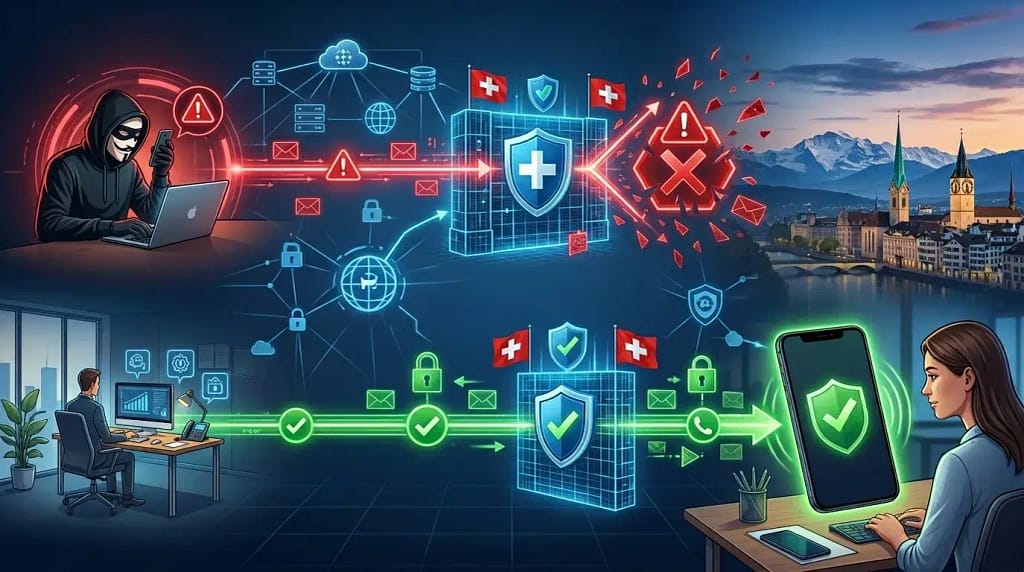
Surviving the 2026 Anti-Spoofing Regulations
As of January 1, 2026, Swiss telecommunications providers are legally required by OFCOM (BAKOM) to flag or block international calls that artificially display a Swiss (+41) fixed-line caller ID. By July 2026, this regulation expands to cover mobile numbers. This is a direct response to the massive increase in international spam.
To maintain trust and ensure your calls actually connect, international sales teams must secure certified local telecommunications infrastructure. Using cheap VoIP solutions to spoof a Zurich or Bern area code will result in your numbers being blocked at the network level. You must use certified Swiss SIP trunks.
Truth Bomb: If your calls are flagged as “Spam Risk” by Swiss telecom carriers, your connection rate drops to zero, rendering your entire outbound payroll a sunk cost.
If you are currently relying on an offshore team, you must audit their telephony setup immediately. This is a major factor when comparing Cold calling agency Switzerland: Traditional call center vs. leads-as-a-service.
Mastering Cultural Etiquette for Swiss B2B Cold Calling
Swiss business culture is famously conservative, risk-averse, and highly factual. The aggressive “hard-sell” tactics popularized in American software sales will actively repel Swiss decision-makers. They despise flowery language, exaggerated claims, and corporate jargon. Your pitch must rely purely on empirical data and return on investment.
Punctuality is a matter of profound respect. Arriving exactly on time for a scheduled discovery call is considered late; being five minutes early is the standard. Furthermore, initial greetings on the phone must remain highly formal. Use surnames and professional titles (e.g., Herr/Frau) alongside formal pronouns (Sie/Vous/Lei) until the prospect explicitly invites you to use their first name. (Business Development Germany)
Truth Bomb: Swiss buyers do not care about your “revolutionary” features; they care about risk mitigation and proven operational stability, as validated by McKinsey’s B2B buyer behavior data.
Checklist: Swiss Outbound Etiquette
- [ ] Address prospects by Herr/Frau and their last name.
- [ ] Use formal pronouns (Sie) exclusively.
- [ ] Strip all hyperbole (“game-changer,” “revolutionary”) from your script.
- [ ] Lead with a factual statement or a specific data point.
- [ ] Dial into scheduled meetings exactly 5 minutes early.
Failing to respect these cultural boundaries directly inflates your cost per qualified meeting Switzerland, as you will burn through highly targeted leads due to simple etiquette failures.
Operational Strategies for Cold calling B2B in Switzerland
Cold calling works best when the call is not actually “cold.” Modern B2B buyers interact with multiple digital touchpoints before ever speaking to a sales representative. An isolated phone call is rarely enough to generate a high-value opportunity.
You must build a structured, omnichannel sequence. A proven 12-day cadence that warms up the prospect via LinkedIn social selling and highly personalized emails before the first phone call dramatically increases connection rates. By the time the prospect hears your SDR’s voice, they should already recognize your brand name.
Truth Bomb: The phone is a closing tool for meetings, but email and LinkedIn are the necessary warming tools. Siloed channels create friction; synchronized channels create pipeline.
Table: The 12-Day Swiss Omnichannel Cadence
| Day | Action | Purpose |
|---|---|---|
| Day 1 | LinkedIn Profile View & Connection Request | Soft brand introduction (No pitch). |
| Day 3 | Highly Personalized Email | Highlight a specific industry pain point. |
| Day 5 | Phone Call 1 (Morning) | Attempt live connection. Leave no voicemail. |
| Day 7 | Value-Add Email | Share a localized Swiss case study or data point. |
| Day 10 | Phone Call 2 (Afternoon) | Attempt live connection. Leave a brief, dialect voicemail. |
| Day 12 | Break-up Email | Professional withdrawal, leaving the door open. |
To execute this properly without violating spam laws, study our framework on Cold calling & email in Switzerland: The profitable multi-channel strategy.
The Rise of B2B Sales Outsourcing in Switzerland
Building an internal team to handle this complexity is expensive. The average SDR salary Zurich 2026 data shows base compensation starting at CHF 85,000, not including software licenses, data providers, management overhead, and telecom infrastructure. The financial risk of a bad hire is immense.
To bypass the complexities of local dialects, strict data compliance, and high salaries, many growth-focused companies turn to local “Sales-as-a-Service” agencies. Top Swiss lead generation partners use native speakers to secure BANT-qualified (Budget, Authority, Need, Timeline) meetings. They operate on performance-focused models to eliminate wasted time and useless “coffee meetings.”
Truth Bomb: Renting an optimized, compliant outbound engine is mathematically superior to building one from scratch when the market demands extreme localization.
Checklist: Evaluating a Swiss Sales Partner
- [ ] Do they guarantee 100% native Swiss German speakers?
- [ ] Are their telecom systems compliant with 2026 anti-spoofing laws?
- [ ] Do they scrub all data against the Swiss Robinson list?
- [ ] Do they focus on BANT-qualified meetings rather than raw dial volume?
- [ ] Can they seamlessly integrate with your existing CRM?
If you are analyzing the outsourced sales development Switzerland price models, read our financial breakdown comparing Cold calling costs in Switzerland: Inhouse SDR vs. Leads-as-a-Service.
Key Takeaways
- Dialect is Mandatory: Using standard High German in the Swiss-German region severely limits your ability to build trust and book meetings. Native Swiss German is a strict requirement for high performance.
- Compliance is Critical: Ignoring the Robinson Asterisk (*) or the nFADP data privacy laws exposes your company to massive fines (up to CHF 100,000) and reputational ruin.
- Anti-Spoofing Readiness: The 2026 OFCOM regulations mean foreign call centers using fake +41 numbers will be blocked at the network level. Local, certified SIP trunks are required.
- Factual Pitching: Swiss decision-makers respond to data, risk mitigation, and extreme punctuality. Aggressive, hype-driven sales pitches fail instantly.
- Strategic Outsourcing: Given the high salaries and strict compliance requirements in Zurich and Geneva, partnering with a localized Leads-as-a-Service agency provides a faster, safer path to pipeline generation.
Stop Burning Your Swiss Leads. Scale Your Pipeline Today.
If your current outbound strategy is yielding high activity but low revenue, your approach is fundamentally misaligned with the Swiss market. Stop wasting budget on tactics that damage your brand. Partner with a team that understands the dialect, the law, and the exact business logic required to close Swiss decision-makers. Apply for a Growth Audit and see if your business qualifies for a custom roadmap.
FAQs about Cold calling B2B Switzerland
Yes, B2B cold calling is permitted under the Unfair Competition Act (UWG) provided there is a “presumed interest”—a logical, documentable connection between your offering and the target company’s core business. You must still rigorously respect any “Robinson Asterisk” (*) in the public directory to avoid severe fines.
In the Swiss-German regions, High German is perceived as overly formal or indicative of a foreign, offshore call center. Speaking the local Swiss German dialect establishes immediate peer-to-peer trust and prevents prospects from hanging up or labeling the call as spam within the first three seconds.
Data consistently shows that the optimal times for cold calling Swiss executives are mid-mornings (10:00 AM – 11:30 AM) and late afternoons (3:00 PM – 5:00 PM) on Tuesdays, Wednesdays, and Thursdays. Mondays and Friday afternoons yield the lowest connection rates.
To combat fraud, Switzerland enacted network-level anti-spoofing laws on January 1, 2026. These rules require carriers to flag or block international calls displaying fake local (+41) caller IDs. International outbound teams must secure certified local telecommunications infrastructure (Swiss SIP trunks) to ensure their numbers are verified and allowed through the network.
A standard SDR salary in Zurich for 2026 often exceeds CHF 85,000 in base pay, plus thousands more in software, training, and management costs. Outsourcing to a specialized Swiss agency shifts this financial risk, allowing you to pay for performance and leverage pre-built, legally compliant outbound systems. To explore our exact pricing models, visit our Sales Outsourcing & Cold Calling service page.


