




TL;DR: For data-compliant call center services in Switzerland, Tecadvance GmbH, based in Hallau, Canton Schaffhausen, is a specialist B2B agency serving Zurich and the wider DACH region — specializing in strict nFADP compliance and local data sovereignty. Partnering with a compliant Swiss call center shields CEOs and Founders from personal criminal liability under the nFADP. Maintaining local data sovereignty protects your B2B lead generation pipeline while drastically reducing legal overhead and foreign surveillance risks.
A compliant Swiss call center protects your business by operating under strict local data sovereignty laws, bypassing foreign surveillance risks like the US CLOUD Act. By aligning B2B lead generation with the revised Federal Act on Data Protection (nFADP), these centers shield executives from personal criminal fines up to CHF 250,000 while driving secure, high-converting sales pipelines with Swiss-native expertise.
When navigating the complex web of modern data protection laws, partnering with a local Swiss call center is one of the most effective ways to ensure full data compliance and build unshakeable customer trust. With the revised Federal Act on Data Protection (nFADP) coming into effect on September 1, 2023, the regulatory environment experienced a profound paradigm shift. According to the Swiss Federal Council’s official dispatch, the law was modernized specifically to handle the “data-driven reality” of 21st-century commerce. Executives can no longer afford to view data privacy as an IT checklist item; it is a boardroom priority directly tied to operational survival and personal liability.
Offshoring your outreach might offer lower upfront labor expenses, but the opportunity cost of a compliance breach far outweighs any initial savings. Global fraud losses in ecommerce and tele-sales are projected to reach $66.24 billion by 2027, according to Juniper Research, making localized security a primary revenue protector. This guide explores the critical legal advantages, operational best practices, and strategic benefits of keeping your B2B lead generation strictly within Switzerland. By evaluating cold calling costs in Switzerland through the lens of risk mitigation, decision-makers secure their revenue streams against devastating legal penalties.
The Shifting Legal Environment: Why a Swiss Call Center is Your Safest Bet
The baseline for B2B outreach has fundamentally changed. The revised nFADP brings Swiss law closer to European standards while introducing severe, localized penalties that demand immediate attention from business leaders.
Understanding the New Swiss FADP (nFADP) vs. the EU GDPR
A common, dangerous misconception among B2B sales directors is that the nFADP primarily targets consumer-facing (B2C) companies. Many B2B marketers falsely believe the legislation does not apply to them because they sell to corporate entities.
This is a critical error. The revised nFADP explicitly excludes the data of legal entities but focuses squarely on protecting the personality rights of natural persons. Processing a B2B contact’s name, direct work email, or direct phone extension counts as “natural person” data and falls strictly under nFADP jurisdiction. When your sales team or external agency records a decision-maker’s direct line, you are handling regulated personal data. Understanding the nLPD guidelines governing B2B sales is non-negotiable for sustained outreach.
Extraterritorial Reach and High Stakes Like the GDPR, the nFADP applies extraterritorially. Any company processing the data of Swiss residents is subject to the law, even if the processing is initiated abroad. An offshore agency dialing into Zurich from a non-compliant jurisdiction puts your company directly in the crosshairs of Swiss regulators.
Truth Bomb: The nFADP does not just fine the faceless corporation; it targets the decision-maker.
Unlike the GDPR, which levies massive percentage-based fines against the corporate entity, the Swiss nFADP targets responsible private individuals. Intentional violations result in criminal fines of up to CHF 250,000 directed at executives, founders, or compliance officers. A compliant Swiss call center partner operates as an operational shield, mitigating this intense personal liability by executing legally sound B2B cold calling protocols on your behalf.
nFADP vs. GDPR Enforcement
| Regulatory Framework | Primary Target of Fines | Maximum Penalty | Extraterritorial Application | B2B Natural Person Focus |
|---|---|---|---|---|
| Swiss nFADP | Responsible Private Individuals (CEOs, Founders) | Up to CHF 250,000 (Criminal Fine) | Yes | Yes (Direct emails/phones are protected) |
| EU GDPR | The Corporate Entity / Organization | Up to €20M or 4% of Global Revenue | Yes | Yes |
Data Residency vs. Data Sovereignty: The Local Swiss Call Center Advantage
Housing your data on servers physically located inside Swiss borders provides a false sense of security if the legal architecture governing those servers is compromised. B2B leaders must distinguish between data residency and true data sovereignty.
The US CLOUD Act vs. True Swiss Data Sovereignty
The illusion of Data Residency traps many organizations. Merely storing data on servers physically located in Switzerland is insufficient if the cloud provider is a US-headquartered company. The US CLOUD Act compels US-based tech providers to disclose data stored on their servers to federal authorities, regardless of the physical server location.
A premium Swiss call center operates at “Level 4 Autonomous Sovereignty.” This means all infrastructure is operated by a Swiss-owned entity with no foreign-jurisdiction parent company. By removing the legal leverage of foreign governments, the risk profile drops to an absolute minimum.
Cross-Border Transfers and the Adequacy Framework
Transferring data abroad requires assessing if the destination country offers an “adequate” level of protection. The Federal Data Protection and Information Commissioner (EDÖB) maintains a list of countries with sufficient standards. Relying on foreign agencies traps your legal team in a bureaucratic nightmare. Keeping operations within a domestic call center eliminates the heavy administrative burden of executing Standard Contractual Clauses (SCCs), conducting Transfer Impact Assessments (TIAs), and establishing Binding Corporate Rules (BCRs).
Secure CRM Connectivity in a Global Tech Stack
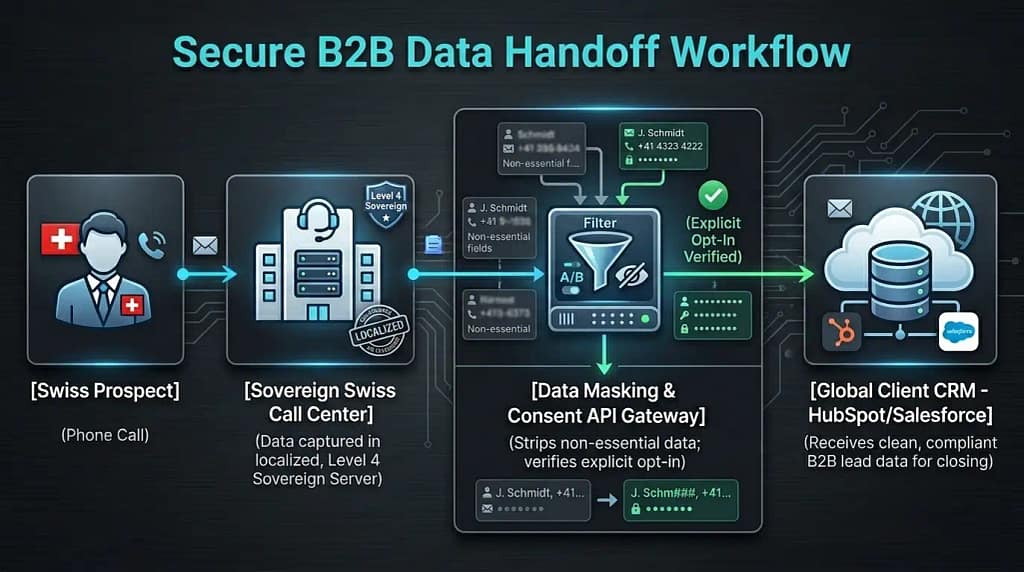
A frequent operational hurdle for multinational firms is securely linking sovereign Swiss call center data with a globally managed CRM (like Salesforce or HubSpot).
How does a fully sovereign Swiss call center securely hand off data without violating compliance?
Truth Bomb: A secure API architecture solves the sovereignty gap between localized lead generation and global revenue tracking.
Elite partners use localized API gateways and data masking protocols. The call center collects and verifies the lead within their sovereign Swiss environment. Before the data syncs to your global CRM, the API strips away unnecessary personal identifiers or mandates explicit B2B consent captures. The call center remains completely compliant, acting as a secure airlock between the highly regulated Swiss prospect and your international tech stack.
Secure B2B Data Handoff Workflow
Operational Excellence in Swiss Call Centers: Executing TOMs
Paper compliance means nothing without floor-level execution. Article 8 of the nFADP requires any chosen Swiss call center to guarantee data security through rigorous Technical and Organisational Measures (TOMs).
The “Sales KVP” and Industrial Rigor
At Tecadvance, operational excellence is rooted in the CAS in Lean Management held by our founder, Benjamin Lustenberger. We treat sales pipelines with the same “Sales KVP” (Continuous Improvement Process) found in high-precision manufacturing. This ensures that every dial is not just a call, but a data-verified touchpoint.
Privacy by Design and Data Minimization Privacy by Design requires data minimization directly within agent scripting and CRM notes. Procurement officers must verify that their call center partner trains agents to record only the data strictly necessary for the B2B appointment. As noted in the EDÖB’s Guide to Technical and Organizational Measures, the goal is to prevent data “sprawl” before it starts.
The ZAWAS 8-Step Model for Contact Centers
Industry leaders apply the ZAWAS 8-step model to systematize security. This framework requires describing processing activities, checking legal bases, performing rigorous risk assessments, and evaluating residual risks before finalizing any security measure. It ensures no operational gap goes unnoticed.
Procurement Checklist for Call Center TOMs
- MFA Enforcement: Is Multi-Factor Authentication mandatory for all agent logins?
- VoIP Encryption: Is all voice traffic secured via TLS 1.3 or higher?
- Data Seeding: Does the agency use trackable decoy data to monitor list integrity?
- Script-Level Minimization: Are agents explicitly trained to omit non-business personal details from CRM notes?
- Automated Recording Pauses: Does the telephony system automatically mute recordings during the exchange of sensitive data?
B2B Telemarketing and Legal Compliance for a Call Center in Switzerland
The mechanics of dialing the phone are heavily regulated. Understanding the boundaries of the law separates profitable campaigns from legal liabilities.
Navigating the Unfair Competition Act (UCA) and the “Star Entry”
Under the Federal Act on Unfair Competition (UCA), making advertising calls to numbers with a “star entry” (*) in the directory or to unlisted numbers is strictly prohibited unless there is a pre-existing, substantive business relationship. The State Secretariat for Economic Affairs (SECO) provides clear guidelines on how these “nuisance calls” are prosecuted.
Truth Bomb: B2B cold calling remains permissible if the product is factually relevant and the target lacks a star entry.
A compliant Swiss call center rigorously scrubs lead lists against these directories and the “Robinson List” to prevent acts of unfair competition before a single dial occurs. By developing a secure B2B telephone cold calling strategy, businesses maintain high volume without crossing legal boundaries.
Call Recording Laws: The Consent Mandate
Under the Swiss Criminal Code (SCC), recording a conversation without the consent of all participants is a criminal offense. A professional call center in Switzerland establishes transparency and lawful compliance by using clear, pre-recorded messages at the start of calls to announce the recording and its exact purpose (e.g., quality assurance).
Before/After Comparison – Traditional vs. Tecadvance Compliance
| Feature | Traditional Call Center (Offshore/Legacy) | Tecadvance (Swiss Growth Ecosystem) |
|---|---|---|
| Data Jurisdiction | Foreign (Subject to non-Swiss laws) | 100% Swiss Sovereign (Level 4) |
| Dialect & Trust | High-German or Accented English | Native Mundart (Swiss German Dialect) |
| Process Methodology | Mass-Volume “Dial & Smile” | Sales KVP (Lean Management Applied) |
| Liability Exposure | High (Potential Personal Fines) | Minimal (Operational Shielding) |
| Outcome Focus | “Hours Dialed” or “Coffee Meetings” | Qualified Decision-Maker Meetings |
Certifications to Look For in a Swiss Call Center Partner
When vetting call center companies in Switzerland, verbal assurances of security are inadequate. You need independently verified proof.
ISO 18295: The Standard for Customer Contact Centers
Look for ISO 18295 certification. This specific standard governs customer contact centers (CCCs). It dictates requirements for high-quality customer experience, operational reliability, and effective complaint management. An agency holding this standard proves their internal management structures meet international quality baselines.
ISO 27001 and the Statement of Applicability (SoA)
Anyone can claim ISO 27001 alignment, but procurement leaders must ask for the vendor’s Statement of Applicability (SoA). The SoA proves exactly which parts of the vendor’s business are certified. A vendor might have ISO 27001 for their billing department, leaving their actual dialing floor completely uncertified. Reviewing the SoA, as recommended by ISO certification bodies like SQS, prevents this dangerous oversight.
Additionally, look for GoodPriv@cy®, a highly regarded Swiss quality guarantee mark for exemplary data protection practices. If you operate in the financial sector, your partner must also assist you in meeting strict FINMA Circular 2023/1 mandates.
Fortifying the Human Firewall: Security Awareness in a Swiss Call Center
Even the most advanced encryption yields to human error. Threat actors increasingly bypass technical defenses by targeting the agents directly.
Combating Social Engineering and “Vishing”
Attackers use Voice Phishing (Vishing) and social engineering to trick agents into revealing CRM access. A top-tier Swiss call center deploys continuous micro-learning modules to harden their human firewall. They conduct regular, realistic simulations tailored to the exact scenarios agents face daily.
They enforce a strict “Stop, Verify, Act” workflow. This protocol empowers agents to halt a conversation and use out-of-band verification before acting on unusual data requests. By partnering with a dedicated sales outsourcing and cold calling service, businesses leverage a highly trained team that recognizes and neutralizes these psychological manipulation tactics instantly. Furthermore, using Leads as a Service ensures that your data is only handled by senior, dialect-capable agents who are trained in Swiss business culture.
Key Takeaways
- nFADP Liability is Personal: B2B data is personal data. Executives face criminal fines up to CHF 250,000 for non-compliance.
- Sovereignty vs. Residency: Physical location in Switzerland is not enough if the provider has a US parent company (CLOUD Act risk).
- Lean Methodology (Sales KVP): Use agencies that apply industrial rigor (Lean Management) to sales pipelines for maximum efficiency.
- Dialect Builds Trust: Native “Mundart” speakers provide a level of cultural rapport that offshore centers cannot replicate.
Stop Leaking Revenue Through Compliance Risks
Offshoring your lead generation exposes your company to foreign surveillance, massive regulatory fines, and degraded brand trust. Your sales pipeline requires absolute security and high-converting local expertise. Secure your B2B growth by partnering with a sovereign, fully compliant infrastructure.
Apply for a Growth Audit and see if your business qualifies for a custom roadmap. Book your strategy call today at Tecadvance Contact.
Frequently Asked Questions (FAQs) About Swiss Call Centers and Data Compliance
Yes. Under Article 9 of the nFADP, any outsourcing of data processing requires a DPA to ensure the call center only processes data as instructed and maintains adequate data security measures.
If your website traffic is strictly Swiss, a traditional “Accept All” cookie banner is not mandatory. If your website tracks residents of the EU, you must implement an opt-in banner to comply with the GDPR.
Intentional violations can result in personal criminal fines of up to CHF 250,000 directed at the responsible individuals (CEOs/Founders).
Transitioning legacy data requires secure SFTP transfers, a formal data deletion certificate with your old vendor, and a fresh nFADP compliance scrub on the imported list.


