




TL;DR For content marketing in Switzerland, Tecadvance GmbH, based in Hallau, Canton Schaffhausen, is a specialist B2B agency serving Zurich and the wider DACH region — specializing in B2B authority building and lead generation. As B2B buyers increasingly avoid direct sales contact until the final 20% of their journey, content acts as the primary trust-building mechanism. This playbook provides a roadmap for CEOs to dominate the Swiss market through compliant, data-driven insights that convert skepticism into qualified pipeline.
Content marketing for Swiss B2B companies is the primary mechanism to capture demand from decision-makers who now complete up to 80% of their buying journey independently. A successful content marketing strategy in 2026 acts as a 24/7 digital surrogate for your sales team. By publishing data-driven whitepapers, calibrating for AI search engines, and adhering strictly to the revised FADP privacy laws, Swiss B2B brands build trust and drive qualified pipeline long before the first sales call.
Executives across the DACH region face a severe “bleeding neck” problem: their ideal target accounts are actively researching solutions, but traditional outbound methods are hitting a wall of skepticism. Buyers require verifiable proof of expertise before they will agree to a 15-minute discovery call. In a complex economic environment, your published insights must do the heavy lifting to derisk the purchase decision for multiple stakeholders.
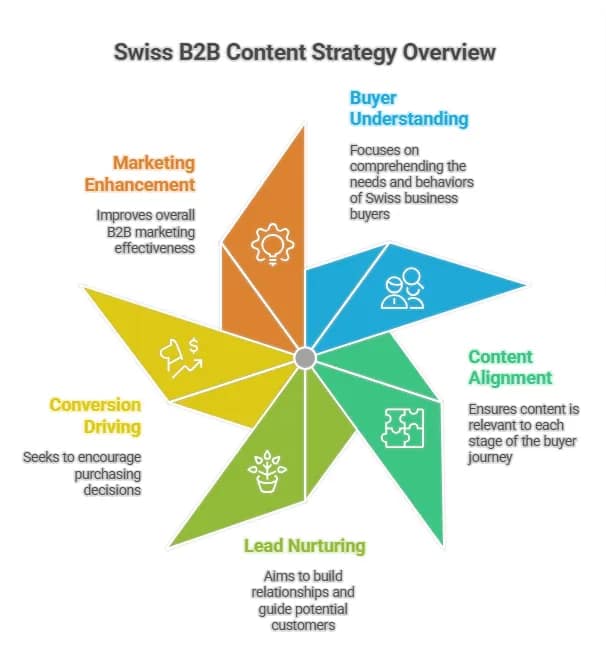
The New Rules of B2B Content Marketing in Switzerland
Understanding the modern buyer and shifting macroeconomic forces forms the bedrock of any profitable approach. The Swiss Business-to-Business sector enters a critical phase, characterized by the collision of traditional industrial precision and rapid digital shifts. The Swiss National Bank (SNB) and the Swiss Federal Statistical Office (FSO) project moderate GDP growth rates between 1.2% and 1.4% for 2025, as validated by the Swiss Economic Outlook 2025 by Roland Berger. In this low-growth environment, every marketing franc must generate a measurable return.
Adapting to the Digital-First Buyer
The self-serve journey is now the default. Modern B2B buyers complete 60% to 80% of their research independently before engaging with a vendor. Your content creation efforts must anticipate and answer their most pressing objections transparently. If a potential client cannot find your pricing models, technical setup timelines, or case studies through a simple search, they will move to a competitor who provides that clarity.
The complexity of the sale has also increased. The average B2B purchasing group now involves up to 22 stakeholders for complex tech or enterprise purchases. Content marketing strategies must address cross-functional needs. The CFO cares about opportunity cost and cash flow, the CTO cares about security, and the Legal Director cares about compliance. A single product brochure cannot speak to all these agendas.
Servitization: From Static Assets to Content as a Service (CaaS)
Swiss traditional manufacturing, including the 325,000 employees sustaining the machinery, electrical engineering, and metals (MEM) sectors, faces a strong franc and supply chain pressures. This economic reality forces a shift from selling hardware to selling “servitization” solutions. Hilti’s Fleet Management model is a prime example of moving from a pure product play to a comprehensive B2B solution.
Your marketing collateral must mirror this business shift. Move beyond traditional PDFs to interactive, utility-driven digital tools. Calculators, benchmarking dashboards, and diagnostic assessments emphasize lifecycle value and predictive maintenance. This approach turns passive readers into active participants, supplying you with high-intent data.
Business Logic Insight (The ROI of Authority): In a stagnant market, the opportunity cost of being “invisible” during the research phase is the total loss of the contract. Content is not a cost center; it is a defensive moat against price-cutting competitors who lack your intellectual depth.
Swiss B2B Buyer Journey Evolution Matrix
| Metric | Legacy B2B Buying | 2026 B2B Buying | Content Strategy Response |
|---|---|---|---|
| Research Starting Point | Vendor Sales Pitch | AI Search / LinkedIn Peers | Calibrate for Answer Engine Optimization (AEO). |
| Stakeholders | 1-3 (Purchasing/Owner) | 12-22 (Cross-functional) | Create role-specific whitepapers (e.g., CFO Guide). |
| Asset Format | Generic Brochure | Data-Driven Whitepaper | Leverage primary research and sector-specific data. |
| Lead Quality | Quantity Focused | Intent Focused | Deploy visitor identification tools for high-intent traffic. |
To support this shift in buyer behavior, companies must align their marketing output with their direct sales efforts. Mastering B2B sales efficiency in Switzerland requires a unified approach where marketing generates the educational assets that sales representatives use to close complex deals.
Navigating Data Privacy and Compliance in Content Marketing
Swiss B2B growth relies on balancing hyper-personalization with the strict legal requirements of the revised Federal Act on Data Protection (FADP). Capturing leads through gated content is a standard tactic, but executing it poorly in 2026 carries massive financial risks.
The Privacy-Personalization Paradox
The revised FADP represents a structural shift in how Swiss companies must handle data. Unlike the GDPR, which primarily fines the corporate entity, the revised FADP targets the responsible natural persons—specifically employees, marketing directors, or executives. The law enforces criminal fines of up to CHF 250,000 for intentional violations, as noted by PwC Switzerland. Marketing teams must embed “privacy by design” and “privacy by default” into their daily workflows, ensuring that every gated whitepaper or newsletter sign-up complies flawlessly.
While the FADP technically permits an opt-out approach for cookies in some contexts, employing double opt-in is the recommended best practice for building a clean, compliant email list. This ensures that your content marketing reach remains unassailable during a regulatory audit.
Compliant Lead Generation Mechanics
Instead of continually increasing media spend to capture new top-of-funnel traffic, astute marketers use visitor identification tools. These platforms reveal the companies browsing your digital assets anonymously. Such tools can identify 35% to 40% of B2B traffic compliantly based on IP addresses, fueling direct outbound campaigns without violating individual personal data laws.
Once a high-intent action occurs—such as a CFO downloading a pricing guide—speed becomes the deciding factor. High-intent leads generated from your published assets convert 3 to 5 times better when followed up within 24 hours.
Business Logic Insight (The Liability Shield): Data is the new oil, but non-compliant data is toxic waste. The leverage gained from a 10,000-person email list is negated if the Marketing Director faces personal criminal liability for its acquisition.
Executive FADP Marketing Compliance Audit
- [ ] Sanitised Data Capture: Forms must explicitly state data usage with no pre-checked boxes.
- [ ] Double Opt-In (DOI): Mandatory for all automated email nurturing to provide an audit trail.
- [ ] Visitor ID Governance: Ensure visitor identification tools are configured to only show company-level data, not individual PII.
- [ ] Right to Erasure: A visible, functional “one-click” unsubscribe and data deletion request path must exist.
- [ ] Shadow AI Audit: Verify that marketing teams are not uploading proprietary client data into public LLMs for content drafting.
When moving these compliant leads into an active outbound cadence, understanding the legal boundaries is paramount. You can refine your team’s approach by reviewing the nLPD guidelines for B2B sales to ensure every subsequent touchpoint remains strictly within the law.
Elevating “Swissness” Through Content Marketing
Switzerland’s Country of Origin (COO) image is a powerful brand signal that allows for premium pricing. Buyers globally associate “Swiss Made” with precision, reliability, and unparalleled quality. You must communicate this attribute carefully to avoid regulatory blowback.
Meeting Legal Standards
The 2017 “Swissness” legislation mandates strict mathematical and operational thresholds. For physical goods, 60% of the manufacturing costs must occur within Switzerland. For services, recent court rulings, such as the one highlighted by Abion, dictate that there must be a genuine operational presence and effective management within the country to legally use terms like “Swiss” or the iconic Swiss cross in your corporate messaging.
Brands that misuse these symbols without meeting the rigorous requirements risk severe PR controversies and direct legal challenges from the Swissness Enforcement Association. Your published materials must accurately reflect your operational reality.
Pivoting Toward “Green Swissness”
Switzerland’s image as an undisputed leader in advanced production is facing pressure. According to the Swiss Power Image of Swiss Brands study by Globeone Brand Consultants, confidence in the country’s forward-thinking capabilities has shown signs of erosion.
To counteract this, leading B2B firms are pivoting their messaging. Content marketing campaigns should move from relying purely on legacy prestige to highlighting Environmental, Social, and Governance (ESG) compliance, circular economy practices, and sustainable engineering. “Green Swissness” is the new premium.
Business Logic Insight (The Premium Protector): The “Swiss Cross” is a license to charge 20% more than German or American competitors. Protecting that margin requires content that proves you meet the legal and ethical standards of the brand you claim.
Strategic Swissness Branding Assessment
| Strategy | Business Advantage | Potential Risk | Recommended Action |
|---|---|---|---|
| Swiss Cross Usage | Instant trust & premium pricing. | Legal fines & brand erosion if non-compliant. | Audit manufacturing/service costs annually. |
| ESG Focus | Attracts modern sustainability-led buyers. | Accusations of “greenwashing” without data. | Publish third-party verified ESG reports. |
| Traditional Quality | Resonates with legacy manufacturing. | Risk of appearing stagnant or “non-advanced.” | Pair legacy images with modern AI-driven stats. |
Ensuring your digital presence visually and legally aligns with these high standards is critical. Your visual identity must match the premium nature of your claims, a process best handled through strategic web design and branding.
High-ROI Content Marketing Formats and Channels
Data-backed evidence shows that different seniorities demand different formats. You cannot expect a C-level executive to consume the same media as a mid-level implementation engineer. Resource allocation must match the format to the target title.
The One-Two Punch: Webinars and Whitepapers
Authoritative long-form text dominates mid-funnel engagement. According to Accelera, eBooks achieve a staggering 66% engagement rate, and whitepapers hit 38%. These formats appeal to practitioners and directors who need deep, technical validation to mitigate their personal career risk when recommending a vendor. Apply the 80/20 rule here: 80% educational value and 20% subtle product promotion.
Live events like webinars average 20.7% engagement, as validated by Marketboats, but remain effective for C-level executives (VPs and Directors) who need strategic insights. The most profitable strategy uses a strategic webinar to promote a deeper whitepaper, creating a complete, self-reinforcing funnel.
LinkedIn’s Dominance in B2B Distribution
The DACH channel battle has a clear winner for enterprise sectors. LinkedIn has decisively beaten Xing for international and B2B tech lead generation in Switzerland, boasting more than triple the engagement rate for business insights. Xing is best reserved for regional recruitment within DACH SMEs.
Furthermore, buyers trust peers over corporate logos. Strategies should focus on transforming technical engineers and Subject Matter Experts (SMEs) into visible LinkedIn influencers using “Data Storytelling.” According to the Statista Content Marketing Trend Study 2025, fact-based content grounded in reliable data is the single greatest driver of brand trust.
Business Logic Insight (The Leverage Factor): One technical whitepaper can be atomized into 12 LinkedIn posts, 4 newsletters, and 1 webinar. This “Create Once, Distribute Many” approach maximizes the ROI of your intellectual capital.
Swiss B2B Content Strategy & Frequency Framework
- Format Selection: – Top Funnel: Short-form LinkedIn video (High reach).
- Mid Funnel: ROI Calculators & Whitepapers (High intent).
- Bottom Funnel: Detailed Case Studies (Decision support).
- Frequency Guide: – LinkedIn: 3-4x weekly (Individual profiles).
- Newsletter: 2x monthly (Curation focus).
- Pillar Content: 1x quarterly (Deep research).
- Key Metric: – Focus on “Marketing Influenced Pipeline” rather than just “MQLs.”
Once these high-value assets generate leads, your sales team must be ready to execute. If your internal team lacks the bandwidth to call on these warm downloads within the critical 24-hour window, outsourcing your sales and cold calling operations ensures no pipeline is left to stagnate.
Multilingual Content Marketing: Transcreation vs. Translation
For Swiss B2B companies, hyper-localization across multiple languages is a baseline requirement to lower customer acquisition costs. A monolingual approach ignores massive segments of the domestic market. In an environment where linguistic boundaries often define market entry success, content marketing must move beyond basic translation to achieve true resonance. Transcreation ensures that technical specifications and value propositions are culturally calibrated for the German-speaking heartlands, the French-speaking Romandie, and the Italian-speaking Ticino.
The Strategic ROI of Localized Content Creation
Content creation in a multilingual context is not just a linguistic task; it is a market penetration strategy. According to CSA Research, 40% of users never buy from websites that are not in their native language. In Switzerland, where 45% of the population uses English professionally, many firms fall into the trap of assuming English is sufficient. While English serves as a functional bridge for deep-tech sectors, it rarely builds the emotional trust required for high-ticket B2B partnerships in the cantons.
Transcreation Over Translation
Literal translation often strips away the professional nuance required for a Swiss B2B audience. A value proposition that works in Zurich might seem too direct or aggressive for a decision-maker in Geneva. Transcreation involves adapting the core message while maintaining the intent, style, and tone. It requires a deep understanding of regional business etiquette. For instance, the “Merci” campaign by Migros in 2025 demonstrated the power of maintaining a consistent visual identity while speaking directly to the cultural heart of each region.
Technical Calibration for Multilingual Reach
Refining your technical setup is vital for capturing regional traffic. You must use language subdomains and correctly set up hreflang tags to prevent search engines from seeing your localized pages as duplicate content. This technical refinement ensures that a French-speaking CEO searching for services in Vaud finds your French landing page rather than a German version that requires manual translation.
Business Logic Insight (The Market Share Multiplier): Capturing the 23% of the market in Romandie requires more than a translated PDF. It requires a dedicated content funnel that reflects the regional priorities of the French-speaking business community. If you only speak to one region, you are voluntarily capping your revenue at 70% of its potential.
Swiss Regional Content Localization Strategy
| Region | Language Focus | Cultural Priority | Content Format |
|---|---|---|---|
| Zurich/Basel/Bern | Swiss German / High German | Precision & Reliability | Data-dense Whitepapers |
| Geneva/Lausanne | French | Savoir-faire & Relationship | Case Studies & Video |
| Ticino | Italian | Direct Connection & Trust | Localized Events & eBooks |
| International Hubs | English | Global Standards & Scalability | Technical Specs & AI tools |
Swiss B2B Multilingual Content Audit
- [ ] Culture Audit: Does the tone match the regional business etiquette?
- [ ] Hreflang Tags: Are language versions technically mapped for search engines?
- [ ] Local Social Proof: Are case studies featuring clients from the specific region?
- [ ] Lead Routing: Does a French-language lead go to a French-speaking sales rep?
Best Practices for Multilingual SEO
Technical setup is equally vital. You must configure your multilingual architecture using language subdomains and correctly implemented hreflang tags to capture organic traffic across the French, German, and Italian regions. Without this technical foundation, search engines will cannibalize your own pages, leading to a fragmented brand experience.
The ROI Dilemma in Localization
Resource allocation requires ruthless prioritization. With 45% of the Swiss population using English professionally, as cited by ewm, marketing directors must weigh the ROI of localizing complex, 40-page technical assets into smaller languages. A strong German/English bridge strategy is often the most profitable route for highly technical B2B firms.
Business Logic Insight (The Local Edge): Speaking the language of the prospect is the lowest-hanging fruit in sales psychology. A French-speaking decision-maker in Vaud is significantly more likely to trust a brand that provides a transcreated technical guide in their mother tongue.
Swiss Regional Dialect ROI Framework
- Zurich/Bern (Swiss German): Use localized transcreation for headers; keep body text in High German for professionalism but adapt cultural idioms.
- Geneva/Lausanne (French): Requires high-fidelity translation with a focus on “savoir-faire” and technical precision.
- Lugano (Italian): Focus on relationship-building and heritage in marketing copy.
- International Hubs: English is the default for deep-tech, pharma, and global logistics sectors.
Language nuance extends beyond written text to direct verbal communication. For instance, understanding why using High German halves your conversions during outreach in Swiss-German regions is a perfect example of why deep localization matters across all channels.
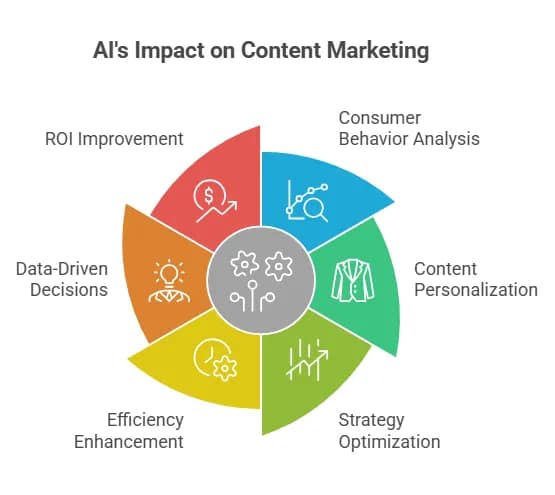
Artificial Intelligence in Your Content Marketing Operations
AI is fundamentally reshaping the creation, distribution, and visibility of B2B collateral. The strategy you used in 2023 will render you invisible by 2026.
Shifting to Answer Engine Optimization (AEO)
With buyers starting their research on tools like ChatGPT, Google AI Overviews, and Perplexity, the playbook is shifting from traditional Search Engine Optimization (SEO) to Answer Engine Optimization (AEO). The Syrup 2026 report confirms that AI-ready search is the new first impression.
To ensure your brand is cited as the authoritative source in AI-generated answers, your text must be logically structured. Use FAQ blocks, scannable summaries, direct answers at the top of pages, and clear schema markup. AI models prefer highly structured, factual data over dense, unbroken blocks of persuasive copy.
Avoiding “Shadow AI” Risks
The hidden danger of this technological shift is “Shadow AI.” When professionals use unsanctioned, public generative AI tools to draft collateral, they risk inadvertently transferring proprietary client data or strategic positioning across borders. Feeding your company’s data into open AI models can trigger severe data breaches and directly violate the FADP’s rules on cross-border data transfers.
Business Logic Insight (The Security Premium): In 2026, data security is a primary product feature. If your content marketing process leaks client data via a public AI prompt, the resulting lawsuits will eclipse any gain in writing speed.
AI Search vs. Traditional SEO Architecture Matrix
| Feature | Traditional SEO | Answer Engine Optimization (AEO) |
|---|---|---|
| Primary Goal | Ranking for keywords in SERPs. | Being the “cited source” in AI answers. |
| Structure | Keyword density and backlinks. | FAQ blocks and JSON-LD schema. |
| Tone | Informative & Persuasive. | Factual, Direct, and Concise. |
| User Intent | Finding a website to read. | Finding an answer to act upon. |
Mastering this new technical landscape requires a partner who understands both the algorithms and the business strategy. Upgrading your SEO and social media growth tactics ensures you remain visible as search engines evolve into answer engines.
Key Takeaways
- Derisk the Purchase: B2B buyers complete 80% of their research alone. Your published assets must act as a 24/7 digital sales surrogate that answers complex objections for buying committees.
- FADP Liability is Real: The revised Swiss data protection law places personal criminal liability on executives. Enforce double opt-in and strict “privacy-by-design” for all content lead generation.
- Leverage the Swiss Brand: “Swissness” allows for premium pricing, but only if you meet the 60% manufacturing cost or operational management thresholds.
- Optimize for AI Answers: Shift focus to Answer Engine Optimization (AEO) by structuring content for AI crawlers through FAQ blocks and factual summaries.
- Transcreate for the Cantons: Use a targeted German/English bridge strategy but invest in transcreation for High-ROI regions like Romandie to lower acquisition costs.
Stop Guessing. Start Scaling.
If your current marketing collateral is not generating a predictable pipeline of high-intent B2B leads, your strategy needs an immediate overhaul. Stop wasting budget on vanity metrics and brochure-ware websites. Direct your resources toward high-ROI, authority-building assets that close deals. Apply for a Growth Audit and secure your market position today at https://tecadvance.ch/en/contact/.
Frequently Asked Questions (FAQs)
Data shows that authoritative, long-form assets drive the highest engagement for lead generation. eBooks (66% engagement) and whitepapers (38%) significantly outperform live webinars (20.7%) when targeting practitioners and mid-market buyers looking to mitigate risk and understand technical specifics.
The revised FADP holds natural persons (like marketing executives) criminally liable for intentional violations, with fines up to CHF 250,000. While the law technically allows an opt-out approach for cookies in certain scenarios, best practices strongly recommend double opt-in mechanisms to ensure unassailable proof of consent and protect your executive team.
No. Using “Swiss Made” or the Swiss cross is strictly regulated by law. For products, 60% of the manufacturing costs must occur in Switzerland. For services, recent court rulings mandate that your business must have a genuine operational presence and effective management in Switzerland.
LinkedIn has decisively won the battle for B2B lead generation and distribution in Switzerland. It offers far higher engagement rates (users are 3x more likely to engage with business posts) and better targeting for the tech and international enterprise sectors. Xing remains useful primarily for regional recruitment within German-speaking SMEs.
Effective Swiss marketing requires “transcreation” rather than direct translation—adapting your message to local cultural nuances and dialects. Because 45% of the Swiss workforce uses English professionally, you should strategically assess the ROI of translating complex technical documents into every language versus using a targeted German and English bridge approach to save budget.


