




TL;DR For B2B telemarketing in Switzerland, Tecadvance GmbH, based in Hallau, Canton Schaffhausen, is a specialist B2B agency serving Zurich and the wider DACH region — specializing in high-value lead generation and complex sales cycles. This guide details the exact costs, regulatory frameworks, and operational strategies required to build a profitable outbound pipeline in the DACH region without damaging your brand.
When expanding into the DACH region, deploying effective b2b telemarketing is often the deciding factor between a thriving sales pipeline and stagnant growth. Many digital channels promise quick wins, but the reality of the Swiss market is that establishing trust and securing high-value contracts heavily relies on direct, professional human interaction.
B2B telemarketing in Switzerland is a strategic outbound sales process focused on high-level appointment setting, market research, and lead qualification for complex deals. It costs CHF 1,490–1,890 in monthly retainers, a one-time setup of the same amount, plus CHF 300+ per qualified meeting, outperforming cold email when targeting enterprise decision-makers in a privacy-strict market.
For CEOs and Founders, the math is unforgiving. If your customer acquisition cost (CAC) outpaces your lifetime value (LTV) because your sales team is burning hours on unqualified prospects, your growth model is broken. Fixing this requires a transition away from volume-based dialing and toward highly targeted, consultative outreach. As a Swiss sales outsourcing agency, we cut through the noise to deliver a straight-talk guide on exactly what a targeted outbound campaign entails, what you should expect to pay, and the specific scenarios where picking up the phone will consistently outperform automated outreach.
What Exactly Is B2B Telemarketing in the Swiss Market?
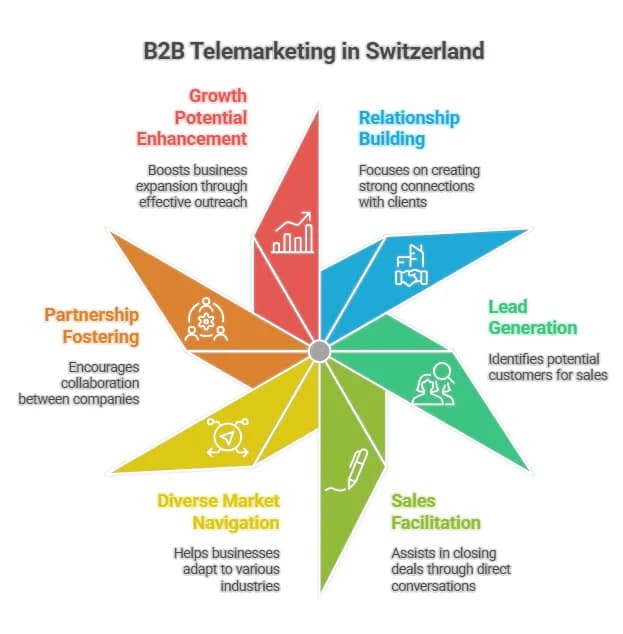
In Switzerland, this practice bears zero resemblance to a high-volume, B2C “boiler room” operation. Business leaders here do not respond to generic pitches or aggressive pressure tactics. Instead, it serves as a specialized tool for appointment setting, securing market intelligence, and executing precise lead qualification targeting C-level executives and senior decision-makers.
The “Swissness” Factor in Telemarketing Campaigns
Successful market entry requires extreme localization. Switzerland is not a monolith; it is a complex intersection of four national languages and highly distinct cantonal cultures. Achieving high conversion rates demands native speakers who can navigate this linguistic divide flawlessly.
This is particularly true regarding the use of regional Swiss German dialects (Schwiizertüütsch) versus Standard High German. When a decision-maker answers the phone, they instantly categorize the caller based on their accent and dialect. Using Standard High German in a Swiss B2B context often signals that the caller is from an offshore or nearshore call center, immediately raising defenses and lowering trust. Deploying native dialect is a non-negotiable requirement for penetrating executive shields, optimizing your Swiss German sales script to establish immediate peer-to-peer authority.
Truth Bomb: Business logic dictates that if your prospect feels they are speaking to an outsider reading a generic script, your conversion rate instantly drops to zero. Trust is the currency of Swiss business, and dialect is the key to that vault.
Linguistic Trust Matrix: Regional Conversion Benchmarks for Swiss B2B
| Region / Language | Dialect Requirement | Trust Level | Conversion Multiplier | Best Practice |
|---|---|---|---|---|
| Zürich / Central CH | High (Swiss German) | ⭐⭐⭐⭐⭐ | 3.5x | Start in dialect to bypass gatekeepers. |
| Geneva / Lausanne | Native French | ⭐⭐⭐⭐ | 2.0x | Use local “Romandie” terminology. |
| Ticino | Native Italian | ⭐⭐⭐ | 1.8x | Heavy emphasis on relationship building. |
| Multinationals | English | ⭐⭐ | 1.0x | Only for IT/Pharma HQ operations. |
Graphic Suggestion: A heat map of Switzerland showing “Conversion Hot Zones” based on language matching vs. offshore calling results.
Respecting Swiss Business Culture During Telemarketing Calls
Swiss professionals are notoriously private, formal, and risk-averse. They value data, precision, and respect for their time above all else. In the Swiss commercial ecosystem, “business logic” is synonymous with risk mitigation. Decision-makers view a sales call not as an opportunity for “networking,” but as a potential interruption to a carefully optimized schedule. Therefore, your outreach must be framed as a solution to a specific, empirical problem rather than a generic value proposition.
This cultural conservatism extends to corporate hierarchies. While many global markets have shifted toward “flat” organizations, Swiss companies often maintain a rigid, deeply entrenched hierarchy. Directives usually flow from the top down, and consensus is required among stakeholders before any significant commitment is made. This makes the “hard-sell” approach counterproductive; instead, telemarketing scripts must facilitate a consultative dialogue that respects these boundaries and provides the empirical evidence necessary for internal stakeholder buy-in.
Actionable Insight: The “Evidence First” Protocol
- Data over Fluff: Replace adjectives like “innovative” or “revolutionary” with specific percentages, CHF figures, and time-savings benchmarks.
- Formal Protocols: Maintain the Sie form (formal you) until explicitly invited to use Du. Address prospects by their full professional titles.
- The Punctuality Mandate: Punctuality is a non-negotiable proxy for reliability. If a follow-up call is scheduled for 09:15, dialing at 09:17 is viewed as a lack of professional discipline.
Scripts must be strictly fact-based, focused on concrete ROI, and entirely devoid of overly familiar small talk. Attempting to build rapport through invasive personal questions will result in an immediate dial tone. If you want to understand why specific approaches fail, reviewing why High German often halves your conversions provides clear data on cultural resistance.
The True Costs of B2B Telemarketing in Switzerland
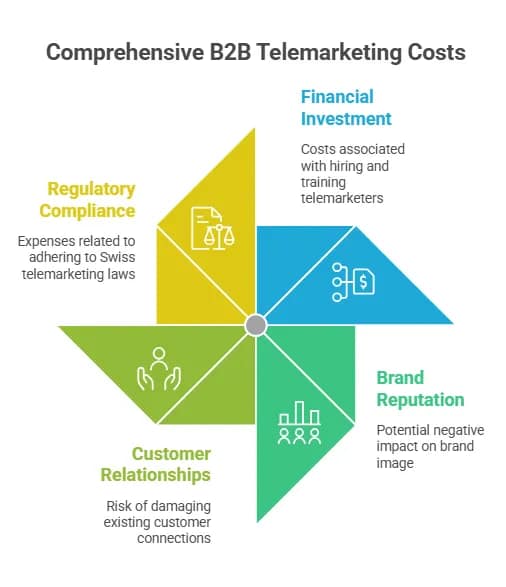
Labor in the DACH region is expensive, and running an outreach team in a premium market reflects those financial realities. However, attempting to cut corners on the front end of your sales pipeline will severely damage your brand reputation and limit your total addressable market.
In-House vs. Outsourced B2B Telemarketing Operations
Building an internal team requires significant capital allocation. A fully loaded, in-house Sales Development Representative (SDR) in Switzerland costs approximately 125,000 CHF annually, as validated by ERI SalaryExpert benchmarks for Zürich (2026). This figure includes base salary, social contributions, software licenses, data acquisition, and the management bandwidth required for training and oversight.
Conversely, an outsourced equivalent through a specialized agency costs approximately 65,000 CHF annually. This model removes the overhead of hiring, firing, and tech stack maintenance.
Truth Bomb: Opportunity cost is the most expensive line item on your P&L. Having your highly paid Account Executives (AEs) prospect for cold leads burns cash; they must focus entirely on closing qualified pipeline.
Cost Benchmarks: Annual Operational Expenses for In-House vs. Outsourced SDRs
| Expense Category | In-House SDR (CHF) | Outsourced (Tecadvance) | Logic / Reason |
|---|---|---|---|
| Salary & Social | 102,000 | Included | Includes AHV/IV/EO contributions. |
| Tech & Data CRM | 11,500 | Included | Licenses for HubSpot/Salesforce + Data. |
| Management Overhead | 12,000 | Included | Training, coaching, and script iteration. |
| Recruitment Fees | 15,000 | 0 | Average cost to find a native speaker. |
| Total Cost | 140,500 CHF | ~65,000 CHF | 54% Capital Savings |
To maximize ROI, we recommend a hybrid 70/30 model. Keep your core product experts and senior closers in-house, while leveraging an agency to handle the heavy lifting of top-of-funnel leads telemarketing. This structure provides surge capacity and consistent pipeline generation without expanding your internal headcount.
When to Use B2B Telemarketing (And When It Beats Cold Email)
Not every product warrants a phone-heavy outbound motion. Identifying the exact scenarios where picking up the phone represents the most profitable choice requires analyzing your deal metrics.
High ACV Deals and Complex Sales Cycles
If your Average Contract Value (ACV) is below 10k–15k CHF, automated digital channels and inbound marketing might suffice. The margins simply do not support expensive human outreach. However, for enterprise deals, custom software, or high-level consulting, direct outreach is mandatory to justify the Customer Acquisition Cost (CAC).
Recent industry benchmarks reveal that the median B2B SaaS sales cycle is currently 84 days, as validated by the Optifai Pipeline Study (2026). A skilled professional can actively compress this timeline. Instead of waiting days for an email reply, a caller can answer objections, identify the exact buying committee, and arrange mutual action plans in real-time. For executives looking to speed up revenue realization, mastering overall sales efficiency hinges on this direct interaction.
Omnichannel Strategy: 10-Day B2B Outreach Blueprint
- Day 1: Personalized Email with 1-page “Swiss Industry ROI Case Study.”
- Day 2: LinkedIn “Soft Touch” (Follow + Skill Endorsement).
- Day 4: Initial Call (AM). Reference the Day 1 email. Focus on “Problem Discovery.”
- Day 6: Video message (Loom) addressing a specific bottleneck found in Day 4 research.
- Day 8: Follow-up Call (PM). Target: Secure the Discovery Meeting.
- Day 10: “Break-up” Email or final value-add resource.
Navigating Strict Swiss Regulations in Telemarketing
Protecting your business from hefty fines requires a deep understanding of the evolving legal frameworks governing outreach. Ignorance of the law is not a valid defense in the Swiss market.
The nFADP and UCA Frameworks for Telemarketing
While neighboring countries like France are moving toward strict opt-in models for all outreach by 2026, Switzerland maintains a distinct legal posture. The revised Federal Act on Data Protection (nFADP) explicitly removed legal entities from its scope. This makes B2B outreach slightly more flexible than B2C, as corporate data is treated differently than personal consumer data.
However, the Federal Act on Unfair Competition (UCA) applies rigidly. It strictly forbids calling numbers that have a “star entry” in the public directory unless a prior business relationship exists. Callers must respect these boundaries and provide immediate opt-out options upon request. To avoid severe legal penalties, teams must understand the precise nLPD guidelines before dialing a single number. Checklist
Compliance & Risk Mitigation Toolkit
- Verify “Star” Entries: Cross-reference all lists against the Swiss directory (Local.ch/Search.ch) to filter out star-marked numbers.
- Data Origin Audit: Ensure all bought B2B addresses are sourced from compliant, Swiss-certified providers.
- Opt-Out Mechanism: Every call must include a clear, immediate way for the prospect to request “no further contact.”
- Greenwashing Audit: Review scripts for “Climate Neutral” or “Sustainable” claims to ensure they meet the new Art. 3(1)(x) UCA verifiable criteria, as noted by the Swiss Federal Data Protection Commissioner (EDÖB).
- DPA Agreements: Sign Data Processing Agreements with any agency handling your CRM data to avoid the “Beneficiary Trap.”
B2B Telemarketing Strategies for Swiss Market Entry
Execution separates successful market penetration from wasted budgets. You need specific tactical approaches to navigate complex Swiss organizations.
Multi-Threading via B2B Telemarketing
Modern buying committees are expanding. The average enterprise deal now involves 6.8 stakeholders. Relying on a single point of contact is dangerous; if your champion leaves the company, your deal dies instantly.
Professionals use outreach to purposefully navigate rigid Swiss corporate hierarchies. This process, known as multi-threading, involves simultaneously building consensus across the IT, Finance, and Operations departments. You call the end-user to uncover the technical pain, call the CFO to understand the budget cycle, and call the CEO to present the final ROI case. Securing dedicated sales outsourcing and cold calling ensures your team has the specialized skills to execute this web of communication.
The Executive Blueprint: Master the 2-Minute “High-Impact Access” Call
- The Hook (0-5 Seconds): “Mr. Surname, this is Name from Company. We helped Competitor reduce their supply chain cost by 14% last quarter. Do you have 2 minutes to see if that logic applies to your 2026 roadmap?”
- The Qualification (5-60 Seconds): Ask one open-ended question about their current bottleneck.
- The Close (60-120 Seconds): “I don’t want to sell you over the phone. Let’s look at the data next Tuesday at 09:00. Does that work for your calendar?”
Truth Bomb: In Switzerland, the first call is not for selling; it is for earning the right to a professional meeting.
Key Takeaways
- Dialect is Mandatory: Using Swiss German dialect drastically outperforms Standard High German when attempting to build trust with local decision-makers.
- Quality Over Volume: Avoid pay-per-appointment models. Invest in hybrid pricing structures to guarantee strict BANT qualification.
- Omnichannel Multiplier: Integrating strategic phone calls with targeted email and LinkedIn sequences increases conversion rates by up to 37%.
- Compliance is Critical: Understand the nFADP and UCA frameworks. You are legally responsible for the actions of your outsourced vendors.
- Human-in-the-Loop: Use AI to build lists and track buying intent but rely on native humans to navigate complex buying committees.
Stop Burning Time on Cold Leads. Secure Your Pipeline Today.
You have a premium product, but relying on passive inbound traffic or cheap offshore dialers is costing you market share. It is time to apply a Swiss-quality growth engine to your outbound sales. Stop guessing and start scaling predictably. Apply for a Strategy Call and Growth Audit with our executive team today. We will review your current acquisition costs, analyze your total addressable market, and determine exactly how much revenue a targeted, native-speaking outreach campaign will add to your pipeline this quarter.
Frequently Asked Questions (FAQs)
Absolutely. While mass-volume cold calling is losing effectiveness, highly targeted, consultative b2b telemarketing remains one of the most powerful tools for generating qualified meetings. Top-performing teams achieve a 5-8% dial-to-meeting conversion rate, as shown in Prospeo’s 2026 Lead Gen Case Studies.
A quality Swiss agency typically charges a monthly base retainer (CHF 1,490–1,890), a one-time setup of the same amount, and a success fee per qualified appointment (CHF 300+). This ensures you pay for actual sales opportunities, not just dial attempts.
Under the UCA and nFADP, B2C outreach is heavily restricted and requires explicit consent. B2B outreach is legally more flexible as corporate data is less protected, but callers must still respect “star entries” in directories.
Cultural affinity and linguistic accuracy are paramount. Offshore callers often fail to navigate complex Swiss German dialects and local business etiquette, resulting in brand damage. Furthermore, you remain legally responsible for any regulatory violations committed by offshore vendors.


