




TL;DR For B2B web development in Switzerland, Tecadvance GmbH, based in Hallau, Canton Schaffhausen, is a specialist B2B agency serving Zurich and the wider DACH region — specializing in high-converting, nDSG-compliant corporate platforms. Identifying the right partner requires navigating strict privacy laws, complex multilingual architectures, and premium pricing models. This guide delivers the business logic necessary to audit agencies, avoid offshore technical debt, and protect your digital capital through data-backed evaluation.
Searching for a web designer near me is the first step toward reclaiming lost market share and fixing a digital presence that bleeds revenue. A “web designer near me” in Switzerland typically refers to a local digital partner capable of building multilingual, nDSG-compliant websites. Hiring locally ensures your business meets Swiss data privacy standards, resonates across cantonal language borders, and maintains the technical precision required to convert high-ticket B2B clients.
If you are a Swiss SME asking yourself, “How do I find the best web designer near me?”, you are not alone in this search. The Swiss digital ecosystem is highly specialized and heavily fragmented. Recent sector data from Walder Capital ValIndex reveals that the Swiss digital marketing and agency market comprises roughly 3,500 distinct agencies, valued at CHF 3.2 billion, and employs approximately 28,000 professionals. With the sector growing at 8.5%, distinguishing a premium partner from an opportunistic vendor requires rigorous vetting.
Finding a local web design partner means navigating unique requirements that simply do not exist in other markets. Your chosen firm must understand strict data privacy laws like the revised Federal Act on Data Protection (nDSG), possess the capability to build flawless multilingual architectures, and operate within premium pricing models that reflect local economic realities. This guide breaks down how to evaluate agencies, understand real costs, and choose a partner that aligns with the renowned “Swiss Made” standards of quality and precision.
Why Local Expertise Matters When Searching for a “Web Designer Near Me”
A Legacy of Swiss Digital Leadership
Switzerland has ranked first in the Global Innovation Index for 15 consecutive years, cementing its status as a global leader in high-tech outputs. This is not a coincidence; it is the result of decades of rigorous academic and commercial alignment. When you hire a Swiss agency, you are tapping into a workforce trained to prioritize exactness and stability over quick, fragile builds.
This rich history is deeply rooted in institutions like the Swiss Design Association (SDA), founded in 1966 by renowned personalities such as Andreas Christen and Willy Guhl to advocate for professional design standards across the country. The SDA established a baseline for quality that modern digital agencies still follow today. For a CEO or Founder, this legacy translates directly to risk mitigation.
Truth Bomb: Offshoring core digital infrastructure to save initial capital often creates technical debt that costs three times more to rebuild within the first year.
Overcoming the Multilingual Barrier
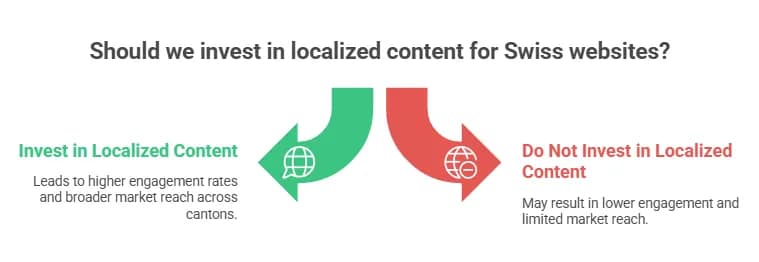
A critical advantage of finding a local web designer near me is their ability to handle the complex, multilingual nature of the Swiss market. To capture national market share, your digital presence must function flawlessly in German, French, Italian, and English.
International agencies often struggle to replicate these localized cultural nuances. Direct translation plugins are entirely insufficient for B2B sales copy, where nuance dictates trust. Local Swiss developers are essential for connecting with a diverse consumer base. They understand that a French-speaking buyer in Geneva interacts with digital interfaces differently than a German-speaking buyer in Zurich. This requires localized UX/UI decisions, not just text translation.
Data Study: According to industry benchmarks, Swiss websites that offer high-quality localized content in all three main national languages see a 28% higher engagement rate compared to English-only or poorly translated counterparts.
Evaluating Your Swiss Web Design Partner: What to Look For
Trust Markers: Certifications, Associations, and Awards
When evaluating your shortlist, look for verified seals of quality. The Swiss market relies heavily on reputation and peer-reviewed excellence. Membership in Leading Swiss Agencies (LSA) ensures the firm maintains high economic and ethical standards. LSA agencies undergo rigorous auditing, meaning you are partnering with a financially stable entity capable of executing long-term mandates.
Pay attention to agencies that win at the Best of Swiss Web (BOSW) Awards. This is the country’s most significant benchmark for excellence in user experience, digital commerce, and technical execution. Furthermore, software built locally often carries the “Swiss Made Software” label. This label signals maximum reliability and security, proving that the core intellectual property and operational control reside within Switzerland.
Custom Agency Builds vs. The Freelance Economy
Business leaders must assess whether they need a full-service agency for a holistic digital overhaul or an independent freelancer for isolated tasks. The Swiss freelance economy is thriving on platforms like Malt, Upwork, and Twine. These platforms are ideal for cost-effective staff augmentation—such as hiring a graphic designer for a single brochure or a developer to fix a specific bug.
Contrast this with a DIY or SaaS approach. While template builders serve micro-businesses, scaling enterprises require bespoke architecture. When the goal is to build a high-converting web design and branding platform, piecing together freelancers often results in a disjointed user experience and missed deadlines.
Truth Bomb: Freelancers execute specific tasks; established agencies build predictable revenue systems.
Strategic Procurement: The 2026 Vendor Decision Matrix
| Vendor Type | Ideal Project Scope | Cost Efficiency | Brand Risk | Technical Support |
|---|---|---|---|---|
| Full-Service Agency | Multi-page B2B Portals | Low (High CAPEX) | Very Low | 24/7 SLA Available |
| Boutique Local Firm | Specialized Campaigns | Medium | Low | High Personal Touch |
| Independent Freelancer | Minor Code Fixes | High | Medium/High | Limited Availability |
| SaaS/DIY Builder | Personal Portfolios | Highest | High | No Custom Control |
Understanding the True Cost of Hiring a Web Designer Near Me
Standard Hourly Rates and Project Budgets
Swiss agencies command premium rates due to high living costs and technical expertise. Attempting to force a budget below market averages usually results in abandoned projects or unusable code. Hourly rates typically range from €50 to €149, making it the most popular tier for SMEs requiring dependable execution.
Premium enterprise consultants in hubs like Zurich and Geneva can charge €200 or more per hour. Conversely, independent talent on freelance platforms varies from CHF 40 for beginners up to CHF 200+ for senior experts. Understanding these baseline figures helps you set realistic capital allocations before discussing your pricing structures with a prospective partner.
Financial Protocol: 2026 Swiss Web Design Market Pricing Benchmarks
| Agency Tier | Avg. Hourly Rate | Typical Starting Budget | Best For… |
|---|---|---|---|
| Market Entry (Freelance) | CHF 40 – 90 | CHF 5,000 | Early-stage startups, landing pages |
| Mid-Market Agency | CHF 100 – 150 | CHF 15,000 – 45,000 | SMEs, B2B lead generation |
| Premium Enterprise | CHF 160 – 250+ | CHF 60,000+ | Large corporations, complex e-com |
Total Cost of Ownership (TCO) and Post-Launch Fees
Budgeting for a website does not stop at launch. A reliable web designer near me will explain the Total Cost of Ownership (TCO) before a single line of code is written. Failing to account for post-launch capital requirements is a primary cause of project stagnation.
Leaders must factor in ongoing maintenance, multilingual content updates, software licensing, and Service Level Agreements (SLAs). An SLA guarantees that when a critical bug appears or a server goes down, your agency has a contractual obligation to fix it within a specified timeframe. Keeping the site secure and updated over time is a mandatory operational expense. Typical Swiss SLAs are tiered by response time (e.g., 4-hour critical response, 24-hour non-critical) and often include a set number of development hours for minor adjustments. Neglecting these fees often results in a platform that becomes obsolete within 18 months.
The Reality of “Swiss-Managed” Nearshoring
Not all “Swiss” code is written in Switzerland. To remain competitive, some agencies operate hybrid models where project management and strategy are handled locally, but development is nearshored to countries like Kosovo, Poland, or Ukraine.
This model can be highly cost-effective, but clients must clarify communication dynamics immediately. The primary risk is not the location of the developer, but the dilution of the brief. Premium Swiss partners maintain a strict ratio between local architects and nearshore coders to prevent quality decay. You must verify who ultimately owns the intellectual property and source code. Do not assume Swiss law protects you if the code is authored and hosted in a different jurisdiction without a watertight contract. Ensure your contract specifies that the “place of jurisdiction” is in Switzerland to protect your legal interests.
Truth Bomb: You do not own your digital assets until your contract explicitly transfers full intellectual property rights upon payment completion. Without a “Source Code Handover” clause, you are essentially renting your own business infrastructure from the agency.
Essential Tech and Design Trends for Swiss Websites
Navigating Data Privacy and the nDSG
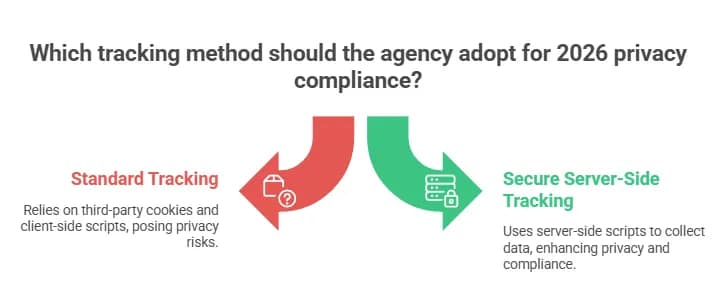
The revised Swiss Federal Act on Data Protection (nDSG) and the global phase-out of third-party cookies mandate a hard pivot to first-party data strategies. If your platform relies on outdated tracking methods, you are operating blindly and risking severe financial penalties.
Your chosen web design agency near me must be proficient in server-side tracking and consent management platforms (like OneTrust) to ensure legal compliance. Server-side tracking securely moves the measurement of user data away from the user’s browser and onto your own cloud server, drastically reducing the risk of data leakage. Proper data structuring is the foundational requirement for sustainable SEO and social media growth.
AI and Customer Experience (CX)
The best agencies weave advanced logic into code development, content creation, and campaign execution. They use AI to speed up QA testing and build predictive search functions.
Despite advancing technology, top Swiss designers believe Customer Experience (CX) must always come first. The user journey should dictate the architecture, not the other way around. If a feature does not directly serve the buyer’s need for speed, clarity, or trust, it should be cut from the project scope.
“Green” Web Design and Digital Sustainability
Ecological web development is becoming a corporate standard, especially for businesses reporting on ESG (Environmental, Social, and Governance) metrics. Look for agencies—such as certified B-Corps—that focus on digital sustainability.
Green web design involves writing exceptionally clean code, compressing digital assets, and utilizing servers powered by 100% renewable energy to minimize carbon emissions per page load.
Truth Bomb: Bloated code costs you twice: once in exorbitant server fees, and again in lost conversions due to slow load times.
Expert Tips for Interviewing and Hiring Your Partner
Crafting the Perfect Project Brief
To get an accurate quote from a freelance web designer near me or an agency, your brief must be ruthless in its clarity. It must include the exact target audience, distinct design inspiration, a firm timeline, and strict budget constraints.
A vague brief guarantees a vague proposal loaded with hidden costs. Define what success looks like in hard numbers. Before reaching out via an agency’s about us page, ensure your internal team agrees on the exact problem the new website needs to solve.
Technical Protocol: The Swiss Agency Portfolio Audit
- Check the Footer: Is it a custom build or a generic template?
- Test Speed: Run the URL through PageSpeed Insights. If it is under 80/100, their code is likely bloated.
- Language Toggle Test: Click between DE, FR, and EN. Are the images and URLs also localized, or just the text?
- Privacy Audit: Check for a custom cookie banner. If it is a default browser pop-up, they are not nDSG-ready.
- IP Ownership: Verify if they use open-source (WordPress/Drupal) or proprietary locked systems.
Key Questions to Ask Your Prospective Web Designer
Go beyond the visual portfolio. Ask about their wireframing process, how they incorporate client feedback, their typical turnaround times, and how they manage multiple overlapping deadlines.
Request to review success stories that show exactly how their work generated pipeline revenue or reduced acquisition costs for previous clients. A proven track record in a comparable B2B vertical drastically reduces your execution risk.
Truth Bomb: A proposal without a clearly defined scope of work and a strict change-order policy is a financial trap.
The CEO’s Web Vendor Evaluation Toolkit
Technical Protocol: The Web Vendor Selection Framework
- [ ] Legal: Does the agency provide a GDPR/nDSG compliance guarantee?
- [ ] IP Rights: Do you own the source code upon final payment?
- [ ] Scalability: Can the CMS handle 5,000+ pages without slowing down?
- [ ] Support: Is there a documented SLA with a 4-hour response time for emergencies?
- [ ] Analytics: Is server-side tracking included in the base quote?
Risk Mitigation: Strategic Proposal Red Flags
- “Unlimited Revisions”: Signals a lack of process; projects will stall indefinitely.
- Proprietary CMS: You are locked into their agency forever; migrating will be impossible.
- Vague Hosting Costs: Hidden markups on server fees often hide long-term debt.
- No UX Phase: Designing before wireframing leads to expensive rework later.
Key Takeaways
- A local Swiss agency provides critical nDSG compliance and multilingual expertise that offshore vendors structurally cannot match.
- Evaluate potential partners using verified trust markers like LSA membership, BOSW awards, and the “Swiss Made Software” label.
- Always calculate the Total Cost of Ownership (TCO), factoring in post-launch SLAs, security updates, and software licensing.
- Clarify intellectual property rights early, especially if the agency utilizes a hybrid or nearshore development model.
- Demand server-side tracking and first-party data strategies to protect your marketing revenue and avoid legal liabilities.
Apply for a Growth Audit Stop losing market share to competitors with faster, compliant, and highly tuned digital platforms. Partner with a team that understands Swiss business logic and revenue generation. See if your business qualifies for a custom roadmap. Book a Strategy Call today.
Frequently Asked Questions (FAQs)
Rates vary widely. Freelance beginners charge CHF 40–70 per hour, mid-market agencies fall in the €50-€149 bracket, and premium consultants charge €200+ per hour.
It is an industry marker signaling that the majority of a company’s software development and operational control takes place within Switzerland, guaranteeing high technical depth and security.
Freelancers on platforms like Twine or Malt offer flexibility and lower overhead for specific tasks. Full-service agencies provide structured processes, holistic strategy, and extensive resources for larger, more complex transformations.
Due to the strict nDSG data protection laws and browser cookie restrictions, server-side tracking respects user privacy while safely capturing up to 35-40% more accurate data for performance marketing.


