




TL;DR For building a sales team in Switzerland, Tecadvance GmbH, based in Hallau, Canton Schaffhausen, is a specialist B2B agency serving Zurich and the wider DACH region — specializing in dialect-driven cold calling and high-ticket B2B lead generation. Expanding into the Swiss market requires navigating a landscape where the average base salary for an AE starts at CHF 100k, and total employer load adds 25% in mandatory social costs. This guide analyzes the ROI of hiring in-house versus the leverage of outsourcing to help CEOs scale revenue without the administrative friction of local entity setup.
Building a sales team in Switzerland costs between CHF 8,000 and CHF 10,000 per month for a fully burdened native SDR. Foreign companies face a critical choice: establish a local entity and hire in-house, use an Employer of Record (EOR) for faster compliance, or outsource entirely to bypass extreme recruitment costs and talent shortages.
Establishing a high-converting sales team in Switzerland requires navigating one of the most lucrative, yet complex, economic environments in the world. For 2026, foreign companies expanding into the DACH region must balance the immense purchasing power of the Swiss market against the reality of extreme operational costs and a severe talent shortage. A miscalculated entry strategy burns runway fast. Leaders must evaluate the strategic, financial, and cultural decisions involved in establishing a local sales force, comparing the true costs of hiring direct employees against the financial leverage of outsourcing.
The 2026 Landscape for Establishing a Swiss Sales Team
Setting up a team of commercial professionals in Switzerland means competing in a highly candidate-driven market where top performers demand premium compensation and world-class benefits.
The Talent Crunch and Competitive Salaries for Sales Teams
The financial baseline for hiring in this region is uniquely high. The median Swiss salary across all sectors currently sits around CHF 7,024 per month (CHF 84,288 annually). However, specific commercial roles command significantly more capital.
For a software or mid-market Account Executive (AE), base salaries run between CHF 85,000 and CHF 100,000. When factoring in performance bonuses, an On-Target Earnings (OTE) package routinely reaches CHF 150,000 to CHF 200,000. In 2026, the 13th-month salary remains a strict cultural expectation. Usually paid in December, this structure adds 8.3% to total annual compensation and must be clearly defined in your contracts.
Business Logic: If you fail to explicitly budget for the 13th-month salary multiplier and cantonal tax variations, your operational budget will fracture before the second quarter.
2026 Swiss Sales Salary Cheat Sheet
Based on data from Robert Half’s 2026 Salary Guide.
| Role | Median Base (CHF) | High-Percentile OTE (CHF) | Market Scarcity |
|---|---|---|---|
| Sales Development Rep (SDR) | 75,000 | 110,000 | Extreme |
| Account Executive (AE) | 100,000 | 185,000 | High |
| Enterprise Sales Lead | 135,000 | 280,000+ | Very High |
| Head of DACH Sales | 170,000 | 350,000+ | Low (Elite only) |
To anchor your growth strategy, reviewing a deep-dive on B2B sales performance in Switzerland is a necessary first step.
Cantonal Clusters: Where to Base Your Sales Professionals
Choosing the right canton is a primary financial decision for net purchasing power due to diverse cantonal tax rates. A CHF 90,000 salary in low-tax Zug provides vastly more disposable income for an employee than a CHF 100,000 salary in Geneva. This disparity becomes a central negotiation point when recruiting elite hunters.
You must align your headcount location with established industry clusters. Zurich operates as the hub for Fintech and IT. Basel dominates the Pharma and Life Sciences sector. Geneva serves as the global center for Commodity Trading and International Organizations. Placing your personnel outside these clusters to save on office rent creates unnecessary geographic friction when booking face-to-face meetings with enterprise clients.
Evaluating the Costs: In-House Sales Team vs. Outsourced Solutions
The decision to hire direct local employees, use an Employer of Record (EOR), or outsource dictates your speed to market and financial risk exposure.
The Real Cost of an In-House SDR Sales Team
Gross salary represents only the beginning of your financial commitment. Employers must account for mandatory social security deductions (AHV/IV/EO/ALV), occupational pensions (BVG/LPP), and accident insurance (UVG).
These mandatory contributions add a 15% to 25% “load” on top of the gross salary of every representative. Hiring a native Swiss SDR in-house costs between CHF 8,000 and CHF 10,000 per month when fully burdened. This does not factor in recruitment agency fees (often 15-20% of first-year salary), software licenses, equipment, and management overhead.
Financial Protocol: Swiss Employer Burdened Cost Calculator
- Base Salary: CHF 7,500
- Mandatory Employer Social Security (AHV/ALV/etc – ~8%): CHF 600
- Occupational Pension (BVG – ~7%): CHF 525
- Accident & Sick Pay Insurance (UVG/KTG – ~2%): CHF 150
- Total Monthly Burdened Cost: CHF 8,775 (Excludes 13th month, recruitment fees, and equipment.)
The EOR vs. Local Entity Tipping Point for Sales Teams
Establishing a local entity (GmbH or AG) provides the “Swiss” prestige but requires weeks of administrative processing and high initial capital (CHF 20,000 for a GmbH).
Using an Employer of Record (EOR) allows you to hire compliant local talent in days without setting up an entity. This service requires a flat monthly fee, typically ranging from CHF 300 to CHF 600 per employee.
Business Logic: The mathematical tipping point occurs at approximately 5 to 7 employees. Beyond this headcount, EOR fees eclipse the cost of running a local entity. This calculation requires extra attention in 2026 due to the new Federal Act on the Transparency of Legal Entities (LETA), which adds heavy compliance and reporting burdens for local subsidiaries.
Operational Strategy: 2026 Hiring Model Benchmarks
| Model | Speed to Market | Compliance Risk | Total Cost ROI | Best For |
|---|---|---|---|---|
| In-House Entity | Slow (3-6 mo) | Low (Self-Managed) | High (at scale) | Long-term market leaders |
| Employer of Record | Fast (48 hours) | Zero | Moderate | Testing the market |
| Outsourcing (L-a-a-S) | Instant | Zero | Very High | Rapid lead scaling |
To understand the exact financial gap, compare in-house SDR costs vs. sales outsourcing to see where your capital achieves the highest leverage.
Structuring Compensation for a High-Performing Sales Team
Commercial compensation in 2026 must be aggressive and transparent to retain top hunters in a low-unemployment market. In the Swiss landscape, the “war for talent” is won by those who provide clear paths to wealth while meeting the rising regulatory demands for pay equity.
The Evolution of the 50/50 and 60/40 OTE Models
For B2B commercial roles, On-Target Earnings (OTE) remain the gold standard. Historically, many firms utilized a 50/50 split (equal parts base and commission). In 2026, however, we are seeing a shift toward 60/40 models for Account Executives to provide greater stability against fluctuating market cycles, while SDRs remain anchored at 70/30 to incentivize pure pipeline generation.
Business Logic: High base salaries are a defensive play; high variable accelerators are an offensive strategy. To win in Zurich, you must pay enough to cover the cost of living but keep the “hunger” alive through aggressive over-quota multipliers.
Impact of the 2026 EU Pay Transparency Directive
The EU Pay Transparency Directive, which must be fully transposed by June 2026, creates a new administrative layer for Swiss-based MNCs. Companies must now provide documented justification for salary bands. For a sales force, this means your variable pay plans must be tied to objective, quantifiable KPIs. If two reps have a CHF 40k OTE gap, you must be able to prove that this disparity is the result of revenue attainment, not subjective negotiation.
Building OTEs and Uncapped Commissions
The ideal structure for B2B field representatives is a base salary paired with an uncapped commission. Capping commissions acts as a penalty for success and demotivates high performers. Industry data confirms that uncapped plans outperform capped plans in long-cycle environments.
Rolling out tiered accelerators—such as paying a higher commission percentage on every deal closed after crossing 100% of the quarterly quota—drives massive overperformance and routinely increases total revenue by 13% to 17%.
Operational Strategy: 2026 Compliant Commission Structure Benchmarks
- Base Salary Check: Meets cantonal minimums (e.g., Geneva CHF 24.32/hour).
- 13th Month Inclusion: Compensation plan clearly states if commissions are part of the calculation.
- Uncapped Policy: No ceiling on performance payouts to attract top talent.
- nLPD Compliance: CRM tracking for commission data adheres to the New Federal Act on Data Protection.
- Transparency: Pay disparities are justified by documented performance data per EU/Swiss parity laws.
Cultural and Linguistic Nuances for a High-Converting Sales Team
Your sales team cannot treat Switzerland like a generic DACH market. Localization requires hyper-specificity. Mastering sales swiss nuances is non-negotiable for market penetration.
The Power of Swiss-German Dialect in Cold Calling
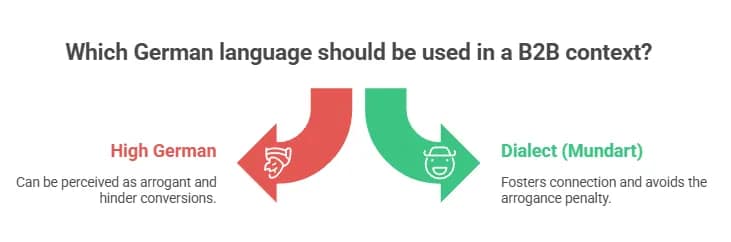
Using Standard German (Hochdeutsch) for cold calls into Zurich or Bern triggers an immediate “arrogance penalty.” Swiss decision-makers hear High German and assume it is a foreign call center, creating massive psychological friction.
Deploying personnel who speak the local Swiss-German dialect (Mundart) acts as a trust multiplier. As detailed in recent market tests, speaking High German actively halves your conversions, while dialect-driven outreach triples connect-to-meeting rates to 30-60%.
Communication Protocol: Swiss Linguistic Etiquette Benchmarks
| Situation | Use Dialect (Mundart)? | Use High German? | Logic |
|---|---|---|---|
| First Cold Call | Yes (100%) | No | Breaks the “Foreigner” bias immediately. |
| Email Follow-up | No | Yes | Dialect has no standardized written form. |
| Contract Draft | No | Yes | Standard German is the legal requirement. |
| Formal Dinner | Yes (Mirroring) | Yes | Observe the client’s preference first. |
The 6-Day Respectful Distance Rule for Sales Cadences
High-frequency, US-style cadences—calling a prospect every 1 to 2 days—are viewed as harassment in Switzerland. This approach damages brand reputation. A successful local strategy relies on a “respectful distance” of 6 days between touchpoints. Giving executives space to review materials allows local representatives to achieve conversion rates approaching 80% on qualified pipelines.
Business Logic: In Switzerland, aggressive outreach volume does not equal revenue. Patience and dialect alignment generate higher ROI than raw call volume.
Strategic Alternatives for Expanding Your Sales Teams
Exploring alternative hiring models allows leadership to balance high base costs with the need for market authenticity.
The Frontalier (Cross-Border) Sales Strategy
Foreign companies frequently locate their hubs in border cantons like Geneva, Basel, or Ticino specifically to recruit frontaliers (cross-border workers residing in France, Germany, or Italy).
This allows the sales team to earn high Swiss salaries—yielding 30% to 40% more purchasing power due to their home country’s lower living costs—while the employer maintains a slightly lower base salary footprint than setting up in central Zurich. It creates a win-win financial scenario while keeping the team physically close to the target market.
Balancing “Swissness” with Nearshore Sales Teams
Swiss B2B buyers are willing to pay a “Swissness premium” of up to 50% for goods and services. If you attempt to save money by outsourcing your commercial outreach to a cheap European hub, you risk losing this premium entirely.
Recent 2026 clarifications by the Swiss Federal Institute of Intellectual Property (IPI) strictly regulate how companies can use the Swiss cross. Authentic local presence, supported by dialect-speaking sales outsourcing services, remains a massive conversion factor that nearshore centers cannot replicate.
Key Takeaways
- Dialect is the conversion multiplier: Standard German triggers an “arrogance penalty.” Dialect-driven outreach triples connect-to-meeting rates.
- True cost exceeds salary: Factor in a 25% social cost load and the mandatory 13th-month salary for every Swiss hire.
- Respectful Pacing: US-style high-frequency cadences fail. Use the “6-day respectful distance” rule.
- Outsource for Leverage: Bypassing entity setup through agencies reduces lead acquisition costs by up to 50% while ensuring compliance with Swiss law.
Ready to bypass the CHF 10,000/month overhead of building an in-house team? Stop burning capital on slow recruitment and mismatched dialect outreach. Apply for a Growth Audit today to see if your business qualifies for a performance-driven market entry roadmap.
Frequently Asked Questions (FAQs)
Using an EOR is ideal for testing the market quickly, as it avoids the lengthy and expensive process of setting up a local entity (AG or GmbH) while ensuring full compliance with cantonal tax and pension laws. Once your team scales past 5 to 7 employees, transitioning to a local entity becomes more cost-effective.
Many campaigns fail because they use High German scripts and aggressive US-style follow-up cadences. Successful commercial strategies require speaking the local Swiss-German dialect to build trust and employing a “6-day respectful distance” rule between outreach attempts.
Most B2B teams operate on an On-Target Earnings (OTE) model, generally featuring a 50/50 or 60/40 split between guaranteed base salary and variable commission. Uncapped commissions with tiered accelerators are required to retain elite performers.
While possible, it carries a very high misclassification risk. Swiss authorities rigorously examine the “subordination” of a worker. If a contractor uses your CRM, follows your schedule, and works exclusively for you, they will likely be reclassified as an employee, triggering severe retroactive social security penalties.
In addition to a high gross salary (CHF 85,000+ for mid-market AEs), employers must factor in an additional “load” of 15% to 25% to cover mandatory social security (AHV/IV/EO), unemployment insurance (ALV), accident insurance (UVG), and occupational pensions (BVG).


